
Key takeaways
- Chair planks, dips, box squats, and reverse lunges offer a low-barrier way to build muscle tone and strength after 60.
- Each exercise targets different muscle groups: chair planks train shoulders, arms, glutes, and core; chair dips target triceps, shoulders, and chest; box squats work thighs and glutes; and reverse lunges challenge quads, glutes, and hamstrings.
- To maximize muscle tone results, pair your chair exercise routine with protein-rich meals, daily walking, and adequate recovery time.
After age 60, maintaining firm, defined muscles requires more intentional work. Muscle tone—the visible shape and firmness that comes from adequate muscle size and strength—depends on consistent training, proper nutrition, and rest. Beyond appearance, strong muscles at this age directly affect your ability to live independently: standing from a seated position, pushing yourself up with your hands, walking with balance, and climbing stairs all become easier when the right muscles are developed.
Weight training works, and plenty of people over 60 use it successfully. But chair exercises offer a more accessible pathway to building strength with the same effectiveness. The chair provides support, creates a clear target for each movement, and builds the tension needed to make simple exercises challenge your muscles meaningfully.
The following four exercises target the key muscle groups that drive both muscle tone and daily function after 60. They fit into a home routine, require no equipment beyond a sturdy chair, and allow you to scale difficulty by adjusting your range of motion or adding variations.
The Chair Plank: Core and Shoulder Foundation
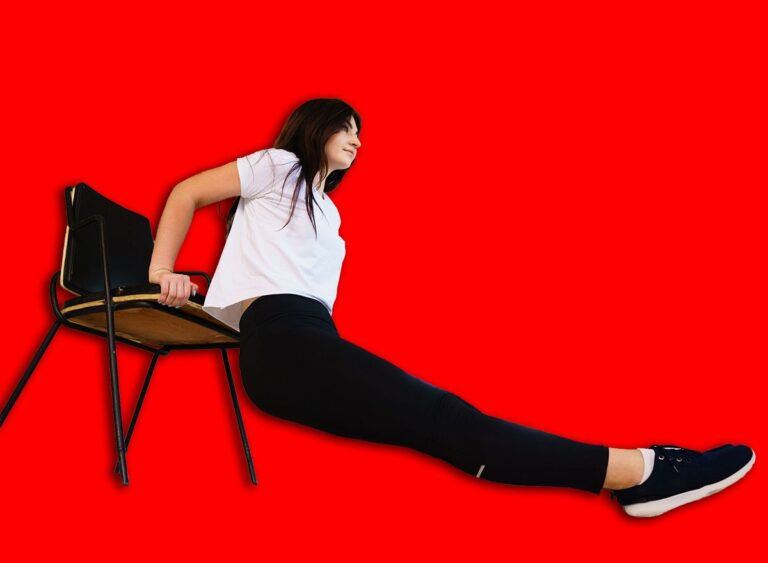
This exercise does far more than work your midsection. A chair plank recruits your shoulders, arms, glutes, and core at once, teaching your entire body to stay tight and support its own weight. That full-body engagement is what builds muscle tone across multiple areas.
How to Perform the Movement
Place your hands on the seat of the chair with your body in a straight line from head to heels. Your core should stay braced, your shoulders stacked over your hands. Hold this position without letting your hips sag.
Sets and Reps
Perform 2 to 3 holds of 20 to 40 seconds each. As you build strength, increase the hold duration rather than rushing into a longer time under tension.
Variations to Try
A higher-hand chair plank (using armrests or a higher surface) reduces difficulty. A chair forearm plank shifts the position to your forearms. A counter plank uses a kitchen counter for additional support. Each variation keeps your shoulders and arms active while managing the challenge level.
Chair Dips: Building Push Strength and Arm Definition
The triceps—the back of your upper arms—is where many people first notice aging. Chair dips address this directly while also training your shoulders and chest through a pushing pattern you use every day when pressing up from a chair or supporting yourself with your hands.
The Triceps and Upper Body Connection
When you push yourself out of a seated position at a table, you use the exact same muscles trained here. Building strength in this pattern increases your real-world capability and makes the firmer look of defined arms a side effect of increased function.
How to Do Chair Dips
Sit on the edge of a sturdy chair and grip the seat beside your hips with your hands. Lower your body by bending your elbows, keeping them relatively close to your torso, then press back up. Start with a small range of motion and let your triceps control the work rather than using momentum.
Recommended Volume
Perform 2 to 3 sets of 6 to 10 reps. You can modify the difficulty by bending your knees (bent-knee chair dip) to reduce the load, or use a bench to perform bench dips for additional challenge.
Box Squats: Leg Strength for Daily Life
No exercise rebuilds leg tone faster than the box squat. The chair or box gives you a target: with each rep, you lower yourself to touch the seat and stand back up, training your thighs and glutes to move with control. This directly transfers to your actual life. If you want to stand from a chair or couch without using your arms, climb stairs with confidence, or walk with better control, this movement belongs in your routine.
Why This Exercise Matters After 60
A box squat isn’t an abstract exercise; it replicates the exact movement pattern you need every day. Every rep you perform builds the strength required to manage this common task with less effort and greater stability.
The Proper Form
Stand facing the chair or box. Lower yourself by bending at the knees and hips, touch the seat briefly, and stand back up. Keep your chest upright and your weight distributed through your heels.
Sets, Reps, and Progressions
Perform 2 to 3 sets of 8 to 12 reps. As you progress, you can use a higher chair squat (a higher surface to reduce the range), a slow box squat (emphasizing control on the way down and up), or add a light dumbbell held at your chest.
Reverse Lunges: Building Single-Leg Stability
Most daily movements use your legs one at a time. Reverse lunges train each leg independently, building more balanced lower-body strength and addressing any side-to-side differences. The chair provides support so you can focus entirely on the working leg without managing balance.
The Case for Single-Leg Training
When one leg is weaker than the other, compensation patterns develop. This reverse lunge format challenges the quads, glutes, and hamstrings on the working side while the chair keeps you stable.
How to Perform a Reverse Lunge
Stand facing the chair, holding it for balance. Step backward with one leg, lower your hips until your back knee nearly touches the floor, then drive through your front leg to return to standing. Keep the step short at first so you can focus on the working leg pushing the rep.
Volume and Variations
Perform 2 to 3 sets of 6 to 10 reps per side. You can reduce difficulty with a smaller range of motion or by using a supported split squat position. As you build strength, perform bodyweight reverse lunges without chair support.
Making Muscle Tone Stick: Beyond the Workout
Chair exercises work when you move with control, create real tension in your muscles, and choose a difficulty level that lets you complete clean reps. But the workout is only part of the picture.
Nutrition for Muscle Building
Pair your training with protein-forward meals. Muscle adapts and grows during recovery, and protein provides the building blocks your body needs. This combination makes the visual difference between an active person and someone with defined muscle tone.
Walking and Daily Movement
Add daily walking to your routine. This complements your strength work, keeps your joints mobile, and supports overall fitness without adding recovery demand.
Recovery and Adaptation
Give your body enough recovery time between sessions. Your muscles don’t build during the workout, they build while you rest. This is where consistency becomes visible: move with intent during your training, fuel well, and let your body adapt.
Source: Eat This Not That
Frequently Asked Questions
Why should I use chair exercises instead of weights to build muscle after 60?
Chair exercises provide support, a clear target for each movement, and a way to build muscle tension effectively. They fit easily into a home routine and train multiple muscle groups while remaining lower-impact than traditional weight training.
What sets and reps should I use for each exercise?
Chair planks: 2-3 holds of 20-40 seconds. Chair dips: 2-3 sets of 6-10 reps. Box squats: 2-3 sets of 8-12 reps. Reverse lunges: 2-3 sets of 6-10 reps per side. Adjust the difficulty using the variations listed for each exercise as you build strength.
How do I maximize muscle tone beyond just doing the exercises?
Pair your training with protein-forward meals to fuel muscle growth, add daily walking to complement your strength work, and give your body adequate recovery time between sessions. Visible muscle tone develops through the combination of training, nutrition, and rest.
