
Key takeaways
- Standing exercises target the exact muscles needed for walking—legs, hips, calves, core—while building balance in ways treadmills cannot.
- Unlike treadmill workouts, you control your own pace, which allows older adults to exercise longer and build stamina more safely.
- Pairing standing exercises with regular walking provides a two-part approach that rebuilds walking capacity faster than treadmill use alone.
Walking endurance—your ability to cover distance without exhaustion—reflects your overall fitness capacity. Loss of endurance signals the body needs conditioning work, though it’s important to rule out underlying health conditions first. When fitness is the issue, targeted exercise can restore your walking stamina faster than relying on treadmills alone.
The Standing Exercise Advantage
According to Eat This Not That, standing exercises offer benefits that stationary machines cannot replicate. Denise Chakoian, a Rhode Island Certified Fitness Trainer and owner of Core Cycle and Fitness LaGree with 16 years of experience training diverse age groups, explains that standing movements work the exact muscles your body uses during walking. The approach engages your legs, hips, calves, and core simultaneously while creating balance challenges a treadmill belt cannot reproduce.
Muscles Targeted in Standing Work
Walking relies on a coordinated chain of muscles from your feet to your midsection. Standing exercises isolate and strengthen these specific areas rather than simulating a repetitive forward motion. This targeted engagement builds the foundation walking demands without the monotony or mechanical consistency of a treadmill.
Balance Training Beyond the Belt
Treadmills move beneath your feet at a preset speed, which reduces the balance demands placed on your stabilizing muscles. Standing exercises, by contrast, force your body to manage its own positioning and weight distribution. This creates an environment where balance systems strengthen in ways treadmill walking cannot trigger, preparing your body for real-world terrain and unpredictable surfaces.
Multi-Directional Movement and Stability
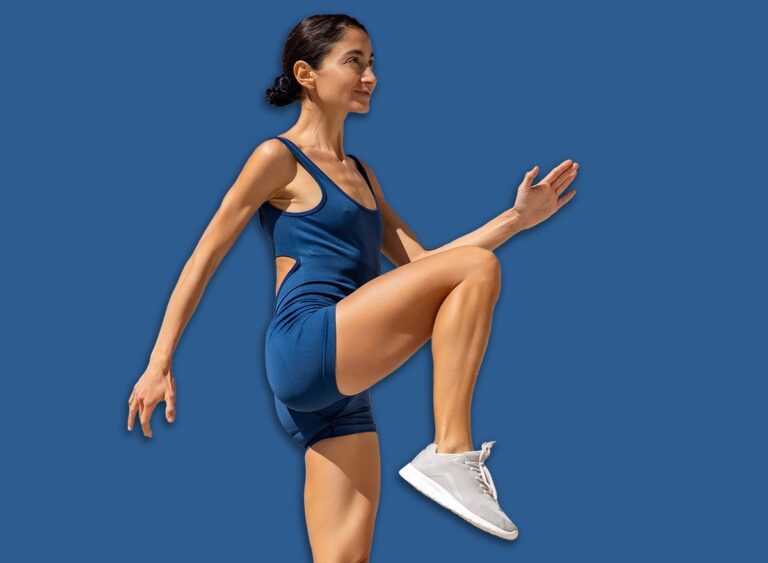
Walking doesn’t happen only forward. Daily life involves stepping sideways, backing up, navigating corners, and adjusting to uneven ground. Chakoian notes that exercises like marching and side steps teach the body to move in multiple directions, building the stability needed for varied movement patterns. Each step becomes more controlled and confident.
Why Directional Variety Matters
Treadmills work in only one direction: forward on a flat belt. Life requires stability in all directions. Exercises that challenge lateral and forward movement patterns build the neural pathways and muscle memory your body needs to move safely in any direction, strengthening legs and hips in ways belt-based movement cannot achieve.
Pacing Control for Sustainable Building
Treadmill workouts dictate pace through belt speed. If the machine moves at a pace uncomfortable for you, you must either slow the belt or step off. Standing exercises eliminate this constraint. You control your movement speed, allowing you to work at a comfortable intensity while building stamina. For older adults, this flexibility matters significantly. Chakoian explains that controlling your pace makes it easier to exercise for longer periods and build endurance safely—a psychological and physical advantage over fighting a preset machine speed.
Combining Standing Work With Walking
The most effective approach pairs standing exercises with regular walking. This combination addresses endurance from two angles: targeted muscle and balance strengthening through standing work, plus the cumulative cardio adaptation from actual walking. Together, they rebuild walking capacity more efficiently than either method alone.
A Practical Pairing Strategy
Standing exercises serve as the conditioning foundation, preparing your muscles and balance systems for walking demands. Regular walking then applies that conditioning to real-world movement, building cardiovascular stamina. The two complement each other: standing work builds capability; walking builds endurance.
Safety and Success After 65
Before starting any exercise program, rule out medical causes of reduced walking endurance. Once cleared, the standing exercise approach offers older adults a controlled, self-paced path to restored fitness. You set the intensity, you set the pace, and you work the muscles that matter most for walking—all without the constraints or risks a treadmill belt can impose.
Source: Eat This Not That
Frequently Asked Questions
Why are standing exercises better than treadmills for walking endurance?
Standing exercises work the specific muscles used in walking while challenging balance in ways treadmills cannot. You also control your pace, making it easier to exercise longer and build endurance safely.
What standing exercises help restore walking endurance?
According to Denise Chakoian, exercises like marching and side steps teach your body to move in multiple directions and build the stability needed for real-world walking.
Should I do standing exercises alone or with other workouts?
The most effective approach combines standing exercises with regular walking. Standing work strengthens the muscles and balance systems, while walking builds cardiovascular endurance.
