
Key takeaways
- Standing exercises engage more muscles than crunches and raise your heart rate faster, making them more effective for fat loss after 60.
- All four exercises—walking intervals, squat jumps, step-ups, and medicine ball chops—can be modified or scaled down for your fitness level.
- The best results come from pairing these exercises with consistent sleep, proper nutrition, and staying active throughout the day.
After 60, a flatter midsection is more about ease than appearance. Carrying extra weight around the waist makes everyday activity feel harder, so reducing that area often improves far more than how clothes fit. The bigger win is usually feeling leaner and moving with less effort.
Crunches can strengthen your abdominal muscles in isolation, but standing exercises deliver more complete results. According to Eat This Not That, standing movements involve your legs, back, and cardiovascular system alongside your core, which usually raises your heart rate faster and gives you more total work in the same amount of time. That makes them a better fit when fat loss is part of the goal.
The complete picture matters too. Regular exercise helps, but daily movement, nutrition, and sleep all influence how your body composition changes. When those pieces line up, the work you do during a short session has a much better chance of paying off.
Walking Intervals: Building Steady Calorie Burn
Walking intervals are one of the easiest ways to increase the effort of a walk without turning it into an all-out workout. The concept is straightforward: alternate between an easy pace and a quicker one, letting you accumulate more work while keeping the session manageable. That makes it a useful option when you want to burn more energy and still recover well enough to stay active the rest of the day.
How to structure intervals
Perform 8 to 12 minutes of intervals, resting as needed. You might walk at a comfortable pace for 60 seconds, then pick up the speed for 30 seconds, then return to easy. The exact timing is less important than alternating effort levels. This approach lets you burn more energy while recovering well enough to stay active for the rest of the day.
Ways to vary your intervals
Incline walking adds challenge without changing the pace itself. You can also shorten the fast intervals to 15 or 20 seconds, or extend the steady intervals to build more aerobic capacity. Each variation offers a different stimulus while keeping the session walking-based.
Squat Jumps: High-Intensity Power Work
Squat jumps ask a lot from the lower body in a short window. Your legs have to produce force quickly on the way up, and the landing forces you to control that force on the way back down. That extra demand can drive your heart rate up fast, making the exercise useful when you want a short burst of higher-intensity work. Perform 2 to 3 sets of 5 to 8 reps, resting 45 to 60 seconds between sets.
If jumping feels too demanding, you have options. A fast bodyweight squat without the jump gives you similar intensity. A low squat jump reduces the height and impact. Supported squat jumps use a TRX strap or counter for stability, removing the balance challenge while keeping the power demand.
Step-Ups: Building Single-Leg Strength
Step-ups keep one leg working at a time, which makes them more demanding than simply standing in place. They also give you a practical way to build lower-body strength while keeping the session moving. Start on a low platform and let the top leg do most of the work.
Proper form makes the difference
Push through the foot on the step instead of bouncing off the floor. This small cue shifts the work to the right muscles and keeps you stable on the platform. Perform 2 to 3 rounds of 30 to 45 seconds per leg, resting 30 to 45 seconds between rounds.
Adjusting difficulty
A supported step-up using a handrail or chair makes the movement easier and safer. Slowing down the pace reduces the intensity while keeping the movement pattern intact. Lowering the step height (using a 6-inch step instead of 12 inches) also scales down the demand.
Medicine Ball Chops: Direct Core Work With Rotation
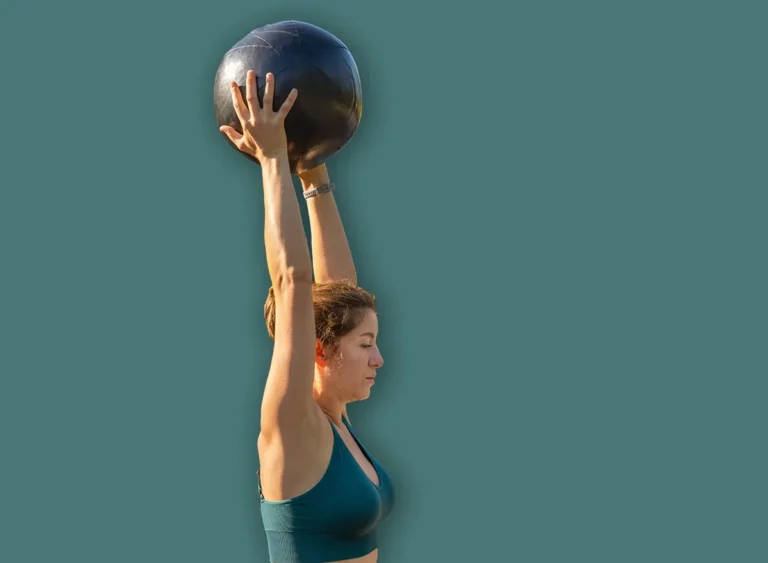
Med ball chops challenge your abs to control rotation while your hips and shoulders move together. Because you’re standing, your legs have to stay involved too, giving you a fuller-body exercise than a basic crunch. The rotation component also works your obliques and builds real rotational strength needed for everyday movement like reaching and twisting. Perform 2 to 3 sets of 8 to 12 reps per side, resting 30 to 45 seconds between sets.
A bodyweight chop (same movement without the ball) reduces the load significantly. A lighter med ball or a slower diagonal chop makes the exercise more manageable while still building strength. You might start with bodyweight and add the ball once the movement feels solid.
Building the Complete Picture: Sleep, Nutrition, and Daily Movement
The four exercises above will only take you so far. The best results come from looking beyond the workout itself. You’ll still get the best results by considering daily movement, nutrition, and sleep all at once.
What the research shows
When sleep is consistent, nutrition supports your goal, and you stay active throughout the week, the work you do during a short session has a much better chance of paying off. A single 10-minute bout of standing exercises is powerful, but it cannot overcome poor sleep, erratic eating, and an otherwise sedentary day.
Why daily movement matters
Staying active between workouts accumulates calorie burn and keeps your metabolic rate elevated. This can matter more than a single intense session. Walking for 30 minutes at a natural pace across the day, using stairs instead of elevators, and standing while working all add up. The goal is to keep your whole body working throughout the day, not just during the dedicated workout.
Nutrition and sleep as multipliers
Sleep helps your body recover from the training stimulus and regulate hunger hormones. Nutrition provides the building blocks for lean muscle while supporting the calorie deficit needed for fat loss. Together, they make your training effort count more than the exercise alone.
Source: Eat This Not That
Frequently Asked Questions
Can I do these exercises if I have never done high-intensity training?
Yes. Each exercise has modifications: walking intervals are low-impact, step-ups can use support and a lower platform, squat jumps can be done as regular squats, and medicine ball chops work without a ball. Start with the easier versions and progress as you get stronger.
How long should a complete routine take?
Walking intervals take 8 to 12 minutes. The other exercises take just a few minutes when done for 2 to 3 sets each. Together, a complete routine takes roughly 15 to 20 minutes.
Why do standing exercises work better than crunches for midsection work?
According to Eat This Not That, standing exercises involve your legs, back, and cardiovascular system in addition to your core, raising your heart rate faster and working more of your body in the same amount of time.
