
Key takeaways
- Sit-to-stands form the foundation of this routine, teaching your legs to lift you from the chair without using your hands.
- Box squats and reverse lunges build the individual and combined leg strength needed for daily activities.
- Chair planks and marching develop core stability and balance while your legs adapt to single-leg support.
- Progress gradually by asking your legs to take on more work as they grow stronger and your grip on the armrest lightens.
Losing the ability to stand from a chair
After 65, relying on the armrests to get up signals that your legs are working less efficiently than they once did. Getting to your feet without using your hands requires substantial strength from your lower body, specifically your hips and thighs. These muscles must generate enough force to lift your entire body weight from the seat, then manage the controlled descent back down when you sit. When this capacity fades, standing becomes slower, less stable, and increasingly dependent on the furniture around you.
Training at home with what you have
The chair itself becomes your training tool. Unlike exercises that require gym equipment or floor space, working with the chair lets you rehearse the exact movement you want to master. The seat becomes your squat depth marker, while the backrest provides balance support during challenging single-leg work. This setup makes it possible to build strength from home with minimal equipment, practicing daily movements in a familiar environment.
Sit-to-stands: the foundational movement
This is where the routine begins. Sit-to-stands isolate the skill you actually want to improve: rising from the chair to standing without pushing off the armrests. If this feels difficult right now, start with a cushion to raise the seat height, giving your legs less distance to work against.
Perform 2 to 3 sets of 6 to 10 reps, resting 45 to 60 seconds between sets. Focus on pushing through your feet rather than using momentum. Variations include elevating the seat further, slowing down each rep for more time under tension, or adding light weight like holding a water bottle.
Box squats and reverse lunges: building lower-body strength
Box squats for added challenge
Once sit-to-stands feel more manageable, box squats ramp up the demand on your legs. The chair serves as a depth target, but you don’t fully relax into it. Instead, lightly touch the seat and immediately drive back up, keeping your thighs and glutes under constant tension.
Perform 2 to 3 sets of 8 to 12 reps, with 45 to 60 seconds rest between sets. Keep the movement controlled: touch the seat without settling your full weight into it. You can increase difficulty by reducing the chair height, slowing the tempo, or holding an object like a dumbbell in front of your chest (called a goblet box squat).
Reverse lunges for single-leg strength
While sit-to-stands and box squats work both legs together, each side needs enough individual strength to support you independently. Reverse lunges place more demand on your front leg while the chair provides balance support with your hand.
Perform 2 to 3 sets of 6 to 10 reps on each leg, resting 45 to 60 seconds between sets. Start with a comfortable range of motion and let your front leg do the primary work as it brings you back to standing. Your hand on the chair keeps your balance stable. To modify, reduce the lunge depth, try a supported split squat, or alternate legs in each rep.
Core stability and balance
Getting from sitting to standing requires a forward lean, and your core helps control that shift before your legs take over. Two exercises build this stability and prepare your legs for the weight shifts that happen during daily movement.
Chair planks for midsection support
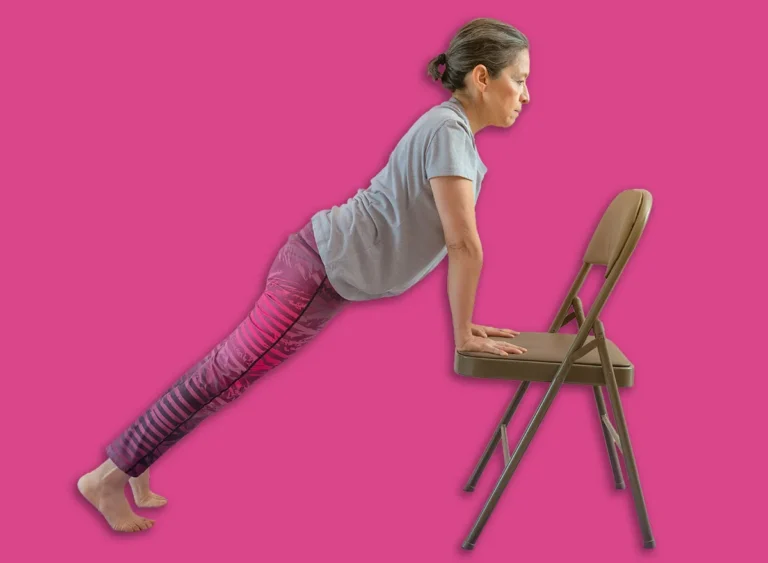
A chair plank works your core from an incline position, which is typically more manageable than starting on the floor. Place your hands on the chair seat and hold your body in a straight line from head to heels.
Perform 2 to 3 holds of 20 to 40 seconds each, resting 30 to 45 seconds between holds. Keep your ribs stacked over your hips. Don’t let your hips sag or pike. To progress, lower the chair height or move to the chair’s edge where it’s more challenging; to modify, increase the height of where your hands rest.
Marching to practice single-leg balance
Marching shifts your weight from one leg to the other while standing, building the balance and stability needed once you leave the chair. Hold the chair back or seat for support, lifting each knee in a controlled march.
Perform 2 to 3 rounds of 20 to 40 seconds each, resting 30 to 45 seconds between rounds. Set each foot down deliberately before lifting the other leg. As your balance improves, lighten your grip on the chair. Variations include seated marching (if standing marching feels too challenging initially), slowing the tempo significantly, or eventually doing it hands-free.
The progression toward independence
You don’t need to eliminate armrest use immediately. Instead, ask your legs to take on more work each time you stand as they grow stronger. The sit-to-stand itself becomes your progress marker—when it feels easier and more stable, you’ll notice the chair providing less support and your legs providing more. Build gradually, let your grip on the armrest lighten naturally, and trust the process.
Source: Eat This Not That
Frequently Asked Questions
What should I do if sit-to-stands feel too difficult at first?
Start by raising the seat with a firm cushion, which gives your legs less distance to work against. As you build strength, gradually lower the cushion or reduce seat height.
How long should I rest between sets of these exercises?
Most exercises use 45 to 60 seconds of rest between sets. Chair planks and marching use shorter 30 to 45 second rest periods.
Do I need to stop using the armrests immediately?
No. Gradually ask your legs to take on more work as they grow stronger, using the sit-to-stand movement itself as your progress marker. Your grip will lighten naturally.
