
Key takeaways
- Resistance exercises like box squats, lunges, bridges, and step-ups rebuild leg stamina faster than treadmill walking because they force muscles to generate force rather than repeat familiar patterns.
- Box squats work your thighs and glutes through 2 to 3 sets of 10 to 15 repetitions, with variations including slow-tempo squats and goblet squats as you gain strength.
- Single-leg movements such as reverse lunges and step-ups ensure each leg builds strength independently, preventing one strong leg from hiding weakness in the other.
- Hip stability through glute bridges and mini-band lateral walks keeps your pelvis steady as fatigue builds, which makes repeated steps and stairs feel more controlled.
Climbing stairs shouldn’t exhaust you. Standing at a kitchen counter to prepare dinner shouldn’t tire your legs before you finish cooking. Getting up from a seated position shouldn’t require you to brace yourself and push hard with your upper body. Yet for many people over 65, these simple movements reveal a troubling reality: the legs fatigue faster than the rest of the body. Stairs feel steeper, standing for any sustained period becomes draining, and basic daily tasks feel harder than they should.
This decline in leg stamina is common, but it is not inevitable. Rebuilding the staying power in your lower body is possible when you use the right exercises. Getting your legs back to reliable strength means independence stays within reach, and daily activities become manageable again.
How Resistance Training Outperforms Treadmill Work
Treadmill walking offers value, particularly for building cardiovascular baseline fitness. But treadmills have a fundamental limitation. Your legs repeat the same movement pattern continuously without pushing against meaningful resistance. The motion becomes familiar, your muscles adapt to that specific repetitive demand, and the benefit plateaus. Your legs do not develop the ability to generate significant force, stabilize under uneven loads, or handle unexpected movement demands.
Squats, lunges, and step-ups work from a different principle. Each repetition forces your muscles to produce greater force against resistance. That demand signals your legs they need to adapt by building both strength and endurance. Your legs learn to handle higher demands, not just repeat familiar motions.
This five-exercise routine approaches leg conditioning from multiple angles. High-repetition sets build the sustained effort your legs need for everyday tasks. Single-leg movements train each side independently so one strong leg does not hide a weaker one. Hip-focused exercises keep your pelvis stable as fatigue sets in. Together, these approaches rebuild leg stamina more effectively than steady-state cardio alone.
Box Squats: Building Strength With Clarity
The Role of the Box
Box squats serve a specific purpose: they eliminate the decision of how far to squat. The box gives you a clear target. Instead of wondering whether you have descended far enough or gone too deep, you simply move back until you touch the box, then press back up to standing. This removes balance complexity while keeping the focus on the work your thighs and glutes perform.
The repeated standing-up effort, performed across multiple sets and repetitions, builds the specific endurance your legs need when daily activities demand it. Each time you stand up from that box, you perform work that carries directly over to standing from a sofa, rising from a car seat, or getting up from a toilet. Your legs learn this exact pattern and become stronger at it.
Perform 2 to 3 sets of 10 to 15 repetitions, resting for 45 to 60 seconds between sets.
Progressive Variations
As your strength improves, the box squat can become harder through several variations. Higher box squats reduce the range of motion and lower demand when you need a stepping stone to harder work. Slow-tempo box squats emphasize control and keep your muscles working longer on each repetition. Goblet box squats add resistance by having you hold a weight in front of your chest, forcing your muscles to work harder against that load.
Reverse Lunges: Single-Leg Development
Once your legs work reasonably well together, training each side independently becomes important. Reverse lunges build single-leg endurance while keeping balance demands low because you can hold a chair or counter for support. You step backward with one leg, lower your body by bending the front knee, and press back up to standing. The front leg does most of the work. You control how far forward the rear knee drops, keeping the range of motion comfortable.
This single-leg focus has real significance. It prevents one strong leg from compensating for a weaker one, and it builds the asymmetrical stability you need for walking, climbing stairs, and moving across uneven ground. Over time, this work translates to more assured movement in daily life.
Perform 2 to 3 sets of 6 to 10 repetitions on each leg, with 45 to 60 seconds of rest between sets. Smaller-range reverse lunges reduce depth when you need to build confidence or manage knee discomfort. Supported split squats performed with a chair behind you offer a different variation. Alternating reverse lunges where you step back on one leg, return to center, and step back on the other allow you to complete higher repetition counts without stopping.
Hip Stability Through Multiple Angles
Glute Bridges for Endurance
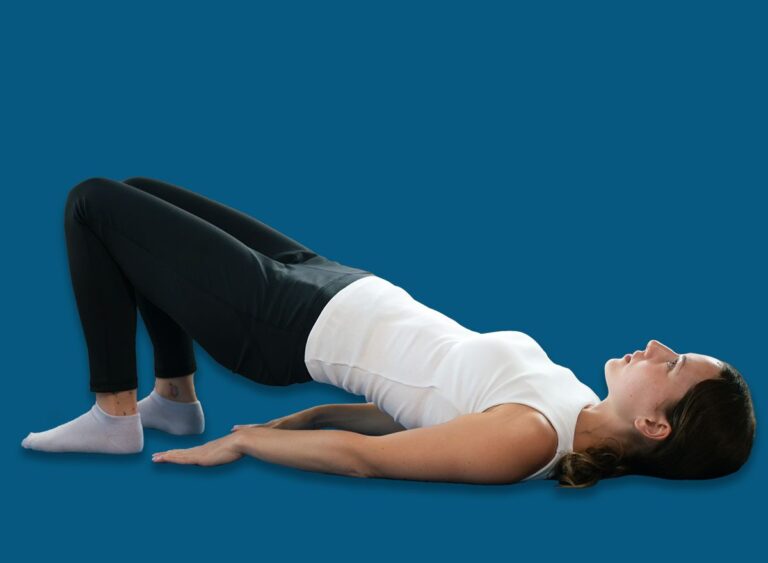
Your glutes stabilize your hips when your legs begin to tire. Without strong glutes, your pelvis becomes unstable, which forces other muscles to work harder and increases risk. Glute bridges allow you to work these muscles without adding balance demands, an advantage later in your routine when fatigue has accumulated.
The setup is straightforward: lie on your back with your knees bent and your feet flat on the ground about hip-width apart. Press your hips upward until your body forms a straight line from your knees to your shoulders. Once this basic version becomes easy, add a brief pause at the top of each repetition, holding for one to two seconds. This pause increases the time your glutes work on each rep.
Perform 2 to 3 sets of 12 to 15 repetitions, resting for 30 to 45 seconds. As you progress, try glute bridge holds where you pause for several seconds at the top of the movement, mini-band glute bridges with a resistance loop around your legs just above the knees, or weighted glute bridges where you hold a dumbbell across your hips.
Lateral Walks for Pelvic Control
Side-to-side movements often get overlooked in routines built around forward stepping and walking. Mini-band lateral walks strengthen the muscles on your hip’s outer side, which keep your pelvis square and stable as you move. This stability means repeated steps feel more controlled and less tiring when your legs start to wear down. Stand with a resistance band around your legs just above the knees, then step sideways, maintaining tension on the band throughout the movement.
Perform 2 to 3 sets of 8 to 12 steps in each direction, resting 30 to 45 seconds between sets. Variations shift the challenge: place the band above your knees instead of below them, take wider steps to increase the load, or move more slowly through each step to extend the time your muscles must work.
Step-Ups: Stairs and Uneven Ground
Step-ups prepare your legs for the exact patterns they face on stairs, curbs, and uneven terrain. Stand facing a low box or platform. One leg lifts your body onto the platform while the other leg controls the descent back down. This up-and-down pattern mimics the movement your legs perform when navigating stairs.
A low step height allows you to complete more repetitions without the exercise becoming a balance challenge. This high-repetition approach builds endurance while keeping the movement manageable. One leg lifts your body onto the box, then controls the descent, this cycle repeats for the prescribed number of repetitions before switching legs.
Perform 2 to 3 sets of 8 to 12 repetitions on each leg, resting for 45 to 60 seconds between sets. Progress by adding support, such as holding a rail or chair as you step, using a lower platform for higher rep counts, or slowing down your movement to increase difficulty.
Programming for Lasting Progress
Leg endurance improves when your muscles get repeated chances to work and recover. Use this routine 2 to 4 days per week. Space your workouts so that you leave at least one day between sessions. This spacing allows your muscles to repair and adapt, which is where the actual strength gain occurs.
As your capacity improves, increase the challenge gradually. Add an extra set, perform more repetitions per set, include longer pauses at the hardest part of each movement, introduce resistance bands, or hold weights. Small increases in difficulty allow your body to adapt steadily without overwhelming it.
Source: Eat This Not That
Frequently Asked Questions
How often should I perform this routine?
Use this routine 2 to 4 days per week with at least one day of rest between sessions, which allows your muscles to repair and adapt.
Why are box squats better than regular squats for adults over 65?
The box provides a clear target depth, removing balance complexity and guesswork, which lets you focus on building the endurance your legs need for daily tasks like getting up from chairs.
How do I progress these exercises as I get stronger?
Gradually increase the challenge by adding more sets and repetitions, including longer pauses at the hardest part of each movement, introducing resistance bands, or holding weights.
