
Key takeaways
- Seated inner-thigh machines train muscles in isolation, disconnecting your adductors from the stabilizing muscles needed for real-world balance and movement.
- Research shows that frontal-plane hip strength is linked to fall risk in older adults, making standing exercises superior for functional strength that protects you in daily life.
- Sumo squats, standing side leg raises, lateral lunges, and cross-body leg swings train multiple muscle groups together while challenging your balance and core stability.
Most gyms feature that seated inner-thigh machine—a strange contraption where you sit down and press two padded arms together to work the muscles running along the inside of your thighs. It feels effective in the moment. Your inner thighs might even feel fatigued after a set or two. But if you’re over 55, this machine might actually be one of the least efficient tools you could choose for building lasting strength that actually helps you in daily life.
The disconnect between how the machine feels and how much it actually helps stems from a mismatch between the machine’s isolated position and the way your body actually needs to work in the real world. Understanding this gap can change how you approach lower-body training for the rest of your life.
Why Seated Machines Fall Short for Aging Athletes
The core problem is the seated position itself. When you sit on that machine with your back against a pad and your legs in front of you, you’re training your inner-thigh muscles in a way that’s fundamentally disconnected from how they function in real life.
The Isolation Trap: Muscles Don’t Work Alone
In everyday life—when you walk, climb stairs, step sideways, or stand up from a chair—your inner-thigh muscles (called adductors) never work in isolation. These muscles activate alongside your hip stabilizers, glutes, core muscles, and the muscles on the outside of your hips. All these muscle groups work together as a coordinated unit to keep you balanced and steady.
A seated machine strips away this requirement. You can press those padded arms together without your other muscles breaking a sweat. Your stabilizer muscles don’t have to fire. Your core doesn’t have to engage. Your balance isn’t challenged. This means the strength you build on that machine stays on that machine. It doesn’t translate into better balance when you’re walking, or steadier legs when you’re reaching for something on a high shelf, or more confident movement when you’re navigating uneven ground.
Research Links Hip Strength to Fall Prevention
This isn’t just a theoretical distinction. Research shows that frontal-plane hip strength—which includes both your adductors (the muscles that pull your leg toward your body’s midline) and your abductors (the muscles that move your leg away from your midline)—is linked to fall risk in older adults. This finding is significant: the way you train these muscles actually affects your risk of falling.
Studies consistently show that training muscles in the specific ways your body uses them produces better results than isolation work. When you train your inner thighs while also maintaining balance, your nervous system learns the coordinated movement pattern. Your muscles and your balance system train together. This creates strength that actually protects you in real-world situations—the situations where falls typically happen.
Why Standing Exercises Win Every Time
Standing exercises train your adductors alongside the stabilizing muscles you rely on for actual movement. Your core has to engage. Your glutes have to work. Your balance system has to stay alert. The strength you build carries over directly into better walking, more confident stair climbing, steadier movement when getting up from a chair, and improved balance in general.
We spoke with James Bickerstaff, a certified personal trainer at OriGym, who designed a series of five standing exercises specifically to address the shortcomings of seated machines. These movements work your inner thighs effectively while forcing your stabilizer muscles to engage the way they do in real life.
Five Standing Exercises for Firmer Inner Thighs
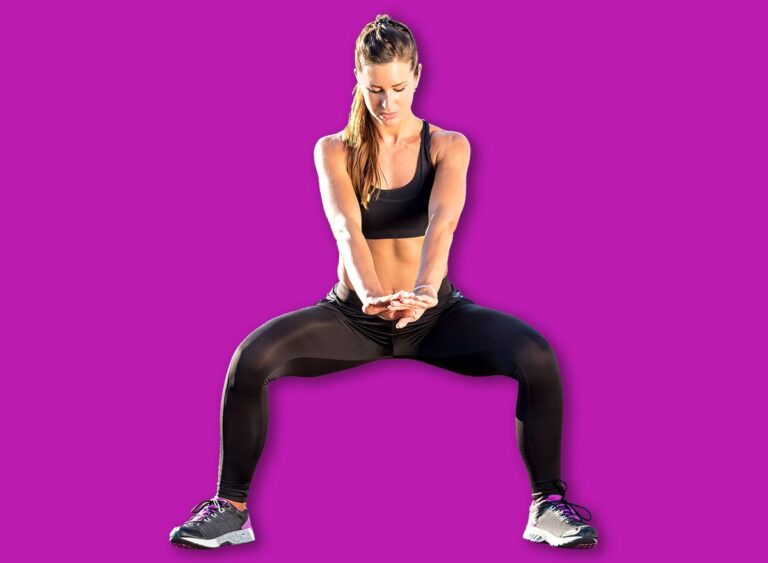
Sumo Squats: A Familiar Movement, Redefined
The sumo squat is an excellent starting point for anyone new to standing lower-body work or transitioning away from machines. It takes a movement you probably already know—the basic squat—and shifts the emphasis toward your inner thighs through a simple change: widening your stance.
According to Bickerstaff, “The wider stance of a sumo squat places greater emphasis on the adductors, or inner-thigh muscles, alongside the glutes and quadriceps. Strengthening major lower-body muscles through one movement.” This efficiency is important. In a single exercise, you’re activating multiple major muscle groups—your inner thighs, your outer thighs, your glutes, and your quads. You’re also training your core and balance system because you have to stay upright without the support of a machine. The wider stance also naturally encourages better stability and form than a narrow-stance squat would.
Standing Side Leg Raises: Building Hip Stability and Appearance
Standing side leg raises are deceptively demanding. You stand on one leg and lift the other leg out to the side. Your standing leg has to work hard to keep you upright and balanced. Your hip muscles have to fire to lift your leg and maintain control. Meanwhile, your core locks in to prevent your torso from tilting.
Bickerstaff explains: “Stronger hip muscles improve lower-body stability. This becomes increasingly valuable for maintaining confident movement.” Beyond stability, side leg raises specifically target your adductors. While people often think of this exercise as working the outside of the hip, the inside of your thigh—the adductors—must also engage to stabilize your hip and control your leg position. As Bickerstaff notes, “Strengthening these inner-thigh muscles can help improve hip and pelvic stability as well as giving the area a firmer appearance as muscle develops.” This dual benefit—both functional strength and visible muscle development—makes the movement valuable whether your primary goal is confidence in movement or aesthetics.
Lateral Lunges: Training Overlooked Movement Patterns
Lateral lunges bring a direction of movement that often gets overlooked in standard leg workouts. Most people focus on forward and backward motions—forward lunges, reverse lunges, walking lunges. These patterns are valuable, but they’re not the only movements your body performs in daily life.
“Lateral lunges help develop the glutes and quads while improving strength in a direction of movement that can sometimes be neglected,” according to Bickerstaff. Think about real-world scenarios: stepping sideways to get past someone in a narrow aisle, shifting your weight side-to-side while standing at a counter, or adjusting your stance sideways on uneven terrain. These sideways movements require strength in a different plane. Training laterally also builds the stabilizing strength you need to move confidently in any direction—not just forward and backward.
Cross-Body Leg Swings: Combining Strength and Mobility
The final exercise pairs strength-building with mobility work in a single movement. Cross-body leg swings keep both your inner and outer thigh muscles working actively while your hips move through a larger range of motion.
“Cross-body leg swings keep your inner and outer thigh muscles working while also encouraging mobility through the hips,” Bickerstaff says. This combination of strength and mobility is especially valuable for older adults. Muscle strength and joint mobility often decline together as people age, and this exercise addresses both simultaneously. You’re building strength while you’re also maintaining or improving your range of motion—a dual benefit that isolated stretches or machine work can’t provide.
Real Strength for Real Life
The advantage of these standing exercises is straightforward: they train your adductors the way your body actually uses them. Your legs, hips, and core learn to work together as one coordinated unit. This creates functional strength that carries over into the movements you perform every single day—walking, stair climbing, getting up from a chair, navigating crowded spaces, and staying balanced during everyday activities.
This is functional fitness in its truest form: the kind of strength that makes a real, measurable difference in how you move through the world after 55. Machines have their place in a balanced fitness program, but if your goal is real-world strength and confidence in your movement, standing exercises deliver superior results for the time you invest. They challenge your balance system, demand core and stabilizer engagement, and build the exact kind of functional fitness that matters most as you age.
Source: Eat This Not That
Frequently Asked Questions
Why are standing exercises better than seated machines for inner thigh strength after 55?
Seated machines isolate your inner thigh muscles without engaging your stabilizers, glutes, and core—muscles you actually rely on for balance and movement in daily life. Standing exercises train all these muscles together, creating functional strength that carries over into real-world activities like walking, climbing stairs, and getting up from a chair.
What does research say about hip strength and fall prevention?
Research shows that frontal-plane hip strength, which includes your adductors and abductors, is linked to fall risk in older adults. Training these muscles in standing positions that challenge your balance produces better results than isolated machine work, because your muscles and balance system train together in the coordinated patterns you actually need.
Which exercise should I start with if I'm new to standing lower-body work?
According to James Bickerstaff, the sumo squat is the perfect starting exercise because it takes a familiar movement—the basic squat—and shifts emphasis to your inner thighs through a wider stance. It activates multiple muscle groups (inner thighs, glutes, and quads) in one movement, making it efficient for building overall lower-body strength.
