
Key takeaways
- A 2019 Harvard study of 1,104 firefighters found that those who completed more than 40 push-ups had a 96% lower risk of cardiovascular disease than those who completed fewer than 10.
- For adults over 60, completing 15 full push-ups with perfect form—chest near the floor, elbows tight to your sides, core braced—indicates elite upper-body strength and functional fitness.
- If 15 push-ups is beyond your current ability, incline push-ups against a bench or countertop train the same muscles while reducing load, letting you progress safely toward full push-ups.
- Push-up strength directly supports everyday tasks: rising from low chairs, catching yourself during falls, and carrying groceries up stairs.
A single drop to the floor and back up takes thirty seconds, yet it tells your cardiologist something that standard cardiovascular testing might overlook: whether your heart and vessels are truly prepared for the stresses of aging. The push-up requires no equipment, no facility membership, and no medical supervision. For adults over 60, both how many you can perform and whether you can maintain perfect form have become reliable markers of immediate strength capability and long-term health risk.
The Research Behind Push-Up Strength
The Harvard Study
In 2019, researchers at Harvard University published findings in JAMA Network Open that shifted how fitness professionals think about the humble push-up. The study followed 1,104 active firefighters over a decade, tracking what their baseline push-up performance predicted about their health outcomes across those ten years. Firefighters who managed more than 40 push-ups showed a 96 percent lower risk of cardiovascular disease compared to those who could complete fewer than 10. The men enrolled averaged roughly 40 years old at the study’s start, not yet in their sixties, so the exact numerical thresholds cannot be directly transferred to older adults. Nevertheless, the pattern held—push-up capacity correlated strongly with heart health and disease risk.
Why a Single Movement Predicts Overall Health
The reason push-ups function as a health window goes well beyond local muscle strength. A person performing proper push-ups recruits the chest, shoulders, triceps, and core simultaneously. This full-body demand means the test measures more than isolated arm power; it reveals how well your cardiovascular system, nervous system, and muscular system work together under load. The ability to move your entire upper body through space—lowering your chest toward the floor, maintaining a rigid torso, and pressing back up against gravity—requires aerobic capacity, muscle coordination, neuromuscular efficiency, and sustained power output all firing in concert.
What Push-Ups Do for Daily Life After 60
Tasks That Demand Push-Up Strength
Rising from a low chair without using your arms recruits the same pressing pattern as a push-up, though in reverse. When you catch yourself after a stumble, you instinctively press your hands and arms into the floor to break your fall and stop your descent. Carrying heavy groceries, bags, or laundry up a flight of stairs demands the combined stability and strength of a strong core, chest, and shoulders to maintain your balance and ascend safely. Push-up training strengthens the exact muscles these movements require.
The Muscles You’re Building
Push-ups engage more than the visible chest. Your pectorals initiate the push motion; your anterior deltoids (front shoulders) stabilize and assist throughout the complete range; your triceps (the back of your upper arms) generate the pressing force; and your entire core—abs, obliques, and stabilizer muscles—keeps your body rigid and aligned from head to heels. Performing them correctly also develops muscular endurance, not just peak strength, meaning your muscles can sustain effort over time rather than producing a single maximal effort and fatiguing.
The Benchmark for Elite Strength
If you are over 60 and want to know whether your upper-body strength has reached an elite level, James Bickerstaff, a certified personal trainer at OriGym, offers a clear, measurable standard. According to Bickerstaff, someone who can complete 15 push-ups after age 60—performed slowly and deliberately, with complete control through the full range of motion, from chest near the floor to full elbow extension—is demonstrating excellent upper-body strength, stability, and muscular endurance for their age group.
Form Over Reps: Why Quality Matters
The temptation to chase higher rep counts leads many people into a trap that undermines the goal they’re pursuing. Bickerstaff emphasizes this distinction: “The quality of your push-ups matters more than chasing a high number.” Sloppy repetitions—partial dips that barely lower your chest, elbows that flare outward away from your ribs, hips that sag in the middle—can inflate a rep count without building the strength the test is designed to measure.
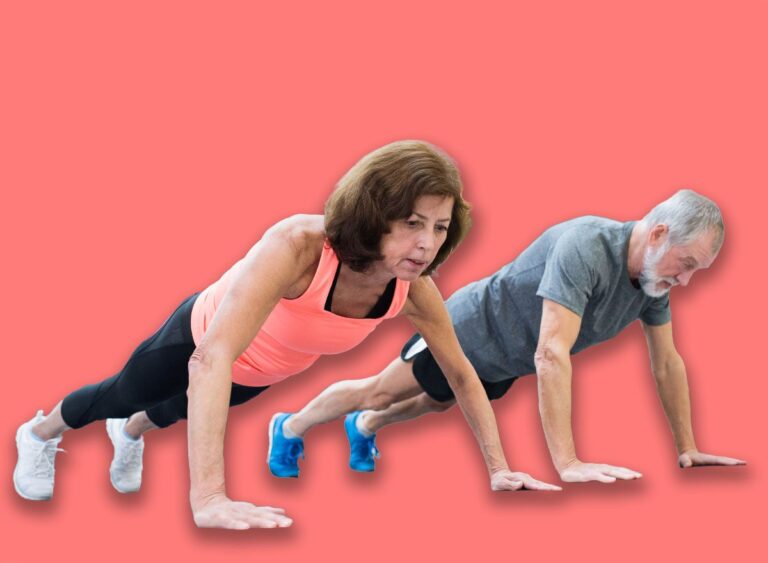
A proper push-up follows specific mechanics. Your chest lowers close to the floor (not just a few inches). Your elbows track tight against your sides (not splayed outward). Your core stays braced throughout (no sagging hips, no pike movement at the rear end). Performing 5 push-ups this way—with deliberate control and full range of motion—builds significantly more strength and endurance than performing 20 sloppy repetitions with reduced range and poor form.
Building Toward the Goal
Not everyone can perform 15 full push-ups today, and that starting point is completely normal. If that describes your current capability, Bickerstaff recommends a proven and effective alternative: incline push-ups. An incline push-up is performed with your hands on a sturdy surface that is higher than the floor—a bench, a countertop, a sturdy table, even a wall—rather than on the floor itself. The higher your hands, the less of your total body weight you need to press, making the movement significantly easier while still training the same key muscle groups.
As you build strength over weeks and months, you can gradually lower the height of your hands (moving from a high bench to a lower bench, from a coffee table to a very low step, until eventually reaching the floor) until you achieve full push-ups. This progression works because it preserves the movement mechanics—your chest, shoulders, triceps, and core still fire together—while reducing the load on your muscles. Over time, your body adapts to the progressive demand and grows stronger.
Moving Forward With Your Training
Push-up ability is an accessible strength test for older adults, and the evidence now clearly shows it signals far more than surface-level fitness. If you can complete 15 push-ups with perfect form after 60, your upper-body strength is performing at an elite level for your age. If you fall short of that mark, incline push-ups offer a safe, effective, and entirely legitimate way to build strength toward that benchmark. Your daily life depends on the muscles you strengthen with this single, equipment-free exercise, and that matters most when you’re rising from chairs, catching yourself during a fall, or carrying groceries.
Frequently Asked Questions
What does the Harvard study tell us about push-ups and health?
A 2019 Harvard study published in JAMA Network Open tracked 1,104 firefighters and found that those who completed more than 40 push-ups had a 96% lower risk of cardiovascular disease than those who completed fewer than 10, suggesting push-up capacity correlates with overall health.
How many push-ups should I be able to do at 60 for elite strength?
According to James Bickerstaff, a certified personal trainer at OriGym, completing 15 push-ups with perfect form at age 60—with your chest lowering close to the floor, elbows tight to your sides, and core braced throughout—indicates excellent upper-body strength and muscular endurance.
What if I can't do 15 full push-ups yet?
Incline push-ups are an effective alternative: place your hands on a sturdy bench, countertop, or table and perform the same movement. The higher hand placement reduces the weight you need to press, and you can gradually lower your hand position over weeks or months until you can perform full push-ups.
