
Key takeaways
- Five counter-supported exercises address the full range of knee strength needs: squats for bilateral movement, lunges and split squats for single-leg work, leg extensions for direct quad strength, and planks for full-body stability.
- Perform squats and leg extensions for 2–3 sets of 8–12 reps, lunges and split squats for 2–3 sets of 6–10 reps per side, and planks for 2–3 holds of 20–40 seconds.
- Kitchen-counter support reduces intimidation, teaches better form, and translates directly to confidence during daily movement like standing, walking, and climbing stairs.
- Progress by reducing counter reliance, increasing hold time, or adding small pauses—consistency matters more than speed or early intensity.
Why Your Kitchen Counter Outperforms a Leg Press
A leg press offers a controlled path for building lower-body strength, but that machine never trains the positions your knees encounter during real life. When you sit down in a chair, climb stairs, or stand up from the couch, your body is not moving on rails—it is working in space that requires balance, coordination, and the ability to adjust midway through the motion. Your kitchen counter bridges that gap. Unlike a locked machine, the counter lets you adjust your range, slow your tempo, and build trust in your legs while they still have something to steady themselves against.
The counter’s advantage runs deeper than safety. In my practice, clients who feel guarded about their knees consistently perform cleaner repetitions when they have a fixed surface in front of them. The psychological shift matters more than people expect. When the support is tangible, the workout feels approachable enough to repeat without anxiety driving the movement. Once the pattern begins to feel automatic, clients usually report that their confidence spreads to daily tasks—standing longer, stepping more fluidly, trusting that their legs will respond.
Support That Teaches Better Form
A counter positioned at waist height forces you into better spinal alignment during knee-focused work. You cannot slouch into the movement or compensate with your lower back because the geometry does not permit it. This changes how your muscles learn the pattern. Your quads, glutes, and hips all fire in the order they are supposed to, and your central nervous system starts to recognize the difference between compensatory movement and genuine strength.
Moving Like You Live
The gap between a machine and daily life is where most people fall short after 60. You may rebuild impressive leg-press numbers and still feel uncertain stepping off a curb or walking down a slope. Kitchen-counter exercises train your knees in the same unstable, adjustable context where they actually function. That translates directly to confidence during movement you actually do.
The Counter-Supported Squat: Rebuilding the Fundamental Pattern
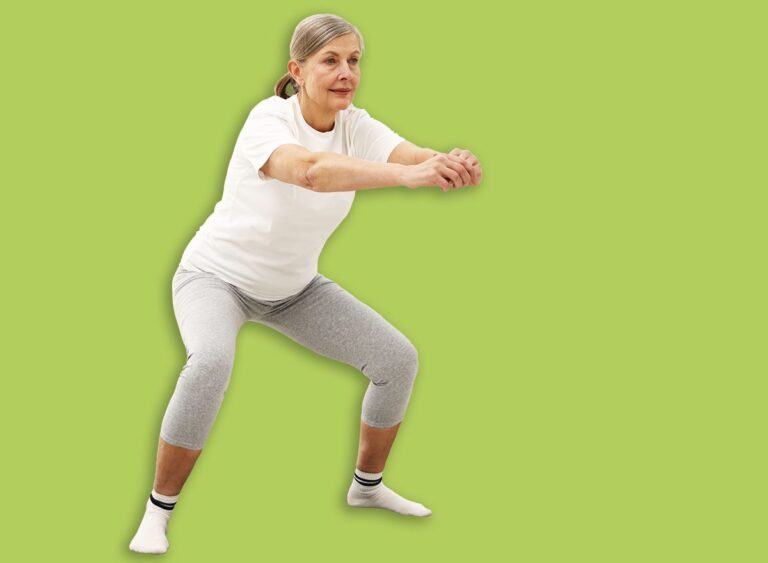
The squat is the most useful lower-body movement because it mirrors the motion of standing up, sitting down, and managing stairs. After 60, your knees need practice bending and straightening while your quads, glutes, and hips coordinate the work. The counter removes balance as a limiting factor, so you can focus on depth, control, and trust.
Stand facing the counter with your feet shoulder-width apart, planted firmly on the ground. Rest your fingertips on the counter—the goal is light contact for balance, not pulling yourself out of the movement. Bend your knees and hips simultaneously as if you were lowering into a chair, keeping your weight distributed across your whole foot. Move at a pace where you can pause briefly at the bottom without losing stability. Return to standing by pressing through your heels and midfoot, not your toes.
Perform 2 to 3 sets of 8 to 12 repetitions. As the weeks progress, ease the pressure of your fingers on the counter, reducing reliance on support as your legs gain strength and confidence. Variations that help during early sessions include a smaller range of motion (dipping halfway down), slowing your tempo to 3 seconds down and 3 seconds up, or pausing for 1–2 seconds at the bottom of each squat.
Single-Leg Training and Balance: Lunges and Split Squats
One knee frequently feels more reliable than the other after 60, especially when stiffness or guarding has built up. Single-leg work addresses that asymmetry directly, forcing each side to carry its own load without compensating toward the stronger side.
The Reverse Lunge for Stepping Confidence
The reverse lunge builds strength around the knee while restoring confidence with stepping patterns. Face the counter, lightly touching it with your fingers. Step one leg backward, lowering your back knee toward the floor while keeping most of your weight in the front leg. The front knee should track above your ankle, and your torso stays upright. Push through the front heel to return to standing, completing all repetitions on one side before switching legs.
Perform 2 to 3 sets of 6 to 10 repetitions per side. This exercise trains your quadriceps, glutes, hamstrings, calves, and core simultaneously. Lighter variations include tapping your back foot to the floor without lowering (step-back taps), reducing your range by not stepping as far back, or pausing for 1–2 seconds in the bottom position.
The Split Squat for Sustained Single-Leg Work
The split squat positions one leg as the working limb for the entire set, building sustained tension through your front thigh and allowing your hips to support the load. Unlike the lunge, your feet do not move—position one foot forward and one foot back, separated by roughly a stride length. The counter is in front of you for balance. Lower your back knee toward the floor while keeping your weight in the front leg, then drive back to standing. All reps happen on one side before switching.
Perform 2 to 3 sets of 6 to 10 repetitions per side. This exercise bridges basic squats and more advanced single-leg work, building knee strength without the balance demand of true single-leg movements. Try smaller ranges of motion during early sessions, holds of 1–2 seconds at the bottom, or extremely slow tempos where each repetition takes 6 seconds down and 6 seconds up.
Direct Quadriceps Strengthening
Your quadriceps stabilize the knee throughout the day. After 60, stronger quads make walking steadier, stairs more manageable, and standing for longer periods more comfortable. The counter-supported standing leg extension isolates the quads without needing a machine.
Face the counter with your feet hip-width apart, touching the counter lightly with your hands for balance. Lift one leg slightly off the floor, keeping your thigh steady. From this starting position, straighten your lower leg forward, controlling the movement so the knee fully straightens but does not lock. Pause briefly, then lower your foot back toward the floor without placing it down. Your working thigh stays lifted throughout. Complete all repetitions on one side, then switch.
Perform 2 to 3 sets of 8 to 12 repetitions per side. The key form cue is keeping your lifted thigh stable—only your lower leg moves. This teaches your quads to work independently while your hip flexors remain still. Variations for early sessions include a smaller range (straightening halfway), performing the exercise while sitting in a chair instead of standing, or holding a light resistance band around your shin.
Building Full-Body Stability: The Incline Counter Plank
Your knees improve when your core, hips, and shoulders work together to keep your body organized during movement. An incline counter plank trains the bracing pattern that supports squats, lunges, and daily tasks without the intensity of a floor plank.
Place your hands on the counter, shoulder-width apart, and step your feet back so your body forms a straight line from your head to your heels. This angle is much more manageable than floor planks, especially when your core is rebuilding. Brace your midsection as if you were about to be punched, pulling your ribs downward so your lower back does not sag. Hold this position steady.
Perform 2 to 3 holds of 20 to 40 seconds each. As your core gains endurance, increase the hold time or progress to a higher counter (moving your hands higher shifts more weight to your feet). Easier variations include a wall plank with your hands on a wall, or holding a higher counter where the angle is less steep. A more advanced variation adds shoulder taps, where you tap one hand to your opposite shoulder while bracing and holding the rest of your body still.
Starting and Building Over Time
Rebuilding knee strength works because of consistency, not intensity. Your kitchen counter makes the first few sessions feel less threatening—there is no intimidation factor, no unfamiliar equipment, no awkwardness about asking for help. Start with the depth and range that feels smooth, the tempo that lets you control each repetition, and the amount of counter support that lets you complete all reps with good form. Your knees will earn more range and deeper control as weeks pass.
Strength improvements after 60 often announce themselves in unexpected ways. You might notice cleaner repetitions before you notice the weight getting easier. You might feel more confidence in how your legs respond when you stand up, more stability when you step down, less hesitation during movement that previously felt risky. These changes mean your nervous system is learning, not just your muscles growing stronger. Keep the routine simple, resist the urge to progress faster than feels comfortable, and let consistency accumulate the work that builds real, functional strength.
Frequently Asked Questions
Which muscles do these five exercises train?
Together, they train your quadriceps, glutes, hamstrings, calves, and core. Squats and lunges work multiple muscle groups simultaneously, while standing leg extensions isolate the quads and planks integrate the core with hips and shoulders.
How many sets and reps should I perform?
Squats and leg extensions call for 2–3 sets of 8–12 reps. Reverse lunges and split squats require 2–3 sets of 6–10 reps per side. Incline planks are performed as 2–3 holds of 20–40 seconds each.
Why does the kitchen counter work better than a leg press machine?
The leg press moves on rails in a controlled path, but daily life requires balance and adjustment. The kitchen counter trains your knees in real space while still providing support, teaching the stability and coordination you actually need for stairs, sitting, standing, and walking.
