
Key takeaways
- Five daily functional exercises target your legs, hips, chest, back, shoulders, and core simultaneously without requiring heavy weights.
- Sit-to-stands and standing hip hinges build lower-body strength while teaching safe movement patterns you use every day.
- Farmer's carries engage your entire body while mimicking real-world movements like carrying groceries and luggage.
- Consistent, controlled repetitions reverse muscle loss more effectively than complicated programs or rushing through exercises.
After turning 60, everyday tasks reveal the reality of muscle loss. Climbing stairs demands more effort than it once did. Rising from a low chair requires noticeable strain. Carrying groceries across a parking lot leaves you tired. These aren’t minor inconveniences—they’re signals that your muscles need consistent, purposeful challenge to stay strong.
The Physical Cost of Muscle Loss After 60
Strength declines gradually but steadily with each year of inactivity. Without intervention, this decline accumulates until movements that once felt automatic become genuinely difficult. The pattern accelerates: weaker muscles mean less daily activity, which leads to further muscle loss in a downward spiral. The stakes extend beyond convenience. Independence depends on maintaining the strength to move freely, climb stairs safely, and carry objects without exhaustion or risk of falling.
The good news is that muscle responds powerfully to the right stimulus at any age. You don’t need years of heavy lifting or complicated training programs. Consistent, functional movement that challenges your major muscle groups produces remarkable results in weeks, not months.
Functional Resistance: A Better Path Than Heavy Weights
A common misconception holds that reversing muscle loss requires heavy barbells and dumbbells. In reality, your body weight, a sturdy chair, and controlled movement patterns provide sufficient resistance when applied with proper technique. Functional exercises offer an additional advantage: they train your muscles to work together rather than in isolation.
This integrated approach matters enormously. When your muscles learn to coordinate and stabilize one another, you gain improvements across multiple dimensions simultaneously—balance improves, coordination sharpens, mobility expands, and strength increases. The result isn’t just larger muscles; it’s a body that remains capable of the movements that define independence. Clients who maintain the most strength after 60 rarely follow complicated programs. Instead, they make movement a daily habit and consistently challenge the muscles they rely on most.
Lower-Body Strength: Sit-to-Stands and Hip Hinges
Sit-to-Stands for Chair and Stair Strength
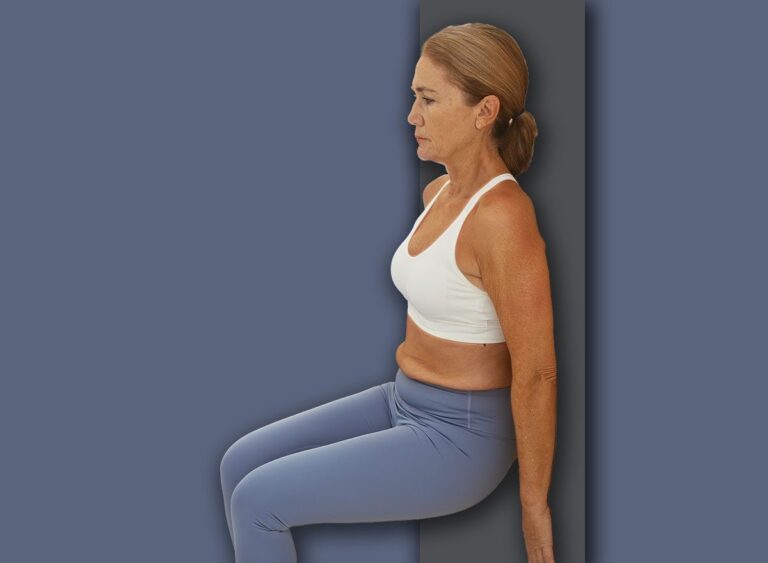
If forced to choose a single daily movement for preserving lower-body strength after 60, sit-to-stands stand near the top of the list. Every repetition recruits your quadriceps, glutes, hamstrings, and core simultaneously while practicing the exact movement pattern you use whenever you rise from a chair. Most people rush through this exercise, but the real strength-building opportunity appears in the lowering phase.
By slowing down as you descend, you control your body against gravity, creating a powerful strength stimulus. Over time, this benefit translates directly into tangible functional improvements: stairs become easier to climb, walking feels less effortful, and rising from low surfaces requires less energy and effort. Your own body weight provides all the resistance you need.
Standing Hip Hinges for Safe, Powerful Movement
The posterior chain—your glutes, hamstrings, and lower back—contains some of your body’s largest and most important muscles, yet it frequently receives insufficient attention in daily life. Standing hip hinges strengthen these critical muscles while teaching you how to bend safely from the hips rather than from your lower back.
This movement pattern appears constantly in real life: picking up objects from the floor, reaching for something below waist height, or any lifting motion. Mastering the pattern with body weight alone prevents injury and builds power. Stronger hips reduce unnecessary stress on your lower back and give your entire body more functional power. Once you’ve refined the movement with proper technique, resistance can be added gradually.
Upper-Body Development
Wall Push-Ups for Chest, Shoulders, and Stability
Upper-body muscle loss makes pushing and carrying increasingly difficult after 60. Wall push-ups provide a straightforward solution by strengthening your chest, shoulders, triceps, and core without requiring you to lie down on the floor. One advantage of this approach is how easily you can control resistance by simply adjusting the distance between your feet and the wall. Closer to the wall means less resistance; stepping back progressively increases the challenge.
As your strength improves, you can gradually advance toward incline push-ups (hands on a countertop or bench) and eventually floor push-ups. Consistency matters far more than beginning with a difficult variation. Moving steadily and controlled through a full range of motion at the wall for weeks produces stronger results than struggling with a harder version for a few days before quitting.
Resistance Band Rows for Posture and Back Strength
Pulling strength often diminishes when people spend most of their time sitting, driving, or working at a desk. Resistance band rows reverse this decline by strengthening your upper back, rear shoulders, and biceps. Beyond building strength, this exercise helps restore the posture that supports healthy movement patterns throughout your day.
What makes resistance band rows particularly valuable is the core engagement required during every repetition. Your core must stabilize your torso while your upper body performs the pulling motion, creating a comprehensive strength challenge. Many clients notice that carrying groceries becomes noticeably easier within several weeks of consistent rows, and maintaining an upright posture throughout the day requires less conscious effort. Strong back muscles provide a powerful defense against the functional decline that typically accompanies aging.
Full-Body Integration: Farmer’s Carries
Ending a daily strength routine with an exercise that challenges your entire body simultaneously produces exceptional results. Farmer’s carries strengthen your grip, forearms, shoulders, core, hips, and legs all at once while teaching you to maintain good posture under load. This movement closely mirrors real-life tasks—carrying groceries, luggage, laundry, or household items.
Unlike an isolated weightlifting exercise that targets a single muscle group, every single step of a farmer’s carry forces multiple muscle groups to coordinate and stabilize your body. That integration is what makes farmer’s carries one of the most practical exercises for preserving strength after 60. You’re not just building larger muscles; you’re building a body that moves and functions like someone strong enough to handle real-world demands.
Building Strength Through Consistency and Control
The five exercises above represent a complete strength system that requires no special equipment and fits easily into a daily routine. The common thread connecting all of them is controlled, purposeful movement. Rushing through repetitions, bouncing at the bottom of a sit-to-stand, or moving carelessly through any of these exercises reduces the strength stimulus and increases injury risk.
Focus on performing each movement with precision and control. Move slowly through the full range of motion. Feel your muscles working throughout each repetition. This attention to quality produces results far more reliably than chasing higher numbers or harder variations. Combined with simple consistency—performing these exercises daily or nearly every day—this approach builds a strong foundation that defends against age-related muscle loss and preserves the independence that matters most.
Frequently Asked Questions
What makes sit-to-stands the most important exercise for older adults?
Sit-to-stands recruit your quadriceps, glutes, hamstrings, and core while practicing the exact movement you use when rising from a chair. Focusing on controlled lowering creates powerful strength stimulus that directly improves stair climbing, walking, and rising from low surfaces.
Do I need heavy weights to reverse muscle loss after 60?
No. Your body weight, a sturdy chair, and controlled movement provide sufficient resistance when applied with proper technique. Functional exercises that train muscles to work together improve balance, coordination, mobility, and strength simultaneously.
Why are farmer's carries valuable for functional strength after 60?
Farmer's carries strengthen grip, forearms, shoulders, core, hips, and legs simultaneously while teaching you to maintain posture under load. The movement mimics real-life tasks like carrying groceries, luggage, and household items, making it one of the most practical exercises for preserving strength.
