
Key takeaways
- Four dynamic full-body exercises engage your entire body through fascial patterns while building balance and coordination more effectively than single-muscle stretches.
- Each exercise requires 5 to 8 reps in one to two sets, with movements controlled and range gradually increasing as your body warms up.
- These exercises work best as a warm-up because they progressively prepare your body for movement while gently elevating your heart rate.
- Older adults benefit especially from these movements because they train proprioception and balance while improving flexibility.
Stretching one muscle at a time has long been the standard approach to improving flexibility, but a full-body dynamic strategy offers something different. According to Eat This Not That, moving through fascial lines—the interconnected tissues that shape how your body functions—can address flexibility and mobility more comprehensively than isolated stretches. These dynamic moves challenge your balance and coordination while loosening your entire body through larger movement patterns that mirror how you actually move in daily life.
Understanding Fascial Patterns in Your Body
Fascia, the connective tissue network throughout your body, behaves like an integrated system rather than separate, independent parts. Thomas Myers explores this concept in detail in his book Anatomy Trains, which covers the electrical and chemical principles that govern how fascia functions. By working through larger fascial patterns instead of isolating individual muscles, you engage multiple areas of your body simultaneously, just as you do when you walk, run, reach, rotate, or jump. This approach to stretching acknowledges that real movement never happens in isolation. Your spine, hips, shoulders, and limbs work together as a single coordinated unit.
Why Full-Body Movement Matters
When you perform dynamic full-body exercises, you’re not just improving your range of motion. You’re training your body to control that mobility while shifting your center of gravity and adjusting your position. This adds a layer of difficulty that isolated stretching doesn’t provide. Your muscles must engage more actively, and your nervous system must work harder to maintain balance and coordination. Because these exercises involve continuous movement, they also elevate your heart rate slightly, making them an efficient addition to your warm-up routine.
The Four Essential Moves
Each of these exercises can be performed with a gradual increase in range of motion. As your body warms up, your flexibility naturally expands. There’s no need to force any position. Begin with whatever range you currently have, maintain control throughout the movement, and allow your flexibility to open up gradually as you progress through your session.
The Walkout and Its Variations
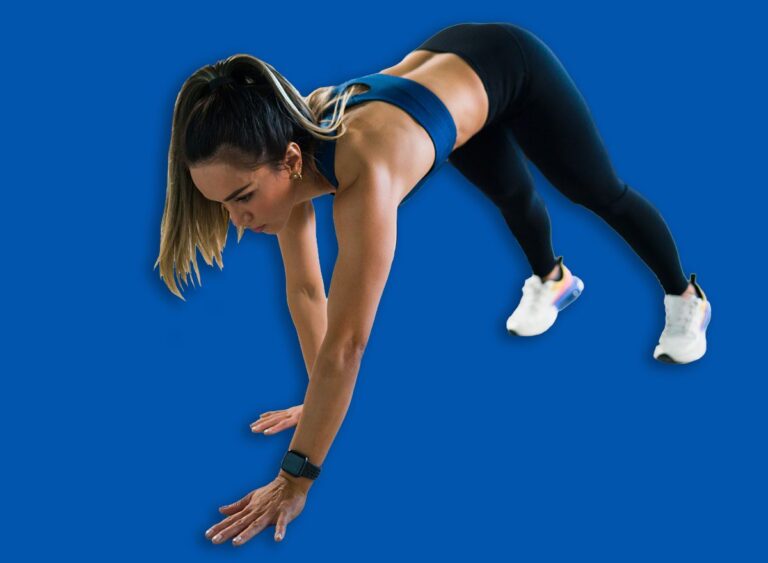
The walkout serves as a fundamental dynamic warm-up exercise. As you move downward toward the floor, articulate your spine one vertebra at a time, creating a rolling motion. On the return trip, work to get your heels down and keep your legs as straight as you can. The key is maintaining straightness in your legs as you walk your feet toward your hands.
Perform 5 to 8 reps moving forward, then 5 to 8 reps moving backward for one to two sets. To add complexity, perform the walkout and then kick one leg through your body while simultaneously dropping your elbow toward the floor. This variation introduces a crossover pattern that engages your core and rotation in a more demanding way. Complete 5 to 8 reps per leg when moving forward and the same number when moving backward, doing one to two sets in each direction.
Walking Archer
This exercise combines three distinct actions into each step. As you move, pull your heel toward your glute, reach your opposite arm up toward the ceiling, and lean your torso back slightly. These movements link together fluidly as you progress from one step to the next. The position challenges your balance while opening up your hip flexors, hamstrings, and shoulders simultaneously. Perform 5 to 8 reps in each direction for one to two sets.
Stepping Glute Stretch
Place one hand on your foot and the other hand gently on your knee. This position creates a glute stretch with every step you take. The gentle pressure applied by your hands encourages a deeper range while the stepping motion keeps your body dynamic rather than static.
Why Older Adults Benefit From This Approach
As you age, maintaining mobility becomes increasingly important for independence and injury prevention. Dynamic full-body exercises offer advantages over traditional static stretching for this population. Movement challenges your proprioception, your body’s awareness of its position in space, which naturally declines with age. By continuously moving through different positions and adjusting your balance, you’re actively training this critical skill. The heart rate elevation, though modest, provides cardiovascular benefit. The coordination demands help maintain the neural pathways that support balance and fall prevention.
Integrating Dynamic Stretching Into Your Warm-Up
These exercises work particularly well as part of a warm-up routine. Because you’re moving progressively through larger ranges of motion, you’re preparing your body for movement while exploring fascial patterns in a way that’s gentle on tissues that aren’t yet warmed. By the time you finish these exercises, your body has naturally increased circulation, your heart rate has risen moderately, and your nervous system has engaged with balance and coordination challenges. This places you in an ideal state to move on to your main workout or activity.
Key Safety Principles
Don’t force any of these positions. The range you have today is the right starting point. Keep all movements controlled and deliberate rather than rushing through repetitions. Allow your range to expand gradually as your body warms up across the session. If you experience sharp pain or discomfort, stop and dial back the intensity of that particular movement. Controlled, gradual progression yields better results than aggressive stretching.
Source: Eat This Not That
Frequently Asked Questions
What's the difference between these dynamic stretches and traditional static stretching?
According to Eat This Not That, dynamic full-body exercises move through larger fascial patterns that connect different areas of your body. Unlike static stretching of individual muscles, these moves challenge your balance and coordination while you move, and they elevate your heart rate slightly. They work better as a warm-up because they prepare your body progressively through larger ranges of motion.
How many sets and reps should I do of each exercise?
The walkout and walkout with leg kick each involve 5 to 8 reps forward and backward for one to two sets. The walking archer calls for 5 to 8 reps in each direction for one to two sets. For the stepping glute stretch, following the same 5 to 8 rep range maintains consistency with the other movements.
Is it important to force myself into a deeper stretch?
No. Start with the range of motion you currently have and keep all movements controlled. Allow your flexibility to gradually increase as your body warms up during the exercise session. There's no benefit to forcing positions, and doing so increases injury risk. Prioritize controlled movement over range of motion.
