
Key takeaways
- Wall exercises provide core stability training while supporting your body weight, eliminating the balance demands and fall risks of traditional floor planks for adults over 65.
- Each of the four exercises targets different aspects of core control: wall plank builds basic bracing, wall side plank strengthens obliques, shoulder taps challenge rotational stability, and marching mimics daily movement patterns.
- Training 2 to 4 days per week with focus on control and proper form rather than maximum duration or repetitions builds functional strength for everyday activities.
- Difficulty adjusts naturally by changing stance distance from the wall, allowing you to progress at a pace that matches your current fitness level.
Core stability becomes increasingly important after age 65, affecting how steadily you move, reach, and shift your weight during everyday activities. Many adults at this stage experience a decline in confidence with balance or coordination, but targeted core work can address these concerns by keeping your trunk steady while your limbs move freely.
A traditional plank trains your core to hold a single position indefinitely. In daily life, however, your core rarely operates in isolation. The moment you lift an arm, step forward, or lean to one side, your midsection must adjust to keep you upright and controlled. This is where wall exercises offer a distinct advantage over floor-based work.
Why Wall Exercises Work
Support Without Compromise
The wall provides support while still demanding core engagement, eliminating the safety concerns that come with lying on the floor or balancing on hands and feet. Because the wall supports your upper body weight, you can focus entirely on bracing and control without worrying about falling or injury.
Adjustable Difficulty
The difficulty adjusts naturally by changing your stance: moving closer to the wall makes exercises easier, while stepping farther away increases the challenge. This built-in scalability means you can progress at a pace that matches your current fitness level, adding distance or duration only when the current progression feels manageable. Staying upright also makes the exercises feel more connected to how you move during the day, since your core works to stabilize your trunk while standing rather than prone.
The Foundation: Wall Plank
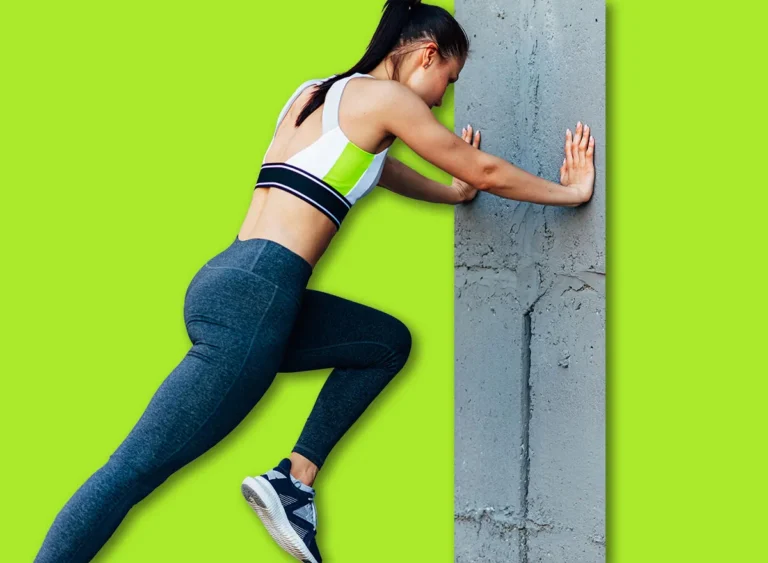
The wall plank teaches core bracing from an upright position. Stand facing the wall, place your hands on it at shoulder height, and lean forward until your body forms a straight line from head to heels. Your core’s job is to prevent your hips from dipping or your ribs from flaring away from your spine, keeping everything aligned vertically.
According to Eat This Not That, this exercise works as your starting point because it removes complexity. You learn what proper bracing feels like without the balance demands of a floor plank or the concerns about your safety on the ground. Once this sensation becomes familiar, the variations and more challenging progressions become far easier to control.
Perform 2 to 3 holds of 20 to 40 seconds with 30 to 45 seconds of rest between holds. A key form tip: keep your ribs stacked directly over your hips throughout the hold, maintaining that neutral spine position. As you adapt, progress using a higher wall plank (moving to an elevated surface), forearm wall plank (shifting weight to your forearms), or longer wall plank holds (extending duration).
Building Lateral Stability: Wall Side Plank
While the front plank focuses on anterior core stability, your obliques, the muscles along the sides of your torso, require their own attention. The wall side plank builds lateral strength without asking your body to support full weight on the floor. Your core also keeps you from drifting sideways as your weight shifts, which is essential for maintaining balance during daily activities.
Stand sideways to the wall, place one forearm against it, and lean your body weight into it so you form a straight line from head to feet. Your core must prevent any sideways drift or tilting as weight flows through your obliques. The muscles along your trunk work to keep you stable even as your center of gravity changes.
Perform 2 to 3 holds of 15 to 30 seconds per side, resting for 30 seconds between sets. Maintain one straight line with your body; avoid letting your hips sag or rotate away from the wall. As you adapt to this position, progress by taking shorter hold times (moving to the easier variation), moving your feet farther from the wall (increasing difficulty), or trying a staggered-stance wall side plank where one foot steps slightly forward.
Testing Stability Through Movement: Shoulder Taps
How the Movement Works
The shoulder tap introduces controlled movement into your core routine. Begin in wall plank position, then lift one hand to tap your opposite shoulder. As your hand leaves the wall, your body weight shifts to the opposite side, and your core must prevent any torso rotation, a stronger stability challenge than a static wall plank while keeping the movement simple to perform and scale.
Performing the Exercise
Perform 2 to 3 sets of 8 to 12 taps per side, with 30 to 45 seconds of rest between sets. Keep your chest facing the wall as each hand lifts, which prevents your torso from turning and reduces core engagement. According to Eat This Not That, this positioning is essential for the exercise to work as intended.
Progress by performing slower shoulder taps (which give you more time to control movement), widening your stance, or returning to a stationary wall plank hold if the taps feel too difficult at first.
Mimicking Daily Movement: Wall March
Marching brings your core work into a movement pattern you use every single day. Stand in wall plank position and lift one foot slightly off the floor, then lower it and lift the other. Each step shifts more of your body weight onto the standing leg, forcing your trunk to stabilize as the opposite side moves. This pattern directly reflects how your core works when you walk, climb stairs, or shift your weight to reach for something.
Slowing this motion gives you more time to control weight shifts and build confidence on each leg. Perform 2 to 3 rounds of 20 to 40 seconds, resting for 30 to 45 seconds between rounds. Set each foot down under control before lifting the other, avoiding rushing or losing connection with the ground, as that defeats the purpose of the exercise.
Variations include a supported march (using light hand contact with the wall for balance), a slower march hold (exaggerating the pause at each step to strengthen control), or a hands-free march (stepping away from the wall once you feel confident).
Programming Your Routine
These four exercises work best when performed 2 to 4 days per week. The focus should be on control and precision before increasing duration or repetitions. Your goal is to help your core handle movement while you remain upright and active. The objective is not maximum output but sustainable, functional strength that carries into your daily life.
Source: Eat This Not That
Frequently Asked Questions
What makes wall exercises better than floor planks for people over 65?
Wall exercises support your body weight while still requiring core engagement, eliminating the balance demands and fall risks of floor-based planks. You can also adjust difficulty by changing your stance distance from the wall, making progression accessible at any fitness level.
How often should I do these wall exercises?
Perform these exercises 2 to 4 days per week, according to Eat This Not That. Focus on control and proper form before increasing hold times, repetitions, or difficulty.
Can I progress these exercises if they become too easy?
Yes. Each exercise includes multiple variations: the wall plank progresses to higher wall plank or forearm plank, the side plank progresses by moving farther from the wall, shoulder taps slow down or widen in stance, and marching becomes hands-free. You can also increase difficulty by extending hold times or moving farther from the wall.
