
Key takeaways
- If you master squats, push press, deadlifts, and standing toe touches at 65, you're fitter than most people in their 50s.
- Standing exercises demand more stabilization than machine workouts, making them truer tests of functional fitness used in daily life.
- Push press builds explosive power, deadlifts coordinate multiple muscle groups, and standing toe touches reveal hamstring flexibility—each testing different fitness aspects.
- Tight hamstrings cause injuries and persistent daily discomfort, making hamstring flexibility essential for quality of life at 65.
Testing your fitness at home using standing exercises might seem like an unconventional benchmark, but research backs up the approach. Competitive games and physical competition improve attention and memory, so adding a touch of personal challenge to your fitness routine has measurable cognitive benefits beyond the physical ones.
Domenic Angelino, MS, MPH, CSCS, CPT, Chief Exercise Scientist at FitCraft, has established a fitness marker worth considering: if you can master these standing exercises at 65, your fitness level exceeds that of most people in their 50s.
Why Standing Exercises Matter More Than Machine Work
The fundamental difference between standing exercises and seated machine work comes down to stabilization demands. “In the real world, nearly all physical activity requires you to heavily stabilize your body as you do it,” Angelino explains. Walking illustrates this: your lower back muscles must continuously hold your torso upright to prevent your body from collapsing forward.
Compare this to seated machines at the gym. The same muscles still work to keep your torso upright, but they don’t have to work nearly as hard. “The supports of the seat remove a lot of the demand that keeping your torso upright places on your body,” Angelino notes. This difference reveals why standing exercises are a truer test of functional fitness—they demand the full engagement your body must use in real life.
Different Exercises, Different Demands
The beauty of standing movements lies in their variety. Some exercises demand more stabilization from your lower back; others place greater demand on your abdominal muscles. “It can vary a lot, so it’s helpful to include a variety of standing exercises in your routine,” Angelino says. This variation ensures you’re building balanced strength rather than compensating with one strong area.
Explosive Power: The Push Press
The push press stands apart because of its explosive nature. Unlike slow, controlled movements, this exercise must be performed quickly—and that’s precisely what makes it valuable.
“The push press is an explosive exercise, meaning that it’s something that has to be done quickly. Explosive exercises help you build muscular power,” Angelino explains. The movement demands your upper and lower body coordinate seamlessly. Your legs drive the initial force upward, then your arms complete the press overhead. Both parts must work in synchronization.
“You also have to coordinate your upper and lower body muscles so that they work together to lift the weight both quickly and safely,” Angelino says. This coordination—moving explosively while maintaining control—builds the kind of functional power that prevents falls and helps you catch yourself if you stumble. At 65, demonstrating this capability puts you ahead of most people a decade younger.
Foundational Strength: Squats and Deadlifts
Squats and Complete Integration
The squat might appear simple, but it engages your entire body simultaneously. “Squatting like this is a great way to build functional fitness because you’re doing something with your lower body, core, and upper body at the same time,” Angelino tells us.
Your quads and glutes drive the movement, your core stabilizes your spine, and your upper back keeps your chest upright. This total-body engagement makes squats irreplaceable for functional strength. It’s also why squats are one of the first movements to decline when overall fitness drops—they demand too much coordination to fake.
Deadlifts: Orchestrating Multiple Muscle Groups
Deadlifts represent the ultimate test of muscular coordination. Multiple muscle groups must work together in a complex, choreographed pattern to generate significant force.
“Deadlifts are highly functional because they involve many muscles in your body working together in a complicated way to produce a large amount of force,” Angelino explains. The movement divides labor between two types of muscles: the movers and the stabilizers.
Your quads and glutes actively lift the weight off the ground. Meanwhile, your transverse abdominis (the deep core muscle that wraps around your midsection) and trapezius (upper back) work to keep your body stable throughout the lift. If any component fails, the lift fails—there’s no compensation possible. This is why deadlifts reveal true strength.
Mobility and Injury Prevention: Standing Toe Touches
The Hamstring Flexibility Connection
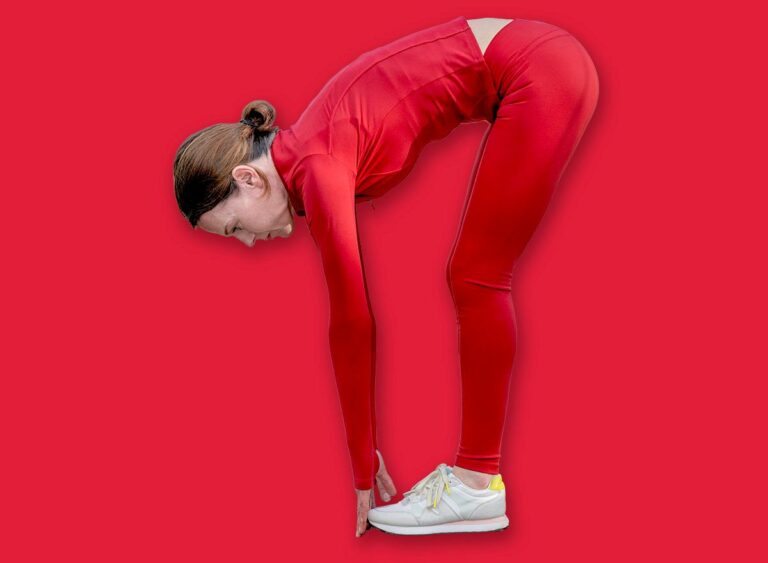
Standing toe touches test something often overlooked: hamstring flexibility. This simple movement—bending forward to touch your toes while standing—exposes a widespread vulnerability.
“Standing toe touches are useful to build into your training because they largely test your hamstring flexibility,” Angelino notes. Tight hamstrings are more than an inconvenience. They’re a common underlying cause of multiple types of injury. Someone with tight hamstrings is prone to strains, pulls, and stress fractures in the lower body.
Beyond Acute Injury
The damage from tight hamstrings extends beyond acute injuries. Many people experience persistent daily discomfort—a chronic pulling sensation in the back of the thigh, stiffness in the lower back, or difficulty standing up from a seated position. These are often symptoms of hamstring inflexibility.
At 65, maintaining hamstring flexibility isn’t about achieving a dramatic toe touch. It’s about preserving the range of motion necessary for daily life: walking comfortably, climbing stairs without pulling, and sitting without constant tension. Demonstrating this flexibility is a mark of functional health.
The Complete Fitness Picture
Together, these standing exercises—squats, push press, deadlifts, and standing toe touches—paint a comprehensive picture of functional fitness. Each tests a different facet of strength, power, mobility, and coordination.
Angelino’s benchmark is clear: if you can perform these movements with control and proper form at 65, your fitness level exceeds what most people achieve in their 50s. That’s not because 50-year-olds are necessarily lazier—it’s because most people lose strength and mobility gradually, without realizing how much until they try to do something simple and can’t.
The good news is that these movements aren’t complicated. They don’t require expensive equipment or a gym membership. What they require is consistency and proper form. Start with bodyweight versions if you need to. Focus on moving through a complete range of motion rather than handling heavy weight. Over time, as your body adapts, you can add load.
The standing exercises you choose become a mirror reflecting your true physical capacity. If you can squat without compensation, press explosively, deadlift with a neutral spine, and touch your toes—you’re maintaining the kind of fitness most people abandon as they age. That’s not average. That’s exceptional.
Frequently Asked Questions
What makes standing exercises better than machine exercises for testing fitness?
Standing exercises require your body to stabilize itself, which mimics real-world activity like walking. Machine exercises have built-in support that reduces stabilization demands, making standing movements a truer test of functional fitness.
Why is the push press considered important for fitness at 65?
The push press is explosive, requiring you to move quickly while coordinating your upper and lower body. This builds muscular power that prevents falls and helps you catch yourself if you stumble—critical skills for safety at 65.
How do tight hamstrings affect daily life beyond acute injuries?
Tight hamstrings cause persistent discomfort and limit your range of motion for everyday activities like walking, climbing stairs, and sitting. At 65, maintaining hamstring flexibility is essential for moving comfortably and preventing chronic pain.
