
Key takeaways
- Restoring walking speed requires power training focused on explosive movements, not endurance alone.
- Train three to four times weekly with two to four sets per exercise; clients report dramatic improvements in stride speed.
- Single-leg balance is the primary limiter of fast walking—train it directly with initial hand support.
- The five movements strengthen every muscle involved in walking: quads, glutes, hamstrings, calves, ankles, and hip flexors.
The Decline of Walking Speed After 65
The pace at which you can walk typically slows as you age. This isn’t an inevitable consequence of getting older, but rather a result of changes in muscle composition and power output, particularly in the lower body. Once your walking speed drops, your overall strength and mobility tend to decline alongside it, creating a downward spiral that compounds over time.
The good news is that walking speed is trainable. It requires a different approach than simply adding more steps to your daily routine. While longer walks build aerobic capacity and endurance, they do not restore the explosive power your muscles need to move quickly. If you’re over 65 and want to reclaim the walking speed you had at 40, you need targeted exercises that train your lower body to generate force rapidly.
Why Walking Speed Requires Specific Training
Walking involves a precise sequence of muscle actions. Your ankle drives you forward at the end of each step by pushing hard into the ground. Your hip extends behind you to propel your body into the next stride. Your standing leg stabilizes your entire body long enough for the other leg to swing through. These actions occur in quick succession, and they demand both strength and speed from multiple muscle groups.
To restore walking speed, you need to increase strength and control in your ankles, boost hip extension and hip flexion, and teach your muscles to apply their force quickly. Most powerful movements in the body originate from the hip, and walking is no exception. If your hip is unable to flex and extend properly, the stress transfers to your lower back instead of driving you forward. This is why power training is essential. Power exercises emphasize forceful, rapid motions performed with complete control. The five movements below target every muscle group involved in walking.
Five Exercises to Restore Speed
Chair Stand for Quad and Glute Power
The chair stand engages all the primary muscles needed for walking: your quads, glutes, hamstrings, and calves work together during this movement. Begin seated in a sturdy chair with your feet hip-width apart. Stand up with explosive force, then lower yourself back into the chair slowly and deliberately. This pattern teaches your muscles to fire quickly on the way up while building stability and control on the way down. The descending phase builds control while the ascending phase teaches your muscles to produce power rapidly. The chair also provides balance support if you need it, which allows you to perform the exercise safely without risking a fall. Keep your form crisp throughout, but prioritize exploding out of the chair with each stand.
Romanian Deadlift for Hip and Hamstring Strength
The Romanian deadlift is where most of the powerful actions in walking originate. This movement strengthens your hip extension, which is essential for driving yourself into each step. The exercise also targets your hamstrings, which play a critical role in walking quickly. When you walk at speed, your hamstrings must decelerate your body and bring each stride to a controlled stop. If your hamstrings are weak, you cannot stop safely when walking quickly, and your pace will suffer. The hamstrings provide the braking mechanism that allows fast walking without loss of control.
Marching for Hip Flexors and Cadence Control
Your hip flexors are incredibly important for the walking movement itself. Marching increases your hip range of motion and builds your ability to walk more quickly. Stand tall and drive each knee up to approximately hip height, moving with purpose and speed. Find a rhythm that feels natural, then gradually increase your speed over time. This exercise teaches proper pacing and speed control while strengthening the muscles that lift your leg. By practicing marching, you develop both the strength and the cadence sense needed for faster walking.
Single-Leg Stand for Walking Balance
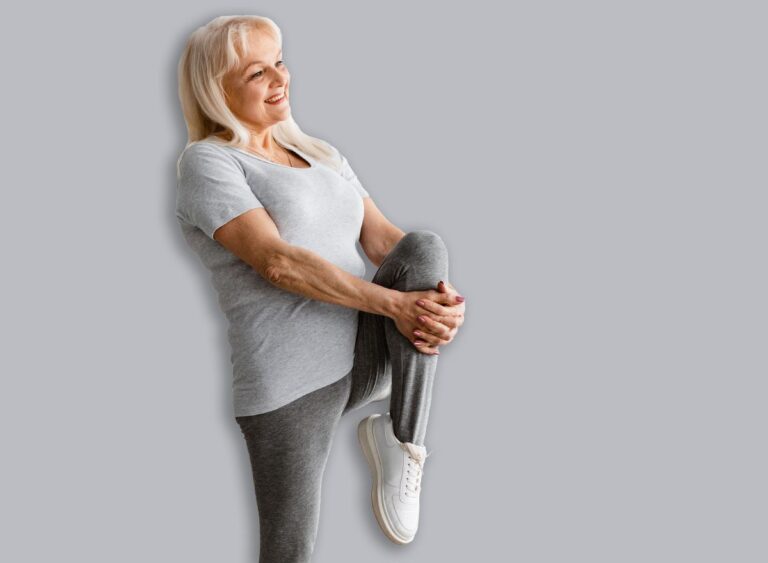
Balance on one leg is one of the primary limiting factors for walking speed in older adults. Walking is essentially a controlled fall: one leg leaves the ground while the other leg must stabilize long enough for the first leg to swing forward. If you cannot safely balance on a single leg, you will never restore your old walking speed. This skill is important enough to train directly. Start by placing one hand on a stable object like a countertop or door frame for assistance. Over time, reduce how much support you need from your hand until you can balance freely. Building this single-leg stability is non-negotiable for safe, fast walking.
Calf Raises for Push-Off Power
Your calves generate the push that drives you forward with every step. Calf and ankle strength determine your walking pace, particularly in the final push-off phase of each stride. Without calf strength, your stride length shortens and your overall walking pace drops. Stand upright and rise up on your toes as quickly as possible, then lower yourself slowly back down. Drive the force evenly through your toes, pushing through the ball of your foot rather than off to one side. Avoid letting your ankle roll inward or outward during the movement, as this reduces the effectiveness of the exercise and can stress the ankle joint.
How to Program These Movements
Train these five exercises three to four times per week for best results. Perform two to four sets of each movement per session. This frequency and volume give your muscles enough stimulus to improve without requiring recovery that extends multiple days. Clients over 65 who follow this protocol consistently have reported dramatic improvements in their stride speed.
Critical Form Points for Injury Prevention
When you perform the chair stand, make sure you are standing forcefully rather than simply moving through the motion. The explosive ascent trains your muscles to generate power quickly, which is the adaptation you need. For the Romanian deadlift and all hip-dominant movements, maintain a neutral spine and hinge from your hips rather than bending at the waist. This protects your lower back and ensures the hip extensors are doing the work rather than your spine flexors.
During calf raises, drive through your toes evenly and distribute your weight across the ball of your foot. Keep your ankle stable and avoid rotating it inward or outward. For the single-leg stand, keep your core engaged and your standing leg slightly bent rather than locked out. These small adjustments prevent injury while maximizing the training effect of each movement. The goal is not simply to perform the exercises, but to perform them in a way that trains your neuromuscular system to produce speed safely.
Frequently Asked Questions
How often should I perform these exercises?
Train these five exercises three to four times per week, performing two to four sets of each movement per session. This frequency provides adequate stimulus without requiring extended recovery.
What muscles do these exercises target?
Together, these five movements work your quads, glutes, hamstrings, calves, ankles, and hip flexors. The exercises strengthen hip extension and flexion and develop single-leg balance.
Why is the single-leg stand so important for walking speed?
Walking is essentially a controlled fall where one leg leaves the ground while the other stabilizes your body. Without the ability to balance on one leg, you cannot restore walking speed safely.
