
Key takeaways
- Walk 10 to 30 minutes daily and perform strength exercises three to five days per week to create a sustainable fat-loss routine for adults over 55.
- Squats, kettlebell swings, medicine ball slams, and cross-body marching build muscle mass while raising daily calorie burn.
- Proper form is essential: bend your knees on medicine ball slams to absorb impact, and drive kettlebell swings with your hips rather than your arms.
- Pair strength training with protein-forward meals and consistent daily movement to create the calorie deficit that produces visible changes around your waist.
Visible changes to your waist require combining regular movement with intentional eating. Exercise raises your daily calorie expenditure and builds muscle tissue that supports both strength and everyday function. Eating patterns that create a calorie deficit provide the other essential ingredient.
You don’t need a single long gym session to achieve this. Walking your neighborhood, performing squats in your living room, or using a kettlebell in your garage deliver results just as effectively and feel easier to repeat over time. The reason this matters: the easier your workouts are to start, the more likely they integrate into your regular routine and build real momentum.
When coaching adults over 55 for fat loss, the goal is a plan that builds muscle and raises daily calorie burn while feeling productive rather than punishing. This article walks you through five exercises that work together to create that effect.
Walking for Daily Calorie Burn
Walking remains one of the most reliable ways to increase daily energy expenditure without adding strain or exhaustion to your day. Unlike high-impact activities, walking pairs well with strength training and requires no special equipment or setup.
For waist-overhang goals, 10 to 30 minutes of daily walking adds up quickly in terms of calories burned. You can walk continuously for 20 or 30 minutes, or split this into shorter 10-minute blocks throughout your day—the total matters more than the format.
Keep your pace purposeful: brisk enough to raise your breathing while remaining sustainable for the full duration. Swing your arms naturally with each step to engage your upper body and chest muscles. When you want to increase effort, incorporate hills or incline walking into your route.
- Outdoor walking on different terrain
- Treadmill walking with incline adjustments
- Indoor walking routes that keep you moving regardless of weather
Building Strength in Your Lower Body
Squats for Leg and Glute Development
Squats engage your thighs and glutes—two large muscle groups that drive both strength and daily mobility. Every repetition trains these areas, and building strength here supports everything from climbing stairs to rising from a chair. Bodyweight squats require no equipment and provide a clear marker for tracking progress over weeks and months as you increase reps or sets.
The movement is straightforward: sit your hips back as though reaching for a chair behind you, keep your chest upright, then drive through your legs to stand tall. The key to consistency is keeping each repetition smooth enough to repeat multiple times in sequence without form breaking down.
Perform 2 to 3 sets of 8 to 15 repetitions.
- Chair squats if you need support
- Slow-tempo squats where you take three seconds to lower and three seconds to stand, increasing time under tension
- Squat-to-calf raises to add ankle and calf work
Cross-Body Marching for Core and Waist Engagement
Cross-body marching lifts one knee across toward the opposite side of your body while your core stabilizes and guides the motion. This exercise keeps your waist actively involved in the movement without requiring impact on your joints.
The interval format—4 to 6 rounds of 20 to 30 seconds of work followed by 30 seconds of rest—lets you raise your effort without pounding your knees or ankles. Stay tall throughout so your core stays engaged in controlling the motion. Move with steady rhythm and keep the knee drive controlled from your first repetition through your last.
- Slower-paced cross-body marching if you’re building up intensity
- Marching while holding onto a wall or chair for balance
- Marching with a lower knee height to reduce range of motion
Upper Body and Power Movements
Medicine Ball Slams for Explosive Effort
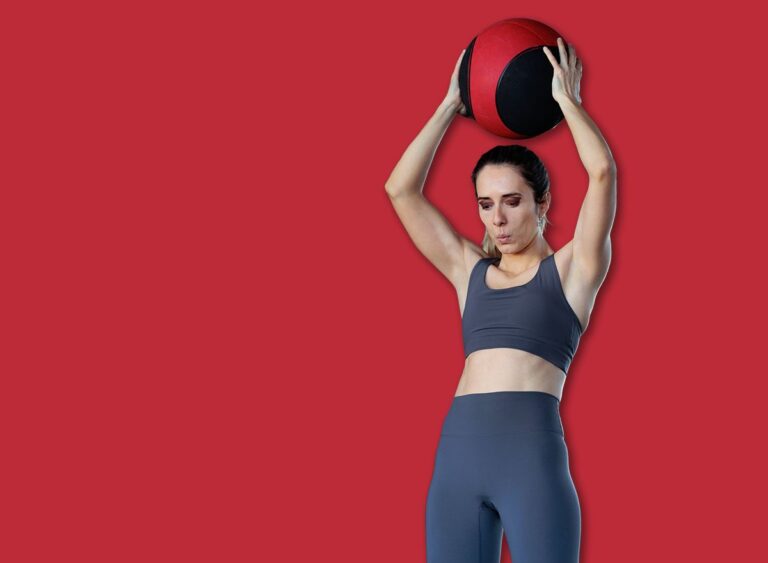
Medicine ball slams deliver a quick burst of high-intensity effort that engages both your upper and lower body. You lift the ball, brace your core to create stability through your midsection, then drive it downward with control. Your upper body initiates the movement while your legs and core contribute to the explosive power.
Start with a ball light enough that the slam feels athletic and controlled rather than sloppy or unstable. A lighter ball helps you develop proper form before adding weight. Perform 2 to 3 sets of 6 to 10 repetitions.
The form tip is important: as the ball comes down, bend your knees so your whole body helps control and absorb the impact rather than relying only on your arms. This protects your shoulders and engages your legs in the movement.
- Using a lighter ball for higher repetitions
- Slamming from chest height instead of overhead to reduce range
- Performing slower overhead slams for lower intensity versions
Kettlebell Swings for Hip-Driven Power
Kettlebell swings generate power through your hips. Your glutes and hamstrings accelerate the kettlebell forward while your core maintains tension and control throughout. This combination builds power output and raises your heart rate in a short time span—useful for burning calories and supporting cardiovascular health.
If the hip-hinge pattern is new to you, begin with kettlebell deadlifts to learn the timing and feel where the power comes from. The deadlift teaches you to hinge at your hips while keeping your chest upright. Once the pattern feels natural and consistent, progress to full swings.
Perform 2 to 3 sets of 8 to 12 repetitions, and the key cue is driving the swing with your hips instead of lifting the kettlebell with your arms. When your hips do the work, the kettlebell swings naturally and your upper body acts more as a guide.
- Lighter kettlebell swings for building movement quality
- Two-hand dumbbell swings for a similar movement pattern
- Kettlebell deadlifts for learning the hip-hinge position
Creating a Sustainable Weekly Structure
Use these five exercises three to five days per week for your structured strength training. Walk on most days of the week—ideally six or seven—to accumulate additional calorie burn and general movement.
The reason this structure works: strength training three to five days per week allows muscle recovery while walking most days adds consistent calorie burn without requiring the same recovery. Your body responds to the combination of sustained effort and recovery time.
Real progress comes from consistent execution over weeks and months rather than dramatic swings in intensity or volume. A plan you can repeat week after week outperforms programs that demand heroic effort and prove unsustainable. Consistency is the real advantage—the more predictable your routine becomes, the more likely it integrates into your life as a permanent habit.
Adding Nutrition to Support Your Training
Exercise creates the calorie deficit you need when paired with intentional eating patterns. Center your meals around protein sources to preserve muscle mass and support recovery from your training. Protein also increases satiety, meaning you feel fuller longer and naturally eat less.
Eat portions you can sustain without feeling deprived or uncomfortable in daily life. A modest, consistent calorie deficit combined with strength work and daily walking beats most trends because the plan is easier to live with long-term. You’re not fighting hunger or deprivation; you’re making small, consistent choices that add up.
Frequently Asked Questions
How often should I perform these five exercises if I'm over 55?
Use these five exercises three to five days per week for your structured strength training, and walk on most days of the week to accumulate additional calorie burn.
What should I do if the hip-hinge pattern for kettlebell swings is new to me?
Begin with kettlebell deadlifts to learn the timing and feel where the power comes from, then progress to full swings once the pattern feels natural and consistent.
How do I choose the right weight for medicine ball slams?
Start with a ball light enough that the slam feels athletic and controlled rather than sloppy or unstable; you can add weight once your form is consistent across all repetitions.
