
Key takeaways
- Underarm jiggle after 60 stems from unused triceps, which make up two-thirds of your arm muscle and rarely engage in daily movements.
- All five exercises require only body weight, light dumbbells, or water bottles and fit into a home routine.
- Expect visible firmness within three to four weeks of consistent training; form control, especially keeping your elbows tucked, prevents momentum from reducing effectiveness.
Many adults over 60 notice their arms look softer when they wave goodbye—the back of the arm continues moving for a moment after the hand stops. This softness, often called underarm jiggle, is a common change, but it is not something you must accept as inevitable. The underlying causes are well understood, and targeted exercises can lead to visible firmness within weeks.
Two factors contribute to underarm jiggle. First, skin loses elasticity with age, which no exercise fully reverses. Second, and more importantly, the muscles underneath have likely shrunk from disuse. This second cause is something you can absolutely change with consistent training.
The Triceps Hold the Key
Your triceps, the muscles running along the back of your upper arm, account for roughly two-thirds of your arm’s total muscle mass. Yet most daily activities make almost no demand on them. You pull doors, lift cups, type at a keyboard, and rarely do any of these motions require your triceps to press or extend under significant load.
When muscles go unused, they gradually shrink. That loss of muscle is the main reason for the softness people notice. Rebuilding tricep strength and size directly addresses this core problem. The good news is that triceps respond quickly to training, often showing visible firmness improvements in three to four weeks with consistent work.
Bodyweight Exercises for Tricep Toning
You do not need a gym membership or expensive equipment. All of the following exercises use only your body weight, and you can perform them in your home.
Chair Tricep Presses
This is the gentlest starting point, especially for anyone who has not trained their triceps in years. According to James Brady, CPT, a certified personal trainer at OriGym, “Pressing down through your palms to lighten your body from the seat teaches the backs of the arms to engage without asking for a full range of motion right away.”
Sit on a sturdy chair and place your hands on the seat beside your hips, fingers pointing forward. Bend your elbows to lower your body slightly, then press back up. You control how much weight you bear through your arms by how far down you lower yourself. Start with a small range of motion and increase gradually as your strength builds.
Wall Push-Ups
These deliver real resistance while keeping you safely on your feet, which is important for anyone whose balance or confidence around floor exercises is limited. Brady explains, “Wall push-ups work the chest, shoulders and triceps without requiring you to get down on the floor. Also, moving your body toward and away from the wall works the pushing muscles of the upper body as a group, and you can make it harder simply by stepping your feet farther back.”
Stand facing a wall at arm’s length. Place your palms flat on the wall at shoulder height. Bend your elbows to bring your body closer to the wall, then press back to the starting position. To increase difficulty, step your feet further from the wall, which increases the angle and the load on your triceps.
Close-Grip Wall Push-Ups
This variation progresses beyond standard wall push-ups by narrowing your hand position. Place your hands on the wall closer together than shoulder-width, then perform a push-up the same way as before. Brady notes, “Bringing your hands closer together and keeping your elbows tucked in as you bend them places extra emphasis on the backs of the arms, making this a natural progression once standard wall push-ups feel manageable.”
Dumbbell and Bottled Water Exercises
Adding light weight amplifies the challenge without requiring heavy equipment. A dumbbell or filled water bottle works equally well for these movements.
Overhead Extensions
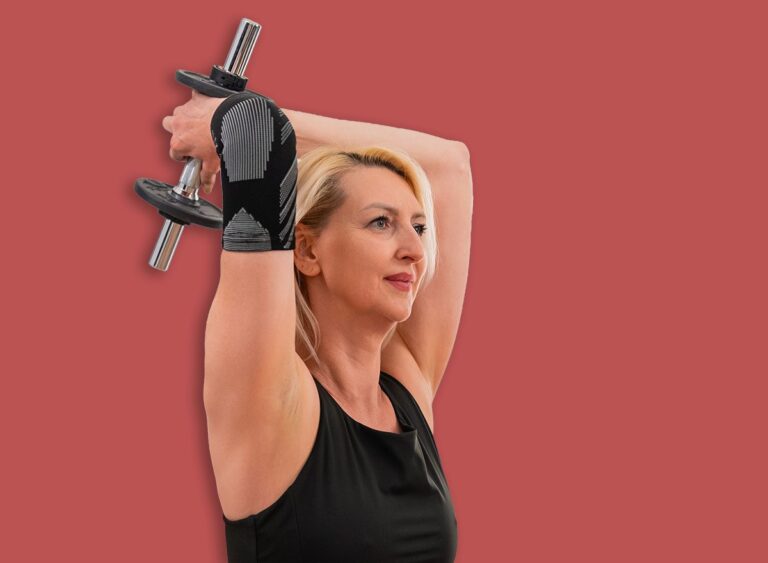
This movement isolates the triceps through a longer range of motion, which is exactly what the muscle needs to rebuild strength and firmness. Hold a light dumbbell or water bottle with both hands directly above your head. Bend your elbows to lower the weight behind your head, then straighten your arms to return to the starting position. According to Brady, “Because your arms are raised overhead, even a light dumbbell or a filled water bottle provides plenty of resistance.”
Kickbacks
Kickbacks mirror how your triceps work in real life, such as when you push a heavy door closed behind you. Hold a light dumbbell in one hand. Bend forward at the hips slightly and keep your upper arm still while you straighten your arm behind you, squeezing your tricep at the end of the movement.
Brady emphasizes, “Keeping your elbow tucked in beside your body is what keeps the tension on the target muscle rather than letting momentum take over.” Perform all repetitions on one side, then switch to the other arm.
Progressive Training and Results
You do not need to perform all five exercises in one session. Start with two or three that feel manageable and perform them three times per week. As your strength builds, gradually add more exercises to your routine.
Once an exercise feels easy, you have several ways to increase difficulty without buying equipment. Use heavier dumbbells, increase your range of motion, add more repetitions, or reduce your rest between sets. For exercises like wall push-ups, stepping your feet back is an immediate way to add load.
Consistency matters more than intensity. You can expect visible changes in firmness within three to four weeks if you train regularly. Building noticeable muscle size typically takes eight to twelve weeks, though every person’s timeline differs based on age, training history, and consistency. Stay controlled throughout each movement and keep your elbows in the correct position to prevent momentum from reducing the benefit.
Source: Eat This Not That
Frequently Asked Questions
Do I need dumbbells to do these arm exercises?
No. Chair presses and wall push-ups use only your body weight. For dumbbell exercises like overhead extensions and kickbacks, a light weight or filled water bottle works equally well.
How often should I train?
Start with three sessions per week. Choose two or three exercises per session and gradually add more as your strength increases.
How long does it take to see results?
Visible firmness changes appear within three to four weeks if you train consistently. Building noticeable muscle size typically takes eight to twelve weeks.
