
Key takeaways
- Complete 20 push-ups, 5 pull-ups, 25 squats, 20 walking lunges and 20-second single-arm planks to match fitness levels expected 10 years younger.
- Bodyweight exercises build relative strength and reveal control across pressing, pulling and lower body patterns without requiring gym equipment.
- Progression strategies for each movement, from wall push-ups to assisted pull-ups to chair-supported squats, allow you to start where you are and advance systematically.
- Struggling with one movement shows you where to focus training effort; revisiting the test after weeks reveals improvement in both numbers and how movements feel.
A single measure of strength tells you surprisingly little about how well you’re aging. One heavy lift might mask weakness in your core. A fast sprint could hide poor grip strength. But ask someone to move their own bodyweight through multiple patterns, control their trunk while doing it, and handle both upper and lower body challenges, and you get a much clearer picture of what your fitness can actually do. That’s the idea behind a fitness test from Eat This Not That, built around five bodyweight exercises that, when completed successfully after 50, suggest your fitness level matches someone a full decade younger.
Why Bodyweight Exercises Matter More After 50
Dumbbells and barbells have their place, but bodyweight movements offer something machines cannot: they demand relative strength, which is the force you can produce in relation to your own body mass. A 160-pound person doing a pull-up is moving a different load than someone weighing 210 pounds, yet both accomplish the same movement pattern. That relativity makes bodyweight training especially useful for tracking real-world capability as you age.
Bodyweight progressions also meet you where you are. You don’t start with heavy weight you might fail to lift safely; instead, you adjust the leverage. A push-up against a wall becomes a push-up from your knees, then eventually a standard floor push-up. A squat holding a chair for balance gradually becomes one without support. There’s always a next step forward, which means everyone can work toward these benchmarks regardless of starting strength.
Push-Ups: Upper Body Pressing Power
The Standard
Twenty consecutive push-ups form the first benchmark. Your chest and triceps provide the driving force, while your shoulders stabilize the movement and your core prevents your hips from sagging or your upper back from rounding. Each rep must reach at least 90 degrees at the elbow and maintain a straight line from head to heels.
Why It Matters
Push-ups demand that you move your entire body weight while keeping every rep consistent. It’s not about grinding out 20 sloppy reps; it’s about 20 reps that all look nearly identical. That consistency reveals both strength and muscular control, two qualities that protect your shoulders, elbows and wrists throughout daily life.
Getting There
Begin with your hands placed on a countertop or bench, which reduces the load your upper body must handle. As you build strength, lower the height of your hands—a sturdy chair, then a low step, then eventually the floor. The key is keeping your chest and hips moving together; if your hips drop while your chest stays high, your core isn’t staying engaged.
Pull-Ups: Pulling Strength and Grip
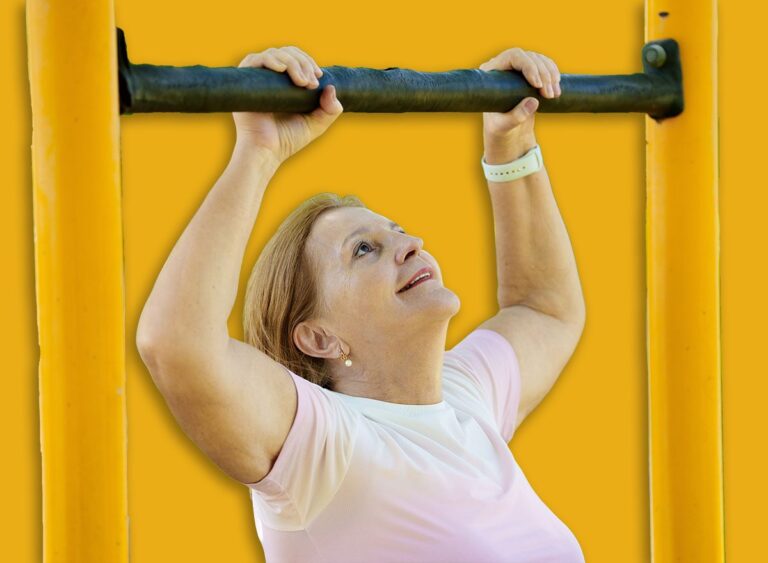
Where push-ups work the front of your body, pull-ups test your back, arms and grip in a single movement. Your hands grip the bar while your entire bodyweight travels upward, which means your upper back and biceps carry a serious load. Five clean pull-ups—with your chin clearing the bar and zero momentum from your legs—form the standard after 50.
Grip endurance plays a crucial role. You must stay connected to the bar long enough for your back and arms to do the work, and each additional rep taxes your grip further. Without sufficient grip strength, your forearms fatigue before your muscles are fully challenged.
Most people outside elite strength circles won’t start with unassisted pull-ups. An assisted pull-up machine, which counterbalances a portion of your weight, offers a realistic entry point. Alternatively, controlled negatives—jumping to the top position and slowly lowering yourself—build strength quickly. Working toward your first unassisted rep counts as meaningful progress; hitting five represents serious upper body capability.
Lower Body: Squats and the Lunge Challenge
Squats for Repetitive Strength
Twenty-five consecutive squats test whether your legs can produce force repeatedly without fatigue shortening your range of motion. Your thighs must reach at least parallel to the ground, and you must stand completely at the top of every rep. The early reps feel manageable; the later ones reveal whether your strength endures or your technique breaks down.
Muscular endurance shines here. Sure, you might squat heavier with good form for one or two reps, but 25 reps demand that your quads, hamstrings and glutes keep firing with the same depth and control when fatigue sets in. Use a chair or box as a depth target during your progression; gradually lower your target as mobility and strength improve. Keep your entire foot planted throughout each rep, never shifting weight to your toes.
Walking Lunges for Unilateral Power
After proving both legs work together in the squat, the lunge test asks each leg to shoulder more load individually. Walking lunges—20 total, which means 10 reps per leg—also challenge your ability to maintain stride length and balance as the set accumulates. Early lunges feel controlled; later ones reveal whether one leg dominates or both legs stay balanced.
Unlike split squats performed in one spot, walking lunges demand that you keep moving without letting fatigue shorten your stride. Give yourself enough distance for your front foot to plant comfortably without your knee extending past your toes. If you’re newer to lunges, start with stationary split squats in place while holding a stable surface, then progress to walking once you own the position.
The Single-Arm Plank: Core Stability Under Stress
You’ve now tested pressing, pulling, squatting and lunging. The final movement tests whether you can hold your body stable when your base of support shrinks. A single-arm plank—holding for 20 seconds on each side—requires your core to prevent your torso from rotating toward the unsupported side. That rotation is precisely what happens when you lose core control in real life, whether you’re reaching for something, turning to look over your shoulder or losing balance.
Twenty seconds can feel surprisingly long when you’re bracing correctly. Press firmly into the floor with your supporting hand, keep your weight centered, maintain level hips and hold your body in a straight line. Elevated hands on a bench make this easier; working down to the floor tests progressively more control. Shorter holds also offer a stepping stone—try 10 seconds per side first, building to 20.
What These Standards Really Tell You
Completing all five tests shows you’ve built relative strength across pressing, pulling and lower body patterns while maintaining trunk control throughout. That combination reflects genuine fitness, not just the ability to lift heavy weight in one lift. Your fitness hasn’t aged in a decade if you hit every standard after 50.
Just as important is where the test gets difficult. If push-ups come easily while pull-ups demand serious effort, you know your pulling strength needs work. If your squats feel strong but your single-arm plank reveals poor core control, that’s your training direction for the next weeks. The test becomes a map, not just a score.
Building Your Training Plan
You don’t need to hit all five standards in a single workout. Instead, include these exercises in a regular full-body routine two or three times per week. That frequency gives you multiple chances to improve the movements while allowing your body sufficient recovery between sessions. As you strengthen, reps feel easier and form improves naturally.
Revisit the test after several weeks. You may hit a rep goal that was unreachable the first attempt, or you may simply notice an exercise feeling smoother. Progress doesn’t always require a new challenge; sometimes repeating the same five tests reveals exactly what you need to know about your improvement and where focus belongs next.
Source: Eat This Not That
Frequently Asked Questions
What does it mean if I can complete all five bodyweight tests after 50?
According to Eat This Not That, hitting all five standards suggests your fitness level matches someone a decade younger. You've demonstrated relative strength in pressing and pulling patterns, lower body capability through repeated movement, and core stability under stress.
Do I need to complete all five exercises in one workout?
No. The five tests serve as benchmarks you can include in a regular strength routine two or three times per week, which gives you multiple chances to improve each movement while allowing adequate recovery between sessions.
What should I do if I can't complete one of the standards?
Each exercise has a progression strategy. Start with wall push-ups or bench push-ups, use an assisted pull-up machine or negatives, hold a chair during squats, practice stationary lunges before walking, and elevate your hands during planks. Gradually reduce the assistance as your strength improves.
