
Key takeaways
- Standing core exercises train your midsection through movement and resistance, teaching your abs and obliques to handle the demands of everyday tasks like carrying and reaching.
- The goblet march, Pallof press, suitcase carry, and side bend require only a dumbbell and resistance band, fitting easily into any weekly routine.
- Unlike planks, these standing exercises keep your core in the upright position you spend most of your day in, making the strength gains transfer directly to real life.
The capacity to lift groceries without straining, to maintain your balance when you step off a curb, or to stay upright when you turn quickly—all depend on core strength. After 60, a stronger midsection becomes more noticeable in daily life. Your core stabilizes your spine during movement, prevents your torso from collapsing when you carry a load to one side, and gives you the control to change direction without losing your footing.
Why Standing Core Work Matters After 60
The Limitations of Floor-Based Core Work
Planks build foundational awareness of how to brace your midsection, but they work within a narrow constraint: you hold one fixed position for the entire duration. When you actually carry something or walk, your core must handle movement, external weight, and constant shifts in where your balance sits. This is where standing exercises excel.
Why Movement and Resistance Matter
According to experts who work with older adults, standing core exercises offer advantages that floor-based work cannot match. You build strength without needing to get down on the floor or use a lot of space. The difficulty is easy to adjust—you change the weight, the band tension, or the duration—and you train your core in the position you occupy for most of your day. Because the exercises involve motion and outside resistance, your abdominal and oblique muscles practice the exact tasks they handle when you’re moving through your home or yard.
Four Ways to Load Your Core
The four exercises below load your core in distinct ways. One challenges your midsection while you march in place, another teaches your torso to resist rotation, and two more give your waist muscles direct work through carrying and bending.
The Goblet March: Core Stability While Moving
Hold a dumbbell close to your chest with both hands, then march in place, lifting one knee at a time. The weight at your chest changes everything compared to bodyweight marching. Each time you lift your knee, that leg’s movement shifts your weight onto the opposite side. Your abdominal muscles have to keep your torso upright and facing forward while your legs keep alternating underneath you.
This exercise bridges the gap between isolated core work and the coordination you need when you walk. Once you master the timing, the challenge transfers directly to your everyday life.
Recommended sets and reps: Perform 2 to 3 rounds of 20 to 30 seconds, resting for 30 to 45 seconds between rounds.
Adjusting the challenge: Start with a lighter dumbbell if you’re new to the movement, or slow the pace of your marching to reduce the intensity. As your control improves, you can increase the weight or march faster.
The Pallof Press: Training Your Core to Fight Rotation
Anchor a resistance band at chest height and stand perpendicular to the anchor point, holding the band’s end with both hands. The band pulls your body toward the anchor, and your job is to keep your torso facing forward as you press your hands straight ahead. Your abdominal muscles and obliques have to resist that rotational pull with every rep.
This pattern comes up constantly in real life. You pick up a bag from the side of your body, or reach across your torso to grab something on a shelf. The Pallof press trains your core to stay stable while your arms move independently.
Recommended sets and reps: Perform 2 to 3 sets of 8 to 12 reps on each side, resting 30 to 45 seconds between sets.
Form and progression: Keep your chest facing straight ahead throughout—that’s the cue that tells you whether your obliques are doing their job. If you feel the band pulling you to rotate, you’re either using too much tension or moving too fast. Lighten the band or slow down, do a simpler variation like a Pallof hold (press once and hold for time instead of pressing repeatedly), or try the half-kneeling version if standing balance feels precarious.
The Suitcase Carry: Offset Loading for Practical Strength
Pick up a single dumbbell in one hand and walk. That’s it. The dumbbell creates an imbalance, constantly pulling your body toward the weighted side. Your waist muscles have to keep you upright and prevent you from leaning into that pull while you move forward.
It’s the simplest core exercise on this list, but also one of the most useful. Carrying something in one hand—a bag, a suitcase, groceries—is a real task you handle often. This exercise trains your core for exactly that job.
Recommended sets and reps: Perform 2 to 3 carries of 20 to 40 seconds on each side, resting 30 to 45 seconds between carries.
Building load gradually: Start with a lighter load and a shorter distance, then gradually increase the dumbbell weight or extend how long you carry. You can also perform a suitcase march instead of a walk, lifting your knees as you carry, which increases the demand on your core. If you want more volume, a farmer carry—holding a dumbbell in each hand—works your core more evenly but removes the anti-lateral bending challenge.
Side Bends: Direct Work for Your Obliques
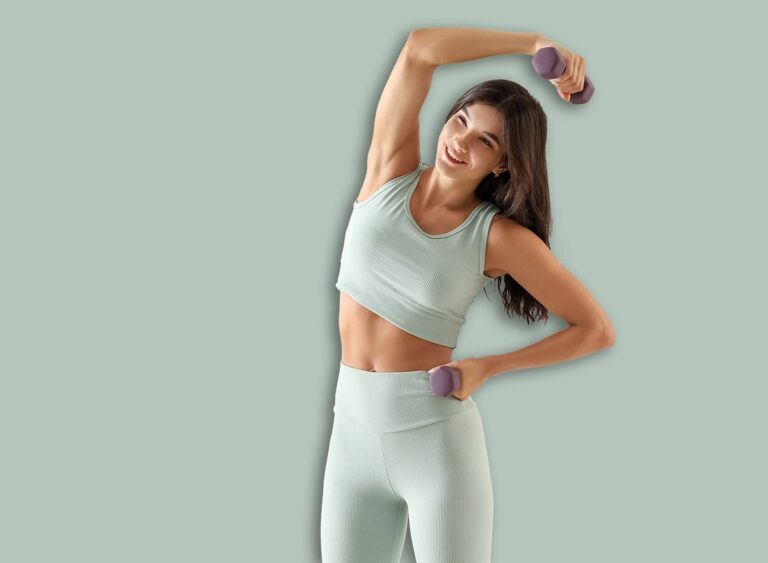
Your oblique muscles (the muscles along the sides of your waist) handle side-to-side movement during the other exercises, but side bends give them a dedicated session. Hold a dumbbell in one hand, stand upright, then bend to that side, letting the dumbbell travel downward as far as feels comfortable. Use your opposite-side obliques to pull yourself back to standing.
The key is control. Lower the weight slowly and deliberately, then use your core to bring yourself upright rather than letting gravity do most of the work.
Recommended sets and reps: Perform 2 to 3 sets of 8 to 12 reps on each side, resting 30 to 45 seconds between sets.
Modifications and variations: Keep your range of motion comfortable enough that your muscles feel in command of the movement. You can reduce intensity by using a lighter dumbbell, performing the movement without any weight, or holding a cable handle if you have access to a cable machine.
Building These Exercises Into Your Weekly Routine
Standing core work fits efficiently into a regular strength program. You don’t need much time, and you don’t need equipment beyond a dumbbell and a resistance band.
Use these four exercises 2 to 4 days per week. You can do them on dedicated core days, or add one or two of them to your strength workouts on other days. Gradually increase the challenge as your body improves—more weight, longer duration, faster tempo, or higher reps. The progression keeps your core responding to the training.
Because the exercises demand balance and control, they also give your nervous system practice with stability. That translates into fewer falls and better movement quality in your daily life.
Source: Eat This Not That
Frequently Asked Questions
Why should older adults do standing core exercises instead of planks?
Planks hold you in one fixed position, while standing core exercises add movement and resistance that your core handles during everyday life—carrying, reaching, and walking. Standing work doesn't require getting on the floor, and you adjust difficulty by changing the weight or duration.
How often should I perform this routine?
Perform these exercises 2 to 4 days per week, either on dedicated core days or mixed into your regular strength training. As your control improves, increase the challenge by adding weight, extending duration, or increasing reps.
What equipment do I need?
You need only a dumbbell and a resistance band. The band should be anchored at chest height for the Pallof press, while the dumbbell is used for the goblet march, suitcase carry, and side bends.
