
Key takeaways
- Six exercises targeting different leg movement patterns provide complete strength coverage for men over 60—from sitting and rising to climbing stairs and moving sideways.
- Each exercise has modifications and variations to match your current fitness level and joint tolerance.
- Consistency with proper form beats occasional intense sessions for building lasting leg strength and daily confidence.
Leg weakness creeps up gradually. The stairs feel more demanding. Rising from a favorite chair requires an extra moment. For men over 60, these small struggles often signal that lower-body strength has dipped below where it was, and without targeted work, the situation worsens.
The answer isn’t complicated. Six exercises can restore and maintain the leg strength you need for daily life. These moves target the patterns you actually use: bending down and standing up, stepping forward, moving your legs one at a time, hinging from the hips, shifting sideways, and driving from the floor.
You don’t have to do all six in one session. Pick three or four for a short workout, or move slowly through all six when you have more time. The goal is clean form and the ability to come back tomorrow—not exhaustion.
The Squat: Power for Sitting and Rising
Men over 60 often feel their leg strength fail first on the way down. The squat trains exactly this phase by strengthening the muscles that control the descent, then demands you return to standing under control.
Why Squats Matter for Daily Life
Every time you sit down in a chair, you squat. Every time you stand up from that chair, you squat. Stairs demand squatting strength. So do picking up objects from the floor or getting in and out of a car. Building squat strength means these everyday tasks feel easier and safer.
How to Perform Squats Safely
Keep your feet planted firmly on the ground. Stand back up with control—no bouncing out of the bottom. If regular squats put stress on your knees, use a box or bench to limit how low you go. As your joints adapt, you can reduce the height gradually.
Sets, Reps, and Variations
Perform 2 to 3 sets of 8 to 12 repetitions. If you find free squats challenging, choose one of these variations:
- Box squat—sit back to a specific height and stand up, controlling the descent
- Goblet squat—hold a weight at chest height while squatting
- Counter-supported squat—use a table or counter for light support as you squat
Single-Leg Training: Lunges and Step-ups
Walking lunges and step-ups both work one leg at a time. This reveals differences between sides—one leg may be stronger or smoother—and that information helps you train more intelligently.
Walking Lunges
In a walking lunge, your front leg catches your body weight, stabilizes, and drives you forward into the next step. Start with a comfortable stride. If the movement feels wobbly, shorten your stride until it’s stable. You’ll build strength faster with good form than with poor form at a longer stride.
Perform 2 to 3 sets of 6 to 10 reps per leg. Variations include:
- Reverse lunge—step backward instead of forward
- Supported walking lunge—hold onto a rail or counter as needed
- Bodyweight walking lunge—using only your body weight
Step-ups
A step-up mimics real life: you place one foot on a raised surface, press through that foot, and lift your body up. This is exactly what you need when stairs, curbs, and outdoor steps feel less automatic.
The most common error is pushing off the back foot instead of driving through the front leg. Choose a step height that forces your working leg to do the lifting. Perform 2 to 3 sets of 8 to 10 reps per leg. Variations include:
- Low step-up—use a shorter step to reduce difficulty
- Weighted step-up—hold dumbbells while stepping up
- Step-up with knee drive—emphasize lifting your knee high at the top
The Hip Hinge and Lateral Movement
Most leg training focuses on the thighs and glutes while ignoring the hinge pattern and sideways motion. That gap leaves your legs incomplete. The Romanian deadlift and lateral lunge fill those gaps.
Romanian Deadlift
The Romanian deadlift loads your hamstrings and glutes while you practice bending from the hips instead of from your knees. It’s among the most useful exercises for keeping the back of your legs strong.
Start light. You should feel a stretch in the hamstrings and maintain good posture throughout. Keep the weights close to your body—this helps control the hip hinge pattern. Perform 2 to 3 sets of 8 to 12 reps. Variations include:
- Bodyweight hip hinge—no weight, just body position
- Kettlebell Romanian deadlift—holding a kettlebell at chest or sides
- Kickstand Romanian deadlift—weight offset to one side for additional balance challenge
Lateral Lunge
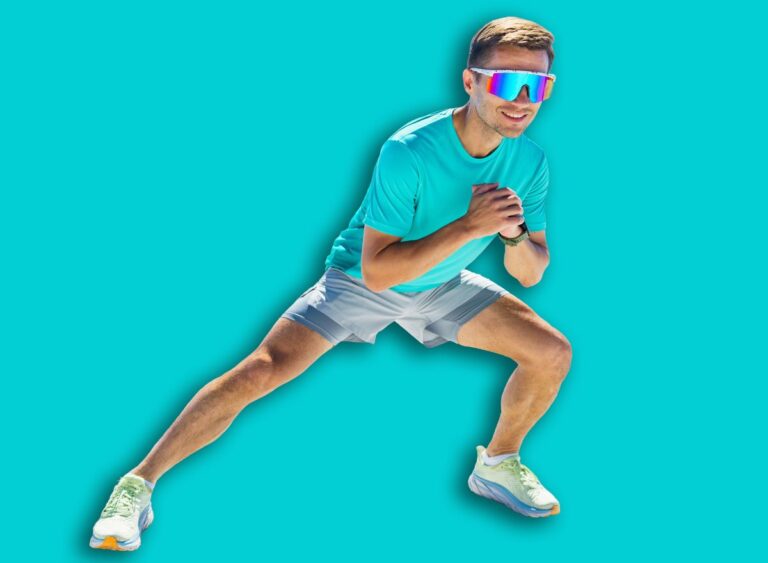
Most workouts move forward and backward. Daily life also asks you to shift sideways, reach to the side, and step left and right. The lateral lunge builds strength in those directions while improving hip and thigh control.
Start shallow. As your hips adapt, you can increase depth. Keep your chest upright and push your hips back as you bend your knee. This exercise trains your quads, glutes, inner and outer thighs, and core. Perform 2 to 3 sets of 6 to 10 reps per side. Variations include:
- Smaller-range lateral lunge—reduce depth for comfort
- Supported lateral lunge—hold onto something stable for balance
- Dumbbell lateral lunge—hold a weight at your chest for added resistance
Glute Bridge: Floor-Based Hip Strength
The glute bridge strengthens your hips while you lie on your back—a welcome break from standing work that still builds muscle. Stronger glutes improve walking, make rising from chairs easier, and give you better lower-body control overall. This exercise is especially useful for men over 60 because it builds hip strength without heavy weights or complicated setup.
Perform each rep deliberately. Squeeze your glutes hard at the top of each rep, and avoid arching your lower back. Perform 2 to 3 sets of 10 to 15 reps. Variations include:
- Glute bridge hold—pause for a few seconds at the top of each rep
- Single-leg glute bridge—lift one foot off the ground while bridging
- Weighted glute bridge—place a barbell or dumbbell across your hips
Programming and Progression
Building stronger legs demands consistency, and your program must be simple enough to repeat week after week. Rotate these exercises through your week based on how your body feels. On days when your joints feel stiff, use easier versions. When the reps feel strong and controlled, add weight or increase the range of motion.
A few clean sets done regularly produce better results than one intense session that leaves you too sore or tired to return the next day. Your goal is a sustainable plan—one you can stick with for months and years, not a short-term burst followed by nothing.
Frequently Asked Questions
Can I perform all six exercises in one workout?
Yes, you can move through all six at a lighter pace, or select three or four for a shorter session based on your time and energy.
What should I do if squats hurt my knees?
Use a box or bench to reduce how low you go, or try a counter-supported squat with hands on a stable surface for light assistance.
How many reps and sets should I perform per exercise?
Most exercises call for 2 to 3 sets of 8 to 12 reps, though step-ups are 2 to 3 sets of 8 to 10 reps per side, and glute bridges are 10 to 15 reps.
