
Key takeaways
- RKC planks deliver more core activation in 10–20 seconds of intense contraction than minutes of sloppy holds.
- Reverse crunches target your lower abs, which standard crunches leave undertrained and weaker after 50.
- The dead bug removes 100 percent of strain from your neck and lower back while building stability through opposite-limb movement.
- Bodyweight exercises demand full-body stabilization from your core, building more genuine strength than machines ever can.
Your Core Is Your Body‘s Foundation
Your core extends far beyond the six-pack muscles you see in the mirror. It encompasses your abdominal muscles, hips, pelvis, and lower back—the entire muscular structure that forms your body’s foundation. This system does critical work: it keeps you balanced when you stand and walk, protects your spine from injury during movement, and provides the force you need to run, bend, and twist through daily life. After 50, maintaining core strength becomes increasingly important because the work your core does doesn’t diminish with age. If anything, the consequences of a weak core become more apparent. Without adequate core strength, ordinary tasks become difficult, and your injury risk climbs significantly.
Why Bodyweight Training Builds More Real Strength Than Machines
Gym machines can build muscle, but they often shortcut the true work of core development—especially for adults over 50. This is where bodyweight exercises shine. Luka Hocevar, founder and co-owner of Vigor Ground Gym in Ljubljana, Slovenia, and owner of Vigor Ground Fitness and Performance in Seattle, Washington, has spent 21 years coaching people through strength training. He sees the difference constantly: machines guide your movement along a fixed path, removing the stabilization demand from your core. Bodyweight exercises demand something different. Your core must stabilize your entire body weight without any mechanical assistance. You cannot cheat the movement by relying on the machine’s rails or handles. This fundamental difference explains why bodyweight training builds more genuine strength. Your core learns to function the way your body actually moves through the world, not the way a machine constrains it to move.
The RKC Plank: Maximum Tension, Minimum Time
Walk into any gym and you will see planks being performed poorly. People hold a plank position for minutes on end, resting their body weight on their joints, doing little to actually engage their core. Hocevar calls this approach backward. “Most planks you see are done without intent, sloppy, and with it, don’t engage the core the way that would build real strength,” he explains. The RKC plank fixes this problem. Instead of passive resting, you contract your core muscles as hard as possible for just 10 to 20 seconds. This brief, intense contraction creates more genuine core activation than lengthy, mindless holds. The goal is not duration but tension—maximum muscular engagement in a short window. This efficiency matters: you build strength faster because your muscles actually work rather than simply support your body weight.
Reverse Crunches: Target Your Lower Abs
Why standard crunches fall short
Standard crunches address your upper abdominal muscles but leave your lower abs largely untrained—a significant gap in typical ab work. This matters more after 50, when weakness in your lower abs contributes to poor posture and lower back pain.
How reverse crunches solve this
The reverse crunch solves this by lifting your hips and knees toward your chest instead of pulling your head toward your toes. This motion targets the lower half of your abdominal muscles, the part that most people struggle to activate with conventional ab exercises. Reverse crunches fill that training gap and build strength where you need it most.
Side Planks Strengthen Your Obliques
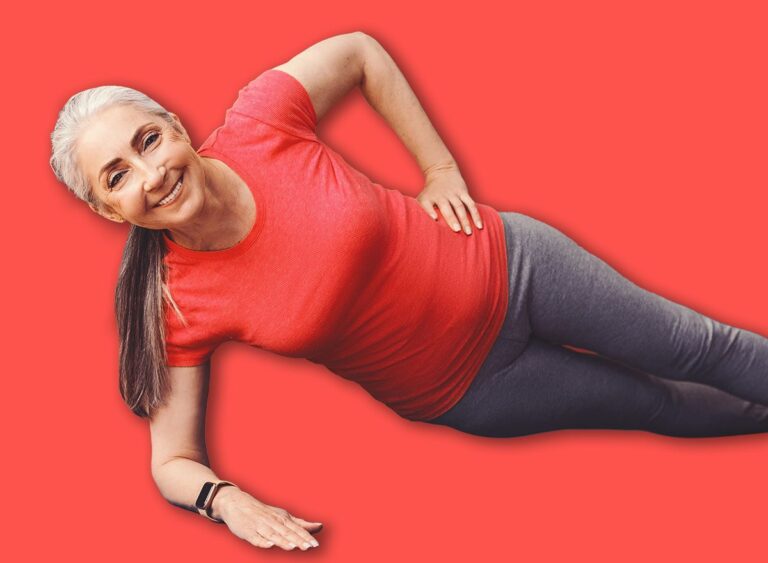
Your oblique muscles—the abs that run along the sides of your torso—seldom get adequate attention in most ab training programs, especially after age 50. Side planks correct this oversight. The movement is simple to describe: support your body on one forearm and the outer edge of one foot, keeping your torso in a straight line elevated off the floor. What makes this exercise valuable is what it actually trains. Unlike front planks, which target your anterior abdominal wall, the side plank loads your lateral core—the muscles responsible for preventing your hips from dropping and resisting side-bending movements. Hocevar emphasizes that these lateral muscles are essential for real-world stability and movement quality. “The side plank is an isometric exercise where you support your body on one forearm and the outer edge of one foot,” he notes. “Unlike standard front planks that target your front abdominal wall, the side plank challenges the lateral core on the sides of your body that resist side bending and hip dropping.”
Hollow Holds and Dead Bugs
The hollow body hold
The hollow hold draws its mechanics from gymnastics training. You lock your entire body into a slight banana shape: press your lower back flush against the floor and extend your arms and legs fully. In this position, your abdominal wall must support your entire body lever under constant tension. Hocevar describes the benefit: “By pressing your lower back flush into the floor and extending your arms and legs, you force your abdominal wall to support your entire body lever under constant tension.” This isometric hold creates one of the most demanding core positions you can perform without equipment.
The dead bug exercise
The dead bug works differently. Imagine a bird-dog upside down: your back stays flat against the floor throughout the movement while your arms and legs move independently. This design removes 100 percent of the strain from your neck and lower back, a significant safety feature after 50. Your core muscles maintain spine stability while your limbs move—specifically, opposite limbs move simultaneously. Moving your right arm while bending your left leg, for example, sharpens your brain-to-body connection. Hocevar notes that “moving opposite limbs simultaneously sharpens brain-body motor control, which is beneficial to people over 50.” This neural benefit complements the muscular work, making the dead bug a uniquely valuable exercise for older adults.
Building a Complete Core Program
These five exercises—the RKC plank, reverse crunch, side plank, hollow hold, and dead bug—form a complete system because they stress your core from different angles and using different muscle contraction patterns. Start by performing two or three of these exercises two to three times per week. Prioritize movement quality over repetition volume. The RKC plank’s intense 10- to 20-second contraction builds strength through explosive force, while the hollow hold’s extended isometric tension teaches your core to sustain force, and the dead bug develops dynamic stability as your limbs move. By rotating through all five exercises, you ensure comprehensive core training and prevent the adaptation plateau that comes from repeating identical movements indefinitely. Hocevar’s two decades of coaching experience underscores one principle: bodyweight mastery creates lasting strength that outperforms any machine-based program.
Frequently Asked Questions
Why are bodyweight core exercises better than gym machines after 50?
Gym machines guide your movement along fixed paths, reducing the stabilization work your core must do. Bodyweight exercises demand your core stabilize your entire body without mechanical assistance, building genuine strength that matches how your body actually moves through daily life.
How long should I hold an RKC plank?
Contract your core muscles as hard as possible for 10 to 20 seconds. Unlike standard planks held for minutes, the RKC plank prioritizes intense muscular engagement over duration.
What makes the dead bug exercise safe for people over 50?
Your back stays flat against the floor throughout the movement, removing 100 percent of strain from your neck and lower back while your core maintains spine stability as your arms and legs move.
