
Key takeaways
- Walking speed after 70 drops because stride length shortens, not from weak legs alone.
- Five targeted exercises train individual walking mechanics more effectively than general strengthening.
- A trial showed stepping-and-walking practice improved speed more than twice as much as standard exercise.
- The exercises target hip extension, push-off, turning, posture under load, and extended stride.
After 70, walking speed drops noticeably not because legs weaken in isolation, but because the step itself shrinks. Each foot lands closer to the other foot than it used to. The push-off through the ankle loses power. The leg does not drive as far behind the body. Fear of falling compresses the step even further. The result is a pace slower than you remember, a pace that leaves you a few steps behind family on the sidewalk.
Coaches who work with adults over 70 see this pattern consistently. The standard advice—walk more and strengthen the legs—helps, but walking more with the same shortened step keeps the step short. A different approach trains the mechanics of the step itself. According to Eat This Not That, a trial of adults averaging about 77 found that stepping-and-walking practice improved walking speed more than twice as much as standard exercise alone.
Why Your Step Gets Shorter After 70
Walking speed depends on two things: stride length and cadence. After 70, cadence—how many steps you take per minute—often stays steady, but stride length collapses. This happens because each step starts behind you. As the hip stops extending backward, the front foot lands short of where it should. The result is a shuffle, a biomechanical consequence rather than a choice.
Fear of falling compounds the problem. A shorter, wider step feels safer to an older walker, and in a way it is: the decreased distance means less time off balance. But the safety comes at the cost of speed. The ankle loses its push-off power over time. The glute does not drive the leg back with force. Over time, the shorter step becomes the default pattern, and the pace follows it down.
Stride Training vs. General Strengthening
Why Traditional Advice Falls Short
Walking more and building leg strength are not wrong, but they address symptoms rather than the cause. A client who walks with a short, choppy step and does 30 minutes of regular exercise every day will still walk with a short, choppy step. The nervous system has learned the abbreviated pattern, and without specific practice, strength gains do not translate to walking speed.
What the Research Showed
Eat This Not That reviewed a trial of adults with an average age of 77 whose walking had lost its natural rhythm and cadence. The group that practiced stepping-and-walking drills—exercises designed to train one specific job in the step at a time—improved walking speed more than twice as much as the group that did standard strengthening exercises. The comparison is clear: target the step, and the speed follows.
What to Prepare Before You Start
The five exercises below each isolate and train one part of the walking cycle. You will need a resistance band, light dumbbells, two standard chairs, and a counter or rail nearby for balance on standing drills. Keep the counter accessible. If you have balance problems, a heart condition, or a recent joint replacement, check with your clinician before starting any of these drills.
Driving the Leg Back: Hip Extension Work
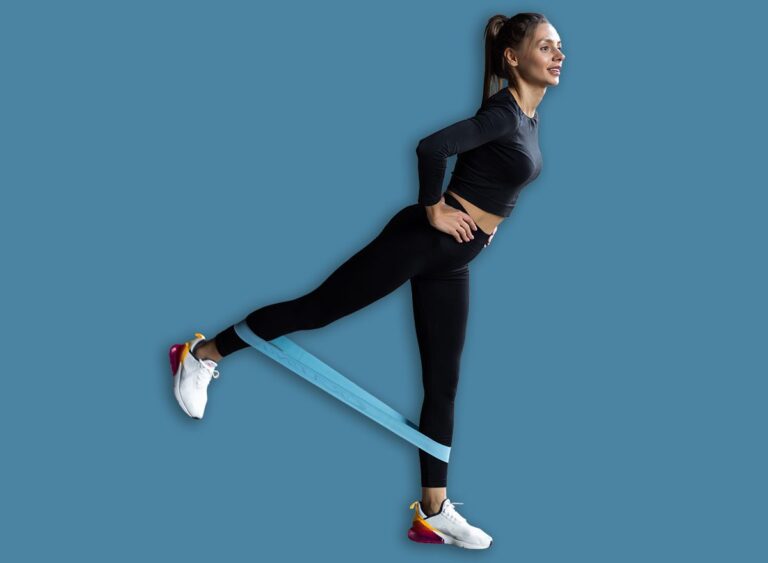
A longer step starts behind you. If the hip does not extend—if it does not drive the leg back forcefully—the front foot lands short of where it needs to land. This is why this drill works with resistance. It teaches the glutes to work against the band’s pull, the way they need to work during a real walking stride.
Loop a resistance band around your ankles and hold the counter for balance. Stand tall and squeeze the glute. Drive one heel straight back with a quick, deliberate push, keeping your hips square and your lower back still. Return slowly against the band’s resistance. Do not let the band snap your foot back. That drive backward—the extension—is where a longer step comes from. The power is in the backward motion, not in the return. Alternate legs and repeat.
Pushing Off to Launch Your Stride
Every step launches from the back foot. Many older walkers lose push-off power because they have never practiced it under load and in motion. Strengthening the calf muscle alone does not solve it. This drill trains the push-off inside a real walking motion, the way it actually works on the street.
Stand with one foot back and one hand on the counter for support. Shift your weight forward and let the back heel rise naturally as your weight moves. Press through the big toe of the back foot until that foot drives your body forward. Let the back leg swing through into a full step. The push should move you forward, not up. Repeat, then switch sides. The goal is forward momentum that covers ground, not vertical height that wastes energy.
Turning and Navigating at Speed
Real walking means weaving down a crowded store aisle, stepping around a curb, or turning through a doorway. Fearful walkers take shorter, wider steps through turns, and that loss of stride rhythm carries over to the straightaway. This drill trains you to keep your step full through a turn, so your pace does not drop when the path bends.
Set two chairs about six feet apart. Walk a figure-8 pattern around them at a brisk but steady pace, keeping your eyes up and your steps full through each curve. Switch directions after a few laps so both sides of your body learn the turn. Smooth turns keep your speed from leaking away as you navigate the real environments where you actually walk.
Carrying Load While Staying Tall
Carrying groceries from the car makes it easy to hunch forward, and the step turns short and choppy as your trunk flexes to balance the load. Your stride follows your posture. The farmer’s carry trains walking tall under load so you can keep your trunk upright and your step length solid even when you are holding something heavy.
Hold a light dumbbell at each side and stand tall. Walk the hallway with full, even steps, shoulders down and back. Do not let the weights pull you forward into a shuffle. The goal is to walk at normal speed while carrying the dumbbells, maintaining posture throughout. This strengthens the pattern of walking with a load without sacrificing stride length or speed.
Extending Your Stride in a Real Walk
The final drill ties the other exercises together by lengthening the step itself. The hip drive from the band work and the push-off from the staggered weight-shift drill both show up here, inside a real walk. That practice carries over when you need to clear the crosswalk before the signal runs out, or keep up on a family outing.
Walk at a brisk pace and reach each step slightly farther than feels normal. Push off from the back foot, let the hip extend behind you, and keep your trunk upright. Land softly on your heel. Over time, the longer step becomes your normal step, and your walking speed returns to what it was years ago.
Source: Eat This Not That
Frequently Asked Questions
Why does walking speed decrease after age 70?
Walking speed drops because stride length shortens as the hip stops extending fully, the push-off weakens, and fear of falling compresses the step. While leg weakness plays a role, the real issue is that the nervous system has learned a shorter, shuffled step pattern.
How are these exercises different from standard leg strengthening?
These exercises train specific components of the walking step—hip extension, push-off, turning, and stride length—rather than general leg strength. According to Eat This Not That, a trial showed stepping-and-walking practice improved walking speed more than twice as much as standard exercise.
What equipment do I need for these exercises?
You will need a resistance band, light dumbbells, two chairs, and a counter or rail for balance on standing drills. If you have balance problems, a heart condition, or a recent joint replacement, check with your clinician before starting.
