
Key takeaways
- Standing exercises train your core under load while keeping you upright, making them more functional than floor crunches after age 65.
- Visible abs require both muscle development and low enough body fat for definition to show through.
- Marching with weight, Pallof presses, medicine ball chops, and suitcase carries each offer different core challenges: bracing, anti-rotation, controlled rotation, and asymmetric loading.
- Perform these exercises 2 to 4 days per week with 8 to 12 repetitions per side or 20 to 40 seconds of work, adjusting variations to match your strength.
Standing exercises keep your core under load while you move, which works your abs differently than floor crunches do. After 65, this approach builds a stronger midsection while keeping you upright and functional. Marching with added weight, Pallof presses, medicine ball chops, and suitcase carries train your core through resistance and movement patterns that challenge your muscles in multiple planes.
But visible abdominal definition comes from two sources working together: enough muscle through the midsection, and body fat low enough that definition shows through. Strength training builds the muscle. Nutrition and overall activity handle the fat side of the equation.
Why Standing Exercises Outpace Floor Crunches
Crunches isolate your abs through spinal flexion, which is the same motion repeated in one plane. Standing exercises force your core to stabilize your torso while your body moves in other ways. Some standing moves resist rotation, making your abs fight against forces trying to pull you off center. Others ask your core to brace while your legs move, or while you carry a load on one side.
This broader challenge matters because your abs do more than crunch in real life. They keep you upright when you turn, steady you while you climb stairs, and stabilize your spine when you reach overhead. Standing exercises train these real-world patterns instead of repeating a single flexion motion. For adults over 65, that means building functional strength alongside visible muscle.
The Math Behind Visible Abs
Having strong abs and having visible abs are two different outcomes. A thick, strong rectus abdominis under a thick layer of body fat stays invisible. Visibility requires both muscle development and low enough body fat that the definition shows.
Strength training builds the muscle. Three to four days per week of core work, including these standing exercises, gives your abs enough stimulus to grow. The rest of the equation lives in nutrition, daily movement, and overall energy balance. If you’re building abs while managing body composition, these standing patterns train the muscles while you handle food intake and activity separately.
Building Stability Through Marching
The Core Challenge of Marching With Load
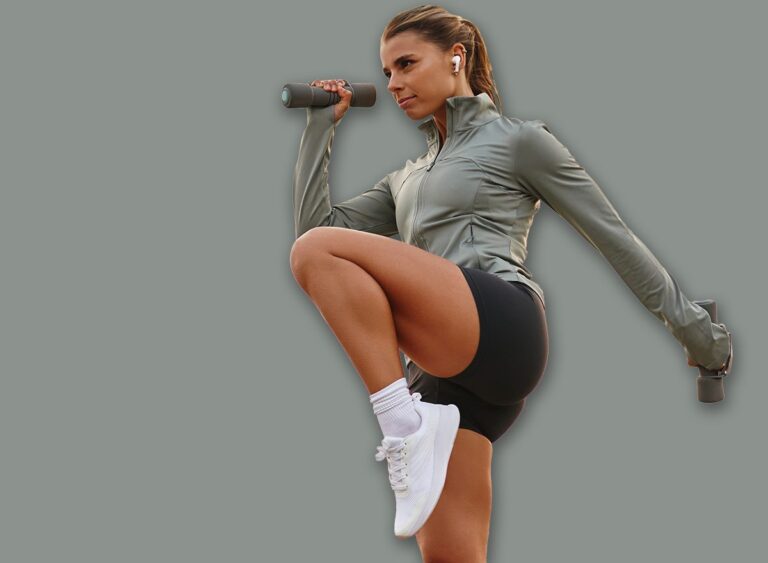
Marching with weight challenges your core in a simple way: each time one foot leaves the floor, your abs and deep stabilizers keep your torso steady while the load stays in place. This is called bracing under load. You’re not doing a motion; you’re holding still while your lower body works.
Finding Your Starting Variation
Variations let you scale the challenge. Bodyweight marching teaches the pattern without load. A goblet hold, where you hold a dumbbell or kettlebell at chest height, adds weight that pulls your posture forward, forcing your core to resist. A suitcase march loads one side, forcing your obliques to keep you square as the weight tries to lean you.
Recommended approach: perform 2 to 3 rounds of 20 to 40 seconds of marching, with 30 to 45 seconds rest between rounds. Start with the variation that feels challenging but lets you keep good posture through every repetition.
Resisting Rotation With the Pallof Press
Why Anti-Rotation Matters
The Pallof press trains anti-rotation, which is your abs’ job to keep you facing forward when something tries to spin you. Set a resistance band at chest height, anchored to one side. Stand perpendicular to the anchor, band in both hands at your chest. Press the band straight out in front of you, and the band will pull your torso toward the anchor. Your abs and obliques have to resist that pull and keep you facing the direction you started.
Variations progress the difficulty. A Pallof hold skips the press motion and holds the tension instead. A half-kneeling Pallof press removes one leg’s stability, forcing your core to work harder. A stronger-band press uses heavier resistance but the same movement.
Recommended approach: perform 2 to 3 sets of 8 to 12 repetitions per side, with 30 to 45 seconds rest between sets. The key is controlled tension, not speed.
Training Rotation Through Med Ball Chops
The Pallof press trains resistance to rotation. Med ball chops do the opposite: they train controlled rotation. Pick up a medicine ball and hold it at one shoulder, arms bent. Explosively rotate your torso and press the ball down across your body to the opposite hip, as if you’re splitting wood. Your abs and obliques work through a diagonal pattern that trains rotation strength instead of rotation resistance.
Weight matters. A light medicine ball, such as 4 to 6 pounds for adults over 65, gives you enough load to feel the work without tempting you to swing through the motion. The movement should be controlled, traveling through a range you can actually manage without jerking the ball.
Variations include bodyweight chops without a ball, lighter medicine balls for lower intensity, and slow diagonal chops that extend the time under tension. Recommended approach: perform 2 to 3 sets of 8 to 12 repetitions per side, with 30 to 45 seconds rest between sets.
The Asymmetric Challenge of Suitcase Carries
A weight held in one hand creates a constant pull toward that side. As you walk or stand, your obliques have to keep your torso upright and stop that pull from leaning you over. This creates intense core tension without complex setup or high impact on your joints. Walk with good posture, keeping your shoulders level and your spine tall from start to finish.
Load should feel challenging but not destructive. A suitcase carry might use a dumbbell, kettlebell, or even a weight plate held at your side. If the load pulls you toward it in a way you can’t resist, it’s too heavy. If it feels easy, you could probably go heavier.
Variations include lighter loads for lower intensity or slower carries that extend the work window. A suitcase march, marching while holding the load in one hand, combines this asymmetric challenge with the bracing pattern of marching. Recommended approach: perform 2 to 3 carries of 20 to 40 seconds per side, with 30 to 45 seconds rest between carries.
Programming These Exercises Into Your Routine
Training your abs hard enough to actually build them is only part of developing visible definition. These four standing exercises work best as part of a broader strength routine, performed 2 to 4 days per week.
You don’t need to do all four exercises in a single session. You might do marching and Pallof presses on one day, med ball chops and suitcase carries on another. Let the choice fit into your overall strength routine and recovery capacity. The priority is consistent stimulus over many weeks, allowing your core muscles to adapt and grow while your overall body composition shifts.
Source: Eat This Not That
Frequently Asked Questions
Why are standing exercises better than floor crunches for building visible abs after 65?
Standing exercises keep your core under load while your body moves in multiple directions, training your abs to stabilize and resist forces rather than just flexing your spine. This builds more functional strength and core stability while keeping you upright, which matters as you age.
How do I know if my core is strong enough to handle these exercises?
Start with the beginner variation of each exercise. Bodyweight marching, a light resistance band for Pallof presses, a 4-to-6-pound medicine ball for chops, and a lighter load for suitcase carries all teach good form before you add intensity. Your form should stay perfect throughout—if you're losing posture or jerking the load, scale back.
Can I do all four exercises in one workout session?
You can, but you don't need to. You might pair marching and Pallof presses on one day and med ball chops with suitcase carries on another. The key is performing these exercises 2 to 4 days per week with consistent intensity. Let your overall routine and recovery capacity guide how you organize them.
