
Key takeaways
- Hold a side plank for 30 seconds per side, perform a bird-dog for 20 seconds per side, and complete 20 controlled taps on an incline plank to test core strength from three different angles.
- Completing all three standards after 60 indicates core strength that surpasses many younger adults, focusing on functional trunk control rather than appearance.
- Each exercise has modifications: start with the version you can control with good form and progress gradually to the full standard.
- Retest every few weeks to track progress in form quality, breathing ease, and side-to-side control rather than only focusing on time improvements.
Strong core muscles mean your body can handle the daily demands most people take for granted: standing without strain, sitting up with control, shifting weight steadily, moving with confidence. After 60, this functional ability matters far more than appearance. Your trunk supports every reach, carry, and lift. When it fails, getting off the floor or recovering from a slip becomes much harder.
Core strength isn’t built through crunches alone. Your muscles need to learn how to brace and hold steady when tension is applied and when your arms or legs shift the load. Testing shows you exactly what your core can do right now, and simple, focused training can then improve whatever you find lacking.
Why Testing Matters at This Age
Knowing whether your core is strong doesn’t come from feeling tired after exercise. It comes from measuring whether specific, real-world movements are under your control.
Feedback You Can Use
A proper core test reveals whether your trunk stays stable, whether one side is significantly weaker than the other, and whether you can breathe steadily throughout the hold. You learn which angle of core strength needs more attention: side-to-side control, front-to-back stability during limb movement, or the ability to stay braced when one arm or leg leaves the surface. Without a test, you’re guessing whether work is paying off.
The Benchmark Approach
According to Eat This Not That, these three holds work without complicated equipment and without a long session. They check your core from three different angles: stability on the side, trunk control as limbs move away from the center, and resistance to rocking when a hand lifts. Complete all three, and you have a clear picture of core function. Retest every few weeks and track where you got steadier, breathed more easily, or held longer.
Progressive and Measurable
The same holds that test you can also train you. Start with whichever variation lets you keep good form, build strength and control from there, then progress to the full standard. The progression stays in your hands. You don’t need a trainer to tell you when you’re ready.
The Side Plank: Testing Side-to-Side Control
Your trunk has muscles on both sides that prevent you from folding sideways or tipping when your weight shifts. The side plank puts those muscles to work immediately.
Standard and Muscles Engaged
Hold a side plank for 30 seconds per side without dropping your hips or letting your shoulder roll forward. This works your obliques (the muscles along your ribs), deep core muscles, glutes, and shoulders. If your hips sag, your side is telling you it ran out of tension or you’re trying too hard.
Proper Form and Setup
Press your forearm firmly into the floor and stack your ribs over your hips. Your body should form a straight line from your head to your feet or knees. The moment your hips drop below that line, the hold is no longer effective. Breathe steadily. Don’t hold your breath, which creates tension instead of control.
Scaling to Where You Are
If 30 seconds feels out of reach, drop to your knees. You’ll still work the exact same muscles; the load just decreases. Alternatively, place your forearm on a bench instead of the floor. To progress beyond the standard, hold longer, raise your top leg while keeping your hips level, or move into a full side plank using only your feet for support.
The Bird-Dog: Stability When Limbs Move
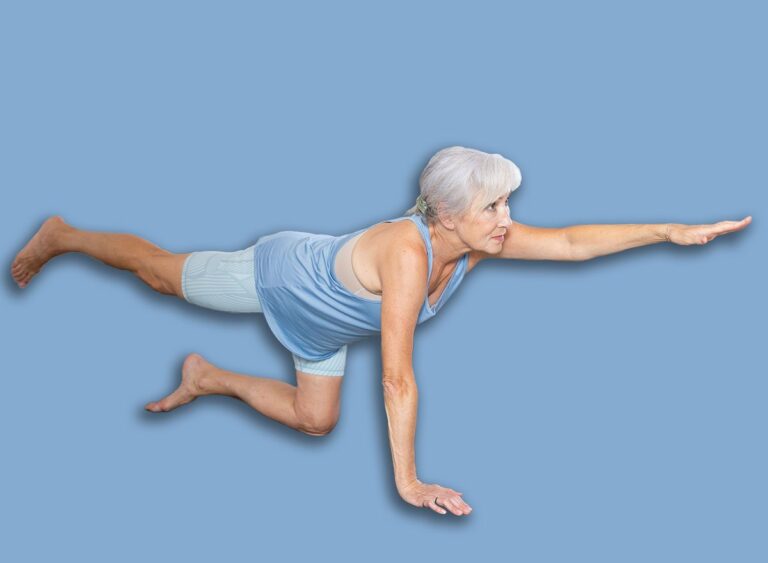
When your arm and leg reach away from your center, your trunk must stay still. If your low back arches or your hips twist, you’ve lost core control.
The Challenge Standard
Hold a bird-dog position for 20 seconds per side while your spine stays neutral and your hips remain level. Opposite arm and leg reach away from each other, creating an opposite-side reach pattern. Your abs, spinal stabilizers, glutes, and upper back all fire to keep your trunk from rocking.
Execution That Counts
Start on hands and knees. Reach your right arm forward and left leg back, extending through your hand and heel without letting your low back sag into an arch. Keep your ribs and hips stacked vertically. If your low back starts to round or your hips start to drop, you’ve hit the limit of your control. Stop the hold there and rest.
Harder Progressions
To make it harder, hold longer, move more slowly between sides, or add a light ankle weight to the moving leg. Slow movement reveals control issues you might miss during quick repetitions.
The Incline Plank With Shoulder Taps: Bracing Under Movement
Planks already challenge your front-side core. Adding shoulder taps (lifting one hand to tap the opposite shoulder) removes support from the surface periodically, forcing your core to work harder to prevent your body from rocking side to side.
Standard and Mechanics
Position yourself in a plank on an incline surface such as a countertop, with your hands about shoulder-width apart. Complete 20 controlled taps total: tap your right shoulder with your left hand, return, then tap your left shoulder with your right hand. That’s one full cycle. Keep your hips level and your body from sagging throughout.
Common Form Breaks
The moment your hips start to sway or your torso sags lower, your core has lost the ability to stay braced. Stop there and rest. It’s better to complete 15 clean taps than 20 sloppy ones where your body is moving around.
Progression Strategy
Start on an incline. A countertop works well. Inclines reduce the load and let your core stay stable during the taps. Progress to the floor once the higher surface feels solid. Slow each tap down for added difficulty without changing the position. As you get stronger, widen your feet slightly at first for more control, then bring them closer together. Movement quality counts more than speed.
Interpreting Your Results
Completing all three standards signals that your core has real strength and control. Your abs can brace. Your trunk can stay stable when limbs move. Your body can resist rocking when one hand leaves the ground.
Where You’re Strong, Where You’re Not
If one hold is much harder than the others, that’s useful data, not a failure. A weak side plank means your obliques or hip stability need work. Difficulty with the bird-dog suggests your spinal stabilizers or single-side control need training. Trouble with the shoulder taps indicates that dynamic movement on top of a brace is where your control fades. Each weakness points to exactly what to train.
Building a Baseline and Retesting
The first time you perform these holds, you’re establishing a baseline. Retest every few weeks. Look for cleaner form, steadier breathing without strain, and better side-to-side control. You don’t need the times to get longer. Sometimes the time stays the same while the breathing gets easier or the form stops breaking down. That’s progress.
Beyond Just Completing
Finishing this test after 60 puts your core strength in a standout place relative to your age group. But completion is the beginning, not the end. Use the three holds as both a test and a training tool. Train the version you can control, then progress when the form tightens up.
The Practical Payoff
Strong core control means you move better, trust your body more, and handle unexpected shifts in weight or balance without fear. You can sit up off the floor without using your hands, carry groceries without bracing your ribs, and bend to pick up dropped items with ease. The strength you build isn’t decorative. It’s the foundation for independence and confidence in daily life.
Source: Eat This Not That
Frequently Asked Questions
How long should I hold each core position?
Hold side planks for 30 seconds per side, bird-dogs for 20 seconds per side, and complete 20 controlled taps on the incline plank. Start with modifications if you can't maintain good form for the full duration.
What does it mean if one hold is much harder than the others?
It tells you which part of your core needs focused training. Weak side planks indicate your obliques or hip stability need work. Difficulty with bird-dogs suggests spinal stabilizers need training. Trouble with shoulder taps means dynamic movement on top of a brace is where control fades.
Can I use easier versions of these exercises?
Yes. For side planks, drop to your knees or place your forearm on a bench. For incline planks with shoulder taps, start on a higher surface like a countertop. These modifications still build productive strength as you work toward the full standard.
