
Key takeaways
- Stairs offer built-in support that makes knee-strengthening safer and more scalable than lunges, eliminating balance anxiety for adults over 60.
- Six specific exercises—from seated leg extensions to supported step-downs—provide exact sets, reps, and form cues for controlled strength building.
- Perform two to three times per week using the stair rail for balance and letting each session build confidence on stairs.
- Proper form and controlled movement matter more than depth or speed, so start with low steps and adjust the range to your current ability.
Knee strength is the foundation of independence after 60. Walking upstairs without hesitation, standing up from a chair, and descending from a curb—all these daily tasks depend on knees that have the support and stability they need. While lunges are often recommended for knee work, they require immediate control and balance that many people over 60 find difficult to manage. Stairs, on the other hand, offer a built-in advantage: solid support is already there.
The rail at your hand, the step beneath your foot, and the structured range of motion create an environment where your knees can grow stronger without triggering the instability that makes lunges feel risky. This routine of six stair-based exercises is designed specifically for rebuilding knee strength with confidence, not just raw power.
Why Stairs Outperform Lunges for Rebuilding Knee Strength
Lunges demand a lot from your nervous system right away. The dynamic shifting of weight, the balance point, and the depth of the movement all happen without much external support. For people over 60, this can feel unsafe—and if an exercise doesn’t feel safe, you’re unlikely to do enough reps to build real strength.
Built-in Support Eliminates Balance Anxiety
Stairs have the rail. That single element changes everything. Your hand can rest lightly on the rail as your legs do the actual work, keeping you grounded and confident through every rep. This stability allows your muscles to focus on strengthening rather than catching you off-balance. You can practice stronger positions and move through a fuller range of motion because you know the support is right there.
Scalable Challenge Without Rushing Through Movement
With lunges, you either do the full lunge or you modify it significantly—there’s not much middle ground. Stairs let you adjust difficulty in dozens of small ways. You can use a lower step, shorten the range of motion, hold a position longer, or work one leg at a time while keeping the other hand close to the rail. You scale the challenge to exactly where you are right now, then progress gradually.
This flexibility means you’ll use proper form from the first rep through the last, rather than rushing through reps to compensate for fear.
How Stair Exercises Train the Entire Leg Structure
Knee strength doesn’t come from the knee alone. The thigh, hip, hamstrings, and calf all influence how the knee functions when you walk, climb stairs, stand from sitting, and lower yourself down. A complete stair routine works all of these muscle groups together, so the knee gets support and stability from every direction.
The Six Stair Exercises for Knee Strength
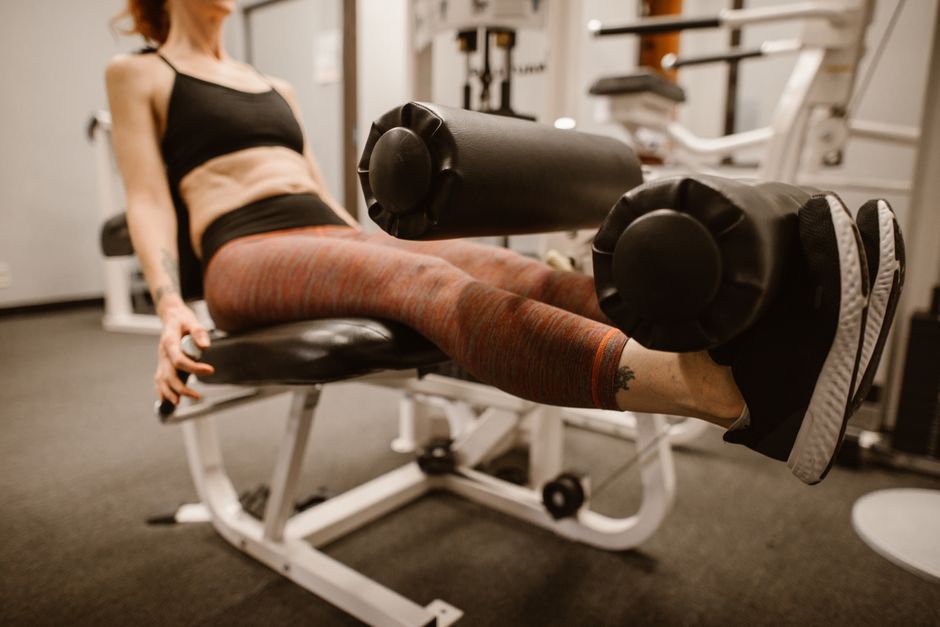
Seated Leg Extensions: Quadriceps Foundation
Sit tall with your back against a support. Straighten one leg slowly, pushing through the quadriceps muscle above the knee, and hold briefly at the top so the thigh has time to fully engage. Lower with control and repeat.
- Sets and Reps: 3 sets of 10 to 12 reps per side, with 30 to 45 seconds of rest between sets.
- Variations: Alternate legs with each rep, add a pause at the top of the straightened position, or slow down the tempo of the lift and lower.
- Form tip: Keep your upper body still so your thigh controls the entire lift—don’t lean back or swing the leg up.
Box Squats: Thigh and Hip Strength With a Safety Net
Stand in front of a step or low box with the stair rail nearby for light support. Lower yourself by sitting back with control, lightly touching the step or box, then stand tall by pressing through your heels. Avoid collapsing into the bottom position—control the lowering and the rising equally.
- Sets and Reps: 3 sets of 8 to 12 reps, with 45 to 60 seconds of rest between sets.
- Variations: Use a higher box, add a pause at the bottom, or slow down each rep.
- Form tip: The rail is there for balance support—use it lightly so your legs still do the work.
Split-Squat Isometric Holds: Static Strength for the Quad
Step one foot forward onto a low step, keeping the rear foot on the ground behind you. Lower into a lunge position and hold that position steady. Rather than moving up and down, you’re simply maintaining tension in the quadriceps, glutes, and hips while the stair rail keeps you steady.
This exercise bridges the gap between basic squats and the more demanding single-leg movements. Holding without moving also builds stability in the muscles around the knee.
- Sets and Reps: 3 sets of 15 to 30-second holds per side, with 45 to 60 seconds of rest between sets.
- Variations: Use a higher step, shorten the hold duration, or slow down the transitions into and out of the hold.
- Form tip: Your front knee should track in the same direction as your toes—don’t let it cave inward.
Extended-Leg Glute Bridge: Strengthen the Back Chain
Lie on your back with your knees bent and one heel resting on a low step. Lift your hips upward by pressing through the heel, creating a straight line from knee to shoulder. The glutes and hamstrings should initiate the lift, not your lower back. Move slowly and keep the lift small and controlled.
- Sets and Reps: 3 sets of 8 to 10 reps per side, with 45 seconds of rest between sets.
- Variations: Perform a standard glute bridge with both feet on the ground, add a hold at the top, or increase the tempo.
- Form tip: Focus on lifting from the hip and glute, not arching your lower back. The movement comes from the posterior chain.
Low Box Step-Ups: Functional Stair Climbing
This exercise mirrors the exact movement pattern you use when climbing stairs every day. Stand facing a low step, place one foot on the step, press through that leg, extend your knee, and bring your body up and over the step. The leg on the step does the majority of the work—avoid pushing hard from the floor. Use the rail and keep the movement controlled and repeatable.
- Sets and Reps: 3 sets of 8 to 10 reps per side, with 45 to 60 seconds of rest between sets.
- Variations: Use a rail for additional support, lower the step height, or slow down each repetition.
- Form tip: Let the leg on the step do the lifting work; avoid pushing off the ground to make the movement easier.
Supported Low Step-Downs: Control on the Descent
Step-downs train the most important part of stair safety: how to lower yourself with control. Many knee injuries and falls happen on the way down, not up. Stand on a low step facing the stair rail. Lower one leg to the ground with control, allowing the back leg to bend slightly. The working leg must stay stable and prevent your knee from collapsing inward.
Start with a very small range and use the rail as much as you need. This is the movement pattern you use when stepping off a curb or descending stairs.
- Sets and Reps: 2 to 3 sets of 6 to 8 reps per side, with 45 to 60 seconds of rest between sets.
- Variations: Use an even smaller range of motion, hold onto the rail more, or slow down the descent.
- Form tip: Lower slowly and stop the rep before your knee starts to cave inward—control is the goal, not depth.
Programming and Safety for Best Results
Perform this routine two to three times per week, allowing at least one day of rest between sessions. The rail should stay close at all times—it’s there for balance support, which helps your muscles focus on building strength.
You can run these six exercises as a circuit, moving from one to the next, or complete all sets of one exercise before moving on. Either approach works well. The key is moving slowly, respecting your current range of motion, and letting each session build your confidence on the stairs.
Keep the reps smooth and controlled. If a movement doesn’t feel stable or strong, use a lower step, a shorter range, or hold the rail with more pressure. Strength comes from repetition with good form, not from rushing through a larger range of motion.
Frequently Asked Questions
Why are stairs better than lunges for knee strength after 60?
Stairs offer built-in support from the rail, which eliminates balance anxiety and allows you to focus on strength-building. Lunges require immediate control and balance, which many people over 60 find risky. Stairs also let you scale difficulty by using a lower step, shortening the range, holding positions longer, or working one leg at a time.
How many times per week should I perform these exercises?
Perform this routine two to three times per week, allowing at least one day of rest between sessions. Use the stair rail for light support, move slowly, and choose a range that feels steady from your first rep through your last.
What muscles do these six exercises train?
Together, these six exercises train the quadriceps, glutes, hamstrings, calves, and core. The full-chain approach ensures the knee gets support and stability from multiple directions, not just from the knee joint itself.
