
Key takeaways
- Completing 12 sit-to-stands in 30 seconds—roughly one every 2.5 seconds—indicates elite leg strength and endurance for adults over 60.
- The test reveals not just your strength level but also where you fatigue, muscular imbalances, and postural issues that need correction.
- After age 40, natural muscle loss accelerates, making sit-to-stand strength critical for maintaining independence, preventing falls, and managing daily activities.
- If you can't reach 12 reps yet, consistent practice with proper form and a controlled 2-3 second descent builds strength faster than expected.
The sit-to-stand represents one of the most straightforward yet revealing fitness tests available for adults over 60. Unlike exercises requiring specialized equipment or extreme flexibility, this movement mirrors something you perform multiple times each day—transitioning from sitting to standing. A single 30-second window can tell you whether your leg strength and muscular endurance meet the thresholds needed to stay independent, avoid falls, and move freely through daily life.
What the Sit-to-Stand Test Actually Measures
The sit-to-stand is far more than a leg exercise dressed up as a test. It assesses whether your body can perform the precise series of muscle contractions and coordinations that power one of your most essential movements.
The mechanics of standing and sitting
Rising from a seated position requires coordinated engagement across multiple muscle groups: your quadriceps must straighten your legs, your glutes must push your hips forward and up, your core must stabilize your torso as you move, and your ankles and feet must maintain balance throughout. Lowering back down with control demands the same muscles working in reverse, with enough stability that you don’t collapse onto the chair. This isn’t an isolated exercise—it’s a whole-body movement that determines whether you can manage stairs, get out of a car, or rise from a table without assistance.
Why the time component matters
The 30-second window is what transforms a simple movement into a meaningful test. You could technically complete 12 sit-to-stands over the course of an hour. The real measure of strength and muscular endurance is whether you can execute 12 clean repetitions at a pace of roughly one every two and a half seconds—all within those 30 seconds, with no hand assistance. Completing 12 reps in 30 seconds demands both the raw strength to lift your body weight and the stamina to sustain that effort without fatigue forcing your form to collapse.
The Elite Benchmark: 12 Reps in 30 Seconds
Reaching the benchmark of 12 sit-to-stands completed in 30 seconds, without using your hands for assistance, indicates you’ve achieved an elite level of leg strength and endurance for someone over 60.
What 12 reps signifies
Completing 12 repetitions at this pace means your legs generate enough force to repeatedly lift your full body weight from a seated position and lower it back down with control. This isn’t merely a number on a test—it correlates directly with your capacity to handle the physical demands of aging. Research has demonstrated that performing the sit-to-stand at this level tracks closely with independence in daily activities and a reduced risk of falling.
The time pressure as differentiator
The challenge isn’t reaching 12 reps eventually; it’s maintaining the pace throughout. The time limit introduces a level of intensity that forces your muscles to work continuously without rest. This mirrors real-world situations more accurately than slow, controlled reps in a gym. When you need to stand quickly to catch yourself if you slip, or move swiftly to respond to an unexpected obstacle, that speed matters. The 30-second window reveals whether your legs have both the strength and the endurance to handle demands without fatigue forcing compromises in your movement quality.
Performing the Test with Proper Form
The setup is deliberately minimal, but correct positioning determines whether you’re testing your strength or your momentum.
Choosing your chair and starting position
Select a sturdy chair that will support your full body weight without shifting or tilting. Sit on the front edge of the seat rather than settling back into it—this ensures you’re generating force from your legs rather than relying on leverage. Both feet should rest flat on the floor, shoulder-width apart, giving your ankles a stable base. Before you begin, cross your arms over your chest. This prevents using your arm strength or momentum to push yourself up, which would invalidate the test as a measure of leg strength.
The movement itself
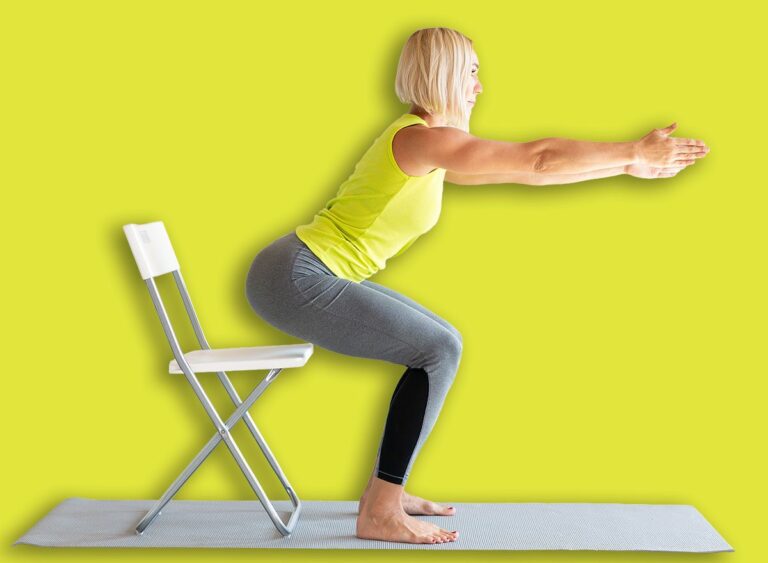
When your timer starts, press firmly through your feet and stand up until your legs are fully extended. Each repetition should be a complete stand from seated to standing. Then lower yourself back down with control. The lowering phase shouldn’t be a collapse or a drop. Aim to take two to three seconds on the descent, allowing your muscles to work through the entire range of motion and maximizing the benefit of each rep. Once you’ve lowered, immediately begin the next repetition. Continue this cycle for the entire 30 seconds without pausing.
Which Muscles Drive Your Performance
Your quadriceps handle the job of straightening your legs, driving your body upward from the seated position. Your glutes extend your hips, providing the power that allows you to stand fully upright. Your core muscles stabilize your torso throughout the movement, preventing your spine from collapsing forward or bending excessively during the transition. Your ankles and feet constantly adjust to maintain your balance, especially during the moment when you’re transitioning from seated to fully standing. All of these muscles must coordinate smoothly and fire with adequate force. If any one of them is weak or fatigues rapidly, your movement quality degrades and your rep count suffers.
What Your Score Reveals Beyond the Number
The sit-to-stand test is simultaneously a strength benchmark and a diagnostic tool. The number of reps you complete tells you where you stand in absolute terms, but how you reach that number—or where you fall short—reveals specific weaknesses worth addressing.
Fatigue patterns as a diagnostic
The first few repetitions usually come easily. If they don’t, you have a baseline strength deficit that needs attention. If the reps feel strong initially but your form begins breaking down halfway through, you’re dealing with an endurance problem—your muscles can generate force, but they tire quickly. These are different issues requiring different solutions. An endurance gap might improve with higher-rep training, while a strength deficit demands heavier or more intense loading.
Form deviations signal imbalances
As fatigue accumulates over those 30 seconds, any muscular imbalances or postural issues become visible. You might notice your weight shifting more onto one side, indicating that one leg is stronger than the other. Your torso might angle forward more than it did on earlier reps, suggesting your core is fatiguing. Your knees might cave inward instead of tracking over your toes. These aren’t just cosmetic form issues—they point to specific areas of weakness or instability that, if left unaddressed, increase your injury risk.
Why Leg Strength Matters Increasingly After 60
The sit-to-stand test exists because researchers have consistently found that the ability to perform this movement predicts real outcomes in older adults’ lives.
The connection to fall prevention and independence
The capacity to stand from a seated position without using your hands, at a brisk pace and without losing your balance, directly reduces your fall risk. When you do stumble or slip, strong legs allow your muscles to react quickly and adapt, helping you regain your footing rather than going down. A person who can perform 12 sit-to-stands in 30 seconds has demonstrated they can manage stairs, get up from a table at a restaurant, rise from a car seat, and respond to unexpected physical challenges.
Sarcopenia and age-related muscle loss
Starting around age 40, your body begins losing muscle mass—a process called sarcopenia. This loss accelerates as you move past 60, making strength maintenance increasingly important. The stronger your legs remain, the more resilient you are to this natural decline. Sitting and standing is a skill your body must perform every single day. Dedicating effort to maintaining and building your sit-to-stand strength directly improves your quality of life and your capacity to remain independent as you age.
Building Your Way to 12 Reps
If you can’t yet complete 12 sit-to-stands in 30 seconds, that’s not a reason to abandon the movement—it’s a starting point.
Building the base if you’re starting from fewer reps
Begin by practicing the sit-to-stand regularly, starting with just a few repetitions. You’ll be surprised how quickly your strength returns when you practice consistently. The key is quality over quantity at this stage. Make sure you’re lowering yourself for two to three seconds onto the chair each time. A controlled descent, rather than a collapse, ensures your joints remain protected and your muscles actually get the benefit of the movement.
Adding resistance once you reach 10–12 comfortable reps
Once you can complete 10 to 12 repetitions comfortably at a steady pace, you’re ready to increase the challenge. Hold a light dumbbell at your chest while you perform the movement. This adds resistance without requiring changes to your movement pattern. Stay upright throughout—don’t let the dumbbell pull your chest forward and throw your spine out of alignment.
Progressing to harder variations
Eventually, you can perform the squat without the chair, though using a wall or steady object for balance first is wise. You can also train your glutes independently using hip bridges or hip hinges. If a standard-height chair feels challenging, start with a taller chair or stool, which reduces how far you must lower your body. Make sure whatever surface you choose is absolutely stable and won’t move or shift when you place your weight on it. Train this movement consistently throughout the week and your leg strength will increase noticeably.
Frequently Asked Questions
What does 12 sit-to-stands in 30 seconds actually mean for my fitness?
It means you can repeatedly lift your body weight from a seated position at a fast pace while maintaining control. This indicates strong legs, good muscular endurance, and reduced fall risk.
What if I can't complete 12 sit-to-stands in 30 seconds yet?
Start by practicing a few reps daily with controlled descent taking 2-3 seconds per rep. Your strength returns quickly with consistent practice. Once you reach 10-12 comfortable reps, add resistance with a light dumbbell at your chest.
Why does the 30-second time limit matter if I can eventually do 12 reps?
Pace is crucial because it tests both strength and endurance simultaneously. Real-world situations like catching yourself if you slip require speed, not just slow, controlled movements.
