
Key takeaways
- Box breathing calms your nervous system and primes body awareness before physical movement.
- Knee-to-chest exercises target low back and hip stiffness by varying knee position toward center or side.
- Calf raises build lower leg strength and improve walking endurance, a key factor for adults over 60.
- Lateral spinal movements open the ribcage and decompress the spine after compressive sleep positions.
Opening your eyes and immediately noticing that your whole body feels tight is a common complaint for people over 60. You can move—nothing is broken—but everything feels bound up, like your joints need oil. The blame doesn’t lie with age itself, but with what happens to your body during sleep.
When you lie in one position for eight hours, your muscles and joints don’t flow through their normal ranges. For older bodies, this creates a cascade problem. “As the body ages, cartilage naturally thins and synovial fluid production lessens inside the joints,” explains Gabriel Ettenson, MS, PT, Chief Medical Advisor at Hypervibe and Co-Founder of Sage Space. “Additionally, over time, the body’s fascia—connective tissue systems—loses water content and elasticity. These combine to create stiffness, which is more exaggerated after prolonged periods of inactivity such as sleep.”
In other words, your joints dry out overnight, your connective tissues lose their suppleness, and you wake up tight. The solution isn’t hours at a gym. It’s five targeted exercises completed in under 10 minutes.
The Science Behind Gentle Movement
Why Joints Become Stiff
You might think that stiffness requires aggressive stretching or intense activity to undo. The opposite is true. The body responds better to gentle, deliberate movement.
How Movement Restores Mobility
“Gentle movement acts as a natural pump that stimulates the production and distribution of warming synovial fluid to lubricate stiff joint surfaces,” Ettenson explains. “This low-intensity activity increases localized blood flow, which rehydrates and warms up tight, bound-up fascial tissues to restore their natural elasticity.”
This is the mechanism you’re relying on: the body already knows how to lubricate itself. Movement reminds it to do so. You’re not forcing flexibility. You’re inviting the body to self-lubricate through light, deliberate action.
Begin With Box Breathing to Calm and Center
The first exercise happens while you’re still in bed or sitting up: breath work. Dr. Milica McDowell, Doctor of Physical Therapy and AVP of Education at US Physical Therapy, brings 20 years of experience in sports and orthopedic physical therapy to this recommendation.
“This is called a box breath. It helps to calm the nervous system, improve mind-body connection, and can be used with positive mental images,” Dr. McDowell explains.
Box breathing is straightforward. You inhale for a count, hold for the same count, exhale for that count, and hold again. The rhythm settles your nervous system and primes your awareness before you move your body. Starting here—before any physical exertion—shifts your approach from rushed to intentional.
Move Your Knees to Release the Low Back and Hips
From breath, transition to movement. Knee-to-chest exercises target two of the stiffest zones after sleep: the low back and hips.
“This is a great way to loosen up the low back and hip; you can play with bringing the knee more into midline, inline with the belly button, or out to the side, lateral to the ribcage toward the armpit,” Dr. McDowell tells us.
The positioning variation is intentional. Bringing one knee straight up toward your belly engages the hip and deep abdominal muscles differently than pulling the knee out to the side toward your armpit. By alternating or experimenting with both positions, you address the stiffness from multiple angles. This flexibility in approach also means you can adapt each morning to how your body actually feels rather than following a rigid script.
Raise Your Heels to Build Calf Strength and Walking Capacity
The Mechanics of Heel Raises
Move to standing and perform calf raises, repeatedly lifting both heels off the ground. This exercise seems simple, but it carries practical value.
“Raise both heels up repeatedly, pumping blood through those calves and moving the ankle joint through full motion,” Dr. McDowell explains. “This could be very helpful to prepare you for daily walking.”
Building Walking Endurance Through Calf Strength
The calf raise prepares your lower leg for the day ahead. More than that, it builds calf strength itself. “This can also boost your calf strength, which can help to improve your walking endurance and distance,” Dr. McDowell notes. For adults over 60, walking endurance often determines how active they can remain. By strengthening the calf—the muscle that propels forward motion—you extend how far and how long you can walk without fatigue.
Activate Your Shoulder Girdle and Upper-Body Stabilizers
The upper body needs attention too. A single exercise engages multiple stabilizers across the shoulders, chest, and upper back simultaneously.
“This exercise fires up the shoulder girdle and chest stabilizers, builds upper-body core control, triggers reflex relaxation in tight neck muscles, and sheds stubborn torso tension,” says Ettenson.
Many people wake with tight shoulders and a tense neck, especially those who favor one side during sleep. This movement addresses that tension through activation rather than stretching. By engaging the stabilizers, you interrupt the tension pattern before it sets the tone for the day.
Unlock Lateral Mobility and Decompress Your Spine
The final exercise improves side-to-side spinal movement, which is often neglected in morning routines.
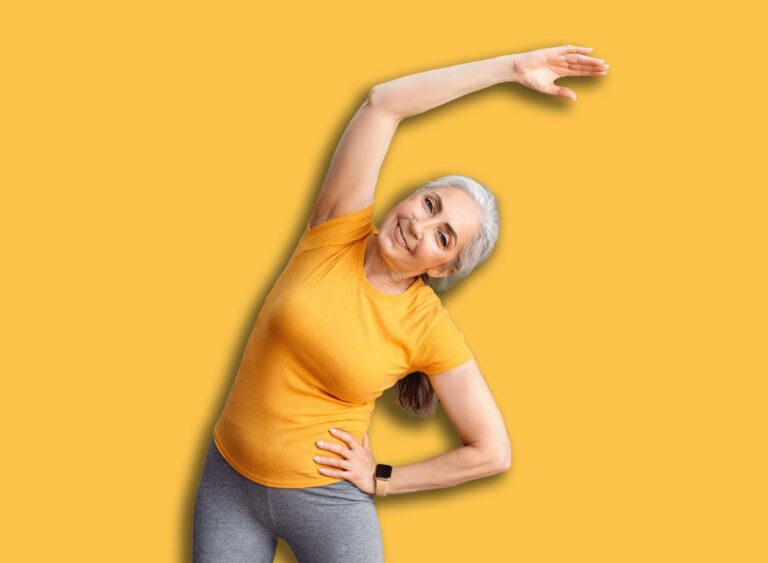
“This exercise opens up the ribcage, waist, and intercostal muscles, elongates the lat muscles, improves lateral spinal mobility, and decompresses vertebrae,” Ettenson tells us.
Sleeping curled on your side or in a fetal position compresses your spine laterally. This exercise reverses that compression by encouraging sideways motion. The intercostal muscles—those between your ribs—also benefit, improving breathing mechanics for anyone who feels shallow or tight in the chest upon waking.
Start the Day Moving Well
Five minutes of breathing and movement before breakfast changes how you experience the morning. Your joints move with less resistance, your spine has been decompressed, and your tissues have been rehydrated. Stiffness doesn’t disappear after 60, but neither is it permanent or inevitable. These exercises prove that small, consistent action beats resignation.
Frequently Asked Questions
Why do joints feel stiff when you wake up?
Cartilage thins with age, synovial fluid production decreases, and fascia loses water and elasticity, all of which are exaggerated after prolonged inactivity during sleep.
What does box breathing accomplish?
Box breathing calms the nervous system, improves mind-body connection, and can be paired with positive mental images.
How do calf raises improve daily activities?
Calf raises boost calf strength, which improves walking endurance and distance, helping adults over 60 remain more active throughout the day.
