
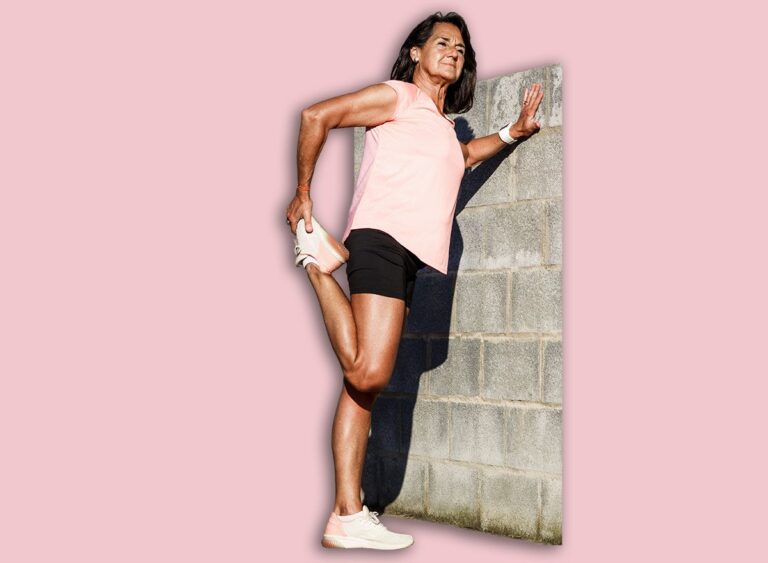
Key takeaways
- Wall exercises train lower body, upper body, calves, and core with built-in progression through distance and duration adjustments.
- Training at home on your own schedule, two to three times per week, produces results faster than infrequent gym classes after 65.
- Each exercise offers variations: wall squats go deeper, push-ups step farther back, calf raises work one leg, planks add shoulder taps.
- Consistency matters more than intensity; the same movements done regularly rebuild muscle tone better than sporadic training.
Muscle tone doesn’t fade because it has to. After 65, lean muscle can drop quickly. You might notice it in how your arms look or in how tired your legs feel after climbing stairs. Regular strength training rebuilds that muscle and makes daily movement easier. The obstacle isn’t what works; it’s what fits your life. Gym classes run on a schedule that isn’t yours, move at a pace that might be too fast or too slow, and offer whatever exercises the instructor decides. A wall workout at home lets you train more often during the week, and that consistency compounds.
The wall itself becomes a tool. You can use it to steady your legs while they work on squats, lean into it to strengthen your chest and arms, or step away to increase the difficulty. The same exercise grows harder as your strength improves, so you never feel like the workout is wasted once you’re ready for more. This is why many coaches use wall exercises with older clients: they’re simple to scale without feeling stripped down.
This routine hits four areas: lower body with wall squats, upper body with wall push-ups, lower legs with calf raises, and core with wall planks. Together, they target the strength you use when standing from a chair, climbing a flight of stairs, and carrying items with a stable spine.
Why Walls Beat Gym Classes for Consistency
More Chances to Train
A gym class happens at a fixed time, three times a week if you’re lucky. If you miss it, your week gets lighter. A home wall workout means you can train whenever it fits: before breakfast, after dinner, whenever you have 15 minutes. Hitting two or three sessions per week becomes realistic, and that regularity builds faster progress than sporadic gym attendance.
Adjustable Difficulty
A floor push-up is binary: you either do it or you don’t. A wall push-up lets you step back to make it harder or step closer to make it easier. Squats work the same way. You can dial in a depth that challenges your legs without overwhelming them. This range matters: the exercise always feels substantial, never watered down, but also never out of reach.
Joint-Friendly Loading
Your wrists, shoulders, and knees don’t have to manage your balance and do the strength work at the same time. The wall handles balance. Your joints do the lifting. This distinction matters when you’re rebuilding after a period of lighter activity.
Wall Squats: Lower Body Foundation
A squat pattern pays immediate dividends. Every time you stand from a couch, sit on a toilet, or climb stairs, you’re doing a squat variation. Wall squats teach your thighs and glutes this pattern with the wall supporting your upper body so your legs stay the focus.
Stand with your back against the wall, feet hip-width apart and about 12 inches from the wall. Lower yourself as if sitting into a chair: knees bend, hips drop, back stays on the wall. Go only as deep as you can control. You don’t need 90 degrees on day one. Push through your heels to stand. One rep.
Perform 2 to 3 sets of 8 to 12 reps. Rest 45 to 60 seconds between sets.
Progress by trying a higher wall squat (stopping partway down), a wall sit (holding the bottom position), or a slower wall squat (taking 3 seconds down, 2 seconds up).
Wall Push-ups: Upper Body Without Impact
Your chest, shoulders, and triceps need regular work to keep your arms toned and strong. A floor push-up demands a lot from your wrists and shoulders at once. A wall push-up lets your upper body press without that load.
Place your hands on the wall at shoulder height, feet about 2 feet away from the wall. Lower your body by bending your elbows, then press back to start. Keep your body straight and your elbows at roughly 45 degrees to your ribs.
Perform 2 to 3 sets of 8 to 15 reps. Rest 30 to 45 seconds between sets.
Progress by stepping farther from the wall (more bodyweight), trying a close-grip wall push-up (more tricep involvement), an incline push-up using a counter (harder), or a slower wall push-up (2 seconds down, 2 seconds up).
Calf Raises: Strength for Walking and Stairs
Calves are overlooked until they fail. When stairs feel harder, standing on your toes gets shaky, or a walk that used to be easy leaves your lower legs tired, their importance becomes clear. Calf raises strengthen the muscles that push you forward with each step. The wall provides support, so you focus entirely on the calf work instead of balancing.
Stand facing the wall with your hands on it lightly, feet hip-width apart. Rise onto your toes, lifting your heels about an inch, then lower back down. The wall steadies you; your calves do the work.
Perform 2 to 3 sets of 10 to 15 reps. Rest 30 to 45 seconds between sets.
Progress by trying a single-leg supported calf raise (all work on one leg), a slower calf raise (3 seconds up, 2 seconds down), or a seated calf raise (sit in a chair, lift your heels, same effect with less balance demand).
Wall Planks: Core Strength for Stability
A strong midsection supports everything else. Abs that brace your spine reduce lower-back strain and give your whole body better control when you move. A wall plank teaches your core to work under load without floor impact.
Place your hands on the wall at shoulder height, step your feet back until your body is at an angle (less than 45 degrees is harder), and hold. Keep your body straight, engage your abs, and breathe.
Perform 2 to 3 holds of 20 to 40 seconds. Rest 30 to 45 seconds between holds.
Progress by trying a higher wall plank (hands higher, easier), wall plank with shoulder taps (tap one shoulder with the opposite hand, alternating), or an incline plank on a counter (hands on a counter instead, harder).
Frequency and Progression
This routine works best when you repeat it consistently. Start with two or three sessions per week. As your recovery and strength improve, you can add more sessions. The wall adjustments (stepping closer or farther, changing hold times, adding pauses or taps) give you progression paths for weeks and months ahead without changing the exercises themselves. Muscle responds to work done often enough, and a wall routine at home makes this schedule achievable.
Source: Eat This Not That
Frequently Asked Questions
How many times per week should I do these wall exercises?
Start with two or three sessions per week. As your recovery and strength improve, you can add more sessions.
How do I make wall exercises harder as I get stronger?
Step farther from the wall to increase the angle and bodyweight percentage, slow down your movements by taking longer to complete each rep, or try variations like single-leg work or shoulder taps for planks.
Do I need any equipment besides a wall?
No. For wall squats, push-ups, calf raises, and planks, the wall is your only tool. Some variations use a counter or chair, but these are optional.
