
Key takeaways
- Your feet contain 26-28 bones, 33 joints, and over 100 muscles, tendons, and ligaments that function as a complex suspension system.
- Each step creates 2-3 times your body weight in force; on hard surfaces while running, that force can reach 12-15 times your body weight.
- Orthotics and supportive shoes provide support but don't strengthen muscles or retrain your nervous system the way barefoot exercises do.
- Four simple barefoot exercises—self-massage, single-leg balance, shuffle walks, and calf-raise marches—can restore your foot's natural strength and coordination after 60.
Your feet are engineering marvels that most of us take for granted. Confined to shoes throughout the day, these structures rarely get the attention they deserve, and that neglect takes a toll as we reach 60 and beyond. The problem isn’t that your feet are weak—it’s that we’ve stopped training them.
The Hidden Architecture of Your Foot
Look down at your feet. They’re far more complex than they appear. Each foot contains 26 bones, or 28 if you include the sesamoid bones. Add in the 33 joints, plus well over 100 muscles, tendons, and ligaments, and you begin to appreciate what’s actually working inside your shoe.
Your foot isn’t a solid platform. Instead, it’s designed with three distinct arches:
- The medial arch, running along the inside of your foot
- The lateral arch, along the outer edge
- The transverse arch, which allows rotation
These aren’t static structures. They shift and adjust with every single step you take.
How Your Foot Moves Like a Suspension System
Picture a pickup truck with no suspension hitting every pothole on a road. Now imagine that same truck with premium shocks—the bumps don’t disappear, but the force gets absorbed and redirected. Your feet work the same way. The big toe extends, loading transfers through the sesamoid bones, pressure distributes across both arches, and the foot becomes rigid as you push off. All of this happens in coordination with the transverse fascia, your plantar fascia, and dozens of other structures working in perfect synchronization.
This coordination is what your feet were designed to do. Each step you take sends 2 to 3 times your body weight traveling through your foot. When you run, that multiplier jumps to about 7 times your body weight. On hard surfaces like concrete while running, the force can reach 12 to 15 times what you weigh. Without proper force distribution through all these moving parts, that impact travels directly into your knees, hips, and spine.
The Role of the Plantar Fascia
Think of your plantar fascia as a heavy-duty winch cable running along the bottom of your foot. As your toes extend, that cable tightens, pulling your arch upward and converting your foot into a powerful lever. When your foot releases, that cable relaxes. This cycle of tension and release happens thousands of times a day, and it only works if all the moving parts stay active and strong.
Why Shoes and Orthotics Aren’t Enough
Shoes and orthotics absolutely have their place. For specific injuries, deformities, and medical conditions, an orthotic can be invaluable. But for most of us, orthotics solve the wrong problem. They support your foot, yes. Socks compress it. Shoes support it. Yet none of these actually strengthen the muscles, improve your coordination, or retrain your nervous system to work properly.
Here’s what matters: orthotics stop your foot from moving the way it’s designed to. When your foot doesn’t move, its muscles don’t work. When muscles don’t work, they weaken. That’s where barefoot training becomes critical, especially after 60.

Proprioception: Your Feet as Your Body’s GPS
The sole of your foot contains thousands of sensory receptors. Every second, they measure:
- Pressure
- Surface texture
- Joint position
- Weight distribution
- Movement
That information streams directly to your brain, which makes tiny adjustments throughout your ankles, knees, hips, and even your spine—usually before you’re even aware of it.
Think of your feet as your body’s GPS system. The stronger the signal, the better the navigation. As we age, those signals weaken. Not because our brains stop working, but because our feet become less active. We spend our days in supportive shoes, with minimal time barefoot. The small muscles shrink. The nervous system receives fewer meaningful inputs. Over time, balance, coordination, and overall movement quality decline.
Why Stimulating Your Feet Matters
Your foot’s sole has one of the highest concentrations of sensory nerve endings anywhere in your body. Practices like foot massage and acupressure have existed for thousands of years, and while research doesn’t support the idea that pressing one spot can heal an entire organ, there is evidence that stimulating your feet improves relaxation, alters pain perception for some people, and increases sensory awareness. Whether through massage, acupressure, or simply moving barefoot, you’re giving your nervous system richer information to work with. That’s the foundation of these exercises.
Four Barefoot Exercises to Restore Your Foot’s Natural Strength
These exercises aren’t just about muscle—they’re about rebuilding your foot’s natural suspension system one step at a time.
Self-Massage for Foot Fascia Release
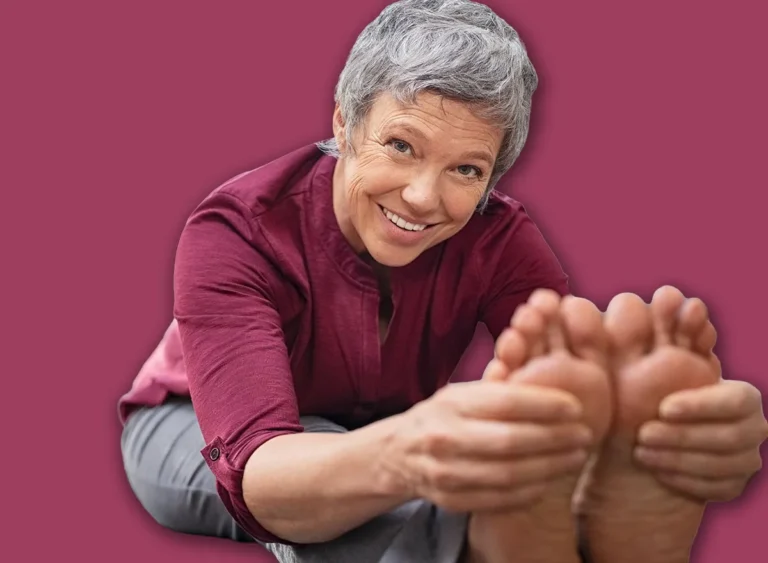
Start here if you’ve never done foot work before. If you lack the flexibility to get on the floor, do this seated in a chair. Using your hands, work the fascia on the bottom and sides of your foot. Your fascia may be extremely tight at first, so use lotion to make the process easier. After you finish, look down at your toes—you’ll usually see a little more space in the foot you just worked. That expansion won’t last all day; it’ll start to tighten again. But imagine doing this most days and gradually restoring your foot’s natural splay and arch.
Single-Leg Balance for Proprioceptive Awareness
Balance on one leg for 60 to 90 seconds per foot, completing one to three sets. Start seated if that’s where you can maintain control, then progress to kneeling, then standing as you get stronger. Once you’re comfortable balancing on a single leg, add coordination challenges to deepen the work.
The Shuffle Walk From the Gait Guys
This technique feeds your proprioceptors even more information. As your toe comes up, drag it slightly, then roll it down as the opposite foot comes up. This creates a coordination challenge that teaches your feet and nervous system to work together more effectively.
March With Calf Raise to Strengthen Toe-Off
This exercise targets the pushing-off phase of your gait, helping you propel yourself forward more easily and redistributing forces away from your knees, hips, and spine. Perform a marching motion, holding at the top of each step for one to two seconds before adding the calf raise when you’re ready.
Making Barefoot Training Part of Your Daily Routine
These exercises work best when they’re consistent. The goal isn’t a one-time fix but a gradual restoration of your foot’s natural strength and coordination. Start with self-massage and single-leg balance, then add the shuffle walk and calf-raise march as your feet adapt. Your feet contain an incredible amount of engineering, and with consistent work, you can restore the suspension system you were born with.
Frequently Asked Questions
How many bones and joints are in each foot?
Each foot has 26 bones, or 28 if you include sesamoid bones, plus 33 joints and more than 100 muscles, tendons, and ligaments.
Why are barefoot exercises better than orthotics for foot strength?
Orthotics support your foot but don't strengthen muscles, improve coordination, or retrain your nervous system. Barefoot exercises activate all three systems, rebuilding your foot's natural suspension.
What is proprioception and why does it matter after 60?
Proprioception is your foot's sensory awareness—thousands of nerve endings measuring pressure, texture, and movement to coordinate balance. These signals weaken with age from less barefoot activity, but consistent barefoot exercises can strengthen this system.
