
Key takeaways
- Triceps make up two-thirds of your upper arm, so strengthening them creates the most visible arm improvements and builds pushing strength for everyday tasks.
- Wall push-ups and chair dips use only your body weight, adjustable for any fitness level, requiring no equipment while rebuilding strength safely.
- Resistance bands maintain constant tension throughout every movement and protect vulnerable joints better than dumbbells, delivering equal strength gains without wrist or elbow strain.
Looking for a way to maintain upper body strength without committing to a gym membership? For adults over 55, rebuilding arm strength doesn’t require expensive equipment or hours away from home. Research demonstrates that consistent strength training using resistance bands or body weight alone can produce meaningful improvements in strength and physical function for older adults. These gains accumulate over time, allowing you to rebuild arm strength regardless of age.
The Reality of Aging Arms
As we age, maintaining arm strength becomes crucial for independence and daily function. Simple tasks—getting up from a chair, pushing open a heavy door, reaching for items on high shelves, or carrying shopping bags—all depend on upper body strength that naturally declines without intentional training. Between work, family commitments and everything competing for your attention, the gym often falls to the wayside. Yet rebuilding genuine arm strength takes just a few minutes when done at home with minimal equipment.
Why Triceps Matter Most
James Bickerstaff, a certified personal trainer (CPT) at OriGym, explains that the triceps make up around two-thirds of your upper arm, so strengthening them creates noticeable improvements in both arm function and definition. “The triceps do more heavy lifting in daily life than most people realize,” Bickerstaff says. “Strengthening them can have a noticeable impact on arm function and definition.” Targeting this muscle group delivers visible results faster than focusing on smaller supporting muscles. For older adults, tricep strength proves essential for pushing movements: getting up from a chair, opening doors, or lifting items at arm height.
The Time-Efficient Approach
The good news: rebuilding genuine arm strength takes just a few minutes when done consistently at home. Bickerstaff confirms that “the tools you already have at home are more than enough” to complete a full upper body workout. The following exercises will strengthen your chest, shoulders, triceps and core simultaneously, addressing multiple muscle groups in a single session.
Wall Push-Ups for Upper Body Control
How Difficulty Adjusts
Wall push-ups rank among the safest and most effective ways to rebuild upper body strength after 55. Unlike traditional floor push-ups, which can strain wrists and shoulders, the wall version offers complete control and adjustability without joint stress. The beauty of wall push-ups lies in their adaptability. You control the challenge by simply moving your feet closer to or further away from the wall. Standing closer to the wall makes the exercise easier; stepping back increases the load on your chest, shoulders, and stabilizer muscles. This scaling means you can progress gradually as you grow stronger, making wall push-ups suitable for any fitness level. Bickerstaff notes: “You can adjust the difficulty simply by moving your feet closer to or further away from the wall.” Whether you’re starting out or advanced, the same basic movement grows with you.
Chair Dips for Everyday Function
Direct Triceps Engagement
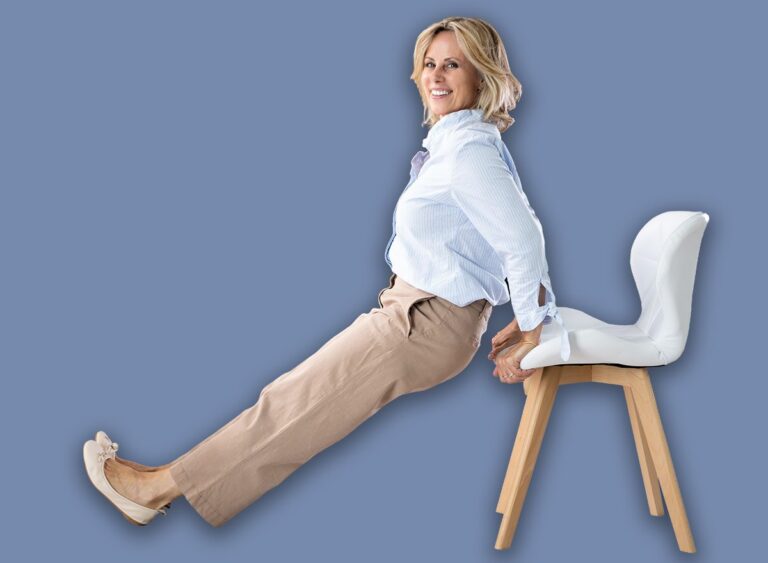
Chair dips work the triceps directly, and since the triceps constitute roughly two-thirds of your upper arm mass, strengthening them creates noticeable improvements in both arm function and visual definition. According to Bickerstaff, “Chair dips are excellent for rebuilding pushing strength needed for everyday tasks like getting out of a chair or pushing open heavy doors.” For older adults managing strength loss, this muscle group delivers visible returns faster than smaller supporting muscles. The triceps handle the bulk of pushing work, making them a high-return target for your training time.
Resistance Bands: Joint-Friendly Strength Building
Biceps Work Without Strain
Resistance bands offer a joint-friendlier alternative to dumbbells or barbells while building identical arm strength. They maintain constant tension throughout the full movement range, unlike free weights that go slack at certain points in the lift. Bickerstaff explains that “resistance bands provide constant tension throughout the movement, making them an excellent alternative to dumbbells.” The constant tension matters because it keeps your muscles engaged from start to finish, increasing time under tension without requiring heavy loads. “They’re particularly joint-friendly and allow you to strengthen the biceps without placing unnecessary strain on the wrists or elbows,” he notes. For adults managing joint sensitivity, arthritis, or past injuries, bands eliminate many of the aggravating factors of traditional strength training. You get real strength gains while protecting vulnerable joints.
Shoulder Strengthening for Independence
Functional Shoulder Capacity
Strong shoulders represent one of the most overlooked yet essential muscle groups for healthy aging. Bickerstaff identifies shoulder strength as non-negotiable for maintaining the independence that comes with growing older. Shoulder work matters because it enables reaching overhead cupboards, carrying shopping bags, moving objects at shoulder height, and countless other reaching and lifting tasks that define independent living. “Using a resistance band challenges your shoulder muscles while also requiring your core to stabilize the body throughout the exercise,” Bickerstaff explains. This dual engagement—shoulders plus core stability—makes band shoulder work exceptionally efficient for older adults. Strong shoulders aren’t just about looks; they’re about the ability to handle daily life without assistance.
Building a Training Routine That Sticks
Research consistently shows that strength training exercises using equipment like resistance bands or just body weight can lead to significant increases in strength and physical function in older adults. The key is consistent training in a format you can actually maintain over time. Rather than pushing for dramatic gains that lead to burnout, commit to these exercises at home on a regular schedule. Wall push-ups, chair dips, resistance band biceps work, and band shoulder exercises together address the muscle groups that matter most for independence after 55. The minutes add up, and compound into meaningful strength improvements. For adults over 55 seeking to rebuild arm strength without a gym, home-based training using walls, chairs, and resistance bands delivers real, measurable results.
Frequently Asked Questions
What makes wall push-ups safer than floor push-ups for adults over 55?
Wall push-ups allow you to adjust difficulty by moving your feet closer to or further away from the wall, and they reduce stress on wrists and shoulders compared to traditional floor push-ups. James Bickerstaff calls them "one of the safest and most effective ways to rebuild upper body strength after 55."
Why do resistance bands work better than dumbbells for older adults?
Resistance bands provide constant tension throughout the entire movement and are joint-friendly, allowing you to strengthen your arms without placing unnecessary strain on the wrists or elbows. They deliver the same arm strength gains as dumbbells while protecting vulnerable joints.
Which muscle group should I prioritize if I only have time for one exercise?
Focus on triceps, which make up around two-thirds of your upper arm. Strengthening triceps has a noticeable impact on arm function and definition, and exercises like chair dips build the pushing strength needed for everyday tasks like getting out of a chair or opening heavy doors.
