
Key takeaways
- A 10-minute kitchen counter routine performed 2-4 times per week can deliver more strength progress than occasional long gym sessions, especially for adults over 60.
- The routine uses three exercises—incline push-ups, squats, and shoulder taps—performed for 40 seconds each with 20-second rest periods across 3 rounds.
- The counter provides stability and allows you to adjust difficulty by changing stance, hand position, or surface height without needing any equipment.
A surprising amount of strength work fits into a single 10-minute session. According to Eat This Not That, that concentrated time can be more effective for older adults than spending an hour at the gym—if the effort is directed correctly. The approach centers on what strength coaches call the minimum effective dose: doing enough work to challenge your muscles and build progress without padding the session with unnecessary time.
Why 10 Minutes Works After 60
After 60, fitting consistent workouts into a normal week becomes the real challenge. Long gym sessions might happen once a month when schedules align, but shorter routines can become part of your rhythm two to four times per week. Those repeated sessions across the week give your muscles multiple chances to work under tension. That consistency often produces more strength gain than relying on occasional long workouts that are hard to schedule.
The Minimum Effective Dose
The minimum effective dose approach isn’t about finishing every session exhausted or wiped out. Instead, you keep the effort steady and let short sessions build on each other over time. The philosophy is straightforward: enough challenge to make progress without adding time for its own sake. This approach makes strength training much easier to fit into a normal week, and the results still add up.
Consistency Beats Long Sessions
A few 10-minute workouts spread across the week can give your muscles repeated chances to work. You don’t have to finish every workout feeling exhausted for it to count. When you show up twice a week for these focused sessions instead of waiting for that rare hour-long gym trip, your body gets more consistent stimulus. That regularity often outperforms sporadic longer sessions, especially as you get older and recovery becomes more important than volume.
What You Need
The kitchen counter is the key piece of equipment for this routine. A sturdy counter provides enough support for upper-body pressing work and stability for lower-body exercises, according to Eat This Not That. The counter lets you control the challenge by adjusting your stance or how much weight you transfer through it. You need only the counter itself and enough room to step backward safely. No weights, no dumbbells, no special equipment required.
The Three-Exercise Circuit
Complete 3 rounds of the circuit. Move through each exercise for 40 seconds, then take 20 seconds to reset. The final minute is easy walking around the room or a supported march. Keep the first round comfortable so you maintain good form throughout the routine. By the third round, the exercises should feel challenging without turning sloppy. If 40 seconds feels too long at first, use 20 to 30 seconds of work and keep the same 20-second rest period. You can build toward the full routine over time.
Exercise 1: Incline Push-Ups
The counter lets you train pressing strength without taking the full load of a floor push-up. Your chest and triceps still have to do meaningful work. You can make the exercise harder simply by stepping farther back or later using a lower surface. The counter provides enough support to make the movement feel more controlled while still challenging your upper body.
Recommended: Perform each round for 40 seconds, rest for 20 seconds. Best variations include the higher incline push-up, close-grip incline push-up, and slower incline push-up. Starting with a higher incline (hands on counter, body more upright) makes the movement easier, and stepping back or lowering your hand position increases the difficulty as you build strength.
Exercise 2: Squats
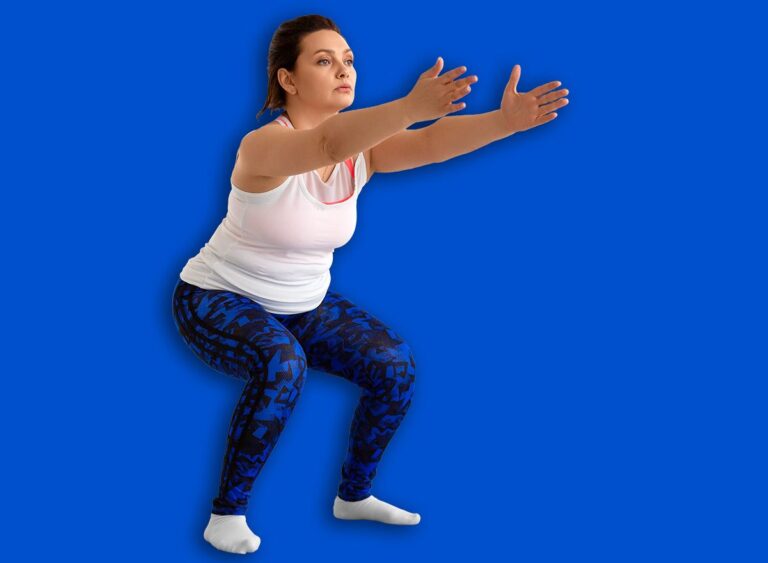
Strong legs make everyday movement easier, and squats give you a direct way to train them. Holding the counter takes some pressure off balance, so you can focus on using your thighs and glutes through a comfortable range. This makes it easier to keep the reps smooth as fatigue builds during your three rounds.
Recommended: Perform each round for 40 seconds, rest for 20 seconds. Use the counter for balance while your legs do the work. Best variations include the higher squat (less depth), slower squat (three-second lowering), and bodyweight squat without support once you build confidence. The counter support is there to give you confidence and help you maintain good positioning without your balance becoming the limiting factor.
Exercise 3: Shoulder Taps
This exercise finishes the circuit by making your upper body support you while your core handles a shifting load. Every time one hand leaves the counter, the opposite side has to work harder to keep you steady. This builds core and shoulder strength in the same movement without getting down on the floor, which is important if floor transitions become difficult.
Recommended: Perform each round for 40 seconds, rest for 20 seconds. Best variations include wider-stance shoulder taps (feet farther apart for more stability), slower shoulder taps (controlled tapping), and incline plank hold (no alternating taps, just holding the position). The wider stance option is a good place to start if balance feels challenging.
How to Use This Routine
A short workout only works if the effort is high enough to challenge you and the routine keeps coming back into your week. Use this circuit two to four days per week and make small adjustments as it starts feeling easier. The counter workout wastes very little time—you move through three exercises that train the upper body, legs, and core, and you’re done in about 10 minutes. That efficiency makes it realistic to repeat it consistently across your week without competing with other commitments.
Building Toward More Strength
Once you complete the 3-round circuit comfortably for two to three weeks, you have several options to increase the challenge. You can step farther back during push-ups, increase the squat depth, or pause longer during shoulder taps. You can also move toward the more advanced variations: close-grip push-ups for different muscle engagement, slower tempo squats that increase time under tension, or bodyweight squats without counter support. The progression is in your hands—make small changes when the routine starts feeling easy, and let those changes drive continued strength gains over the coming weeks.
Source: Eat This Not That
Frequently Asked Questions
How often should I do this kitchen counter routine?
Use this circuit two to four days per week. That frequency gives your muscles repeated chances to work while staying realistic to fit into a normal week.
What if 40 seconds is too long when I start?
Use 20 to 30 seconds of work time instead and keep the same 20-second rest period. You can build toward the full 40-second intervals over time as your fitness improves.
What variations help me progress as the routine gets easier?
You can step farther back during push-ups, increase squat depth, move to slower tempos, or use less counter support. Close-grip push-ups, slower shoulder taps, and bodyweight squats are also available options as you build strength.
