
Key takeaways
- Visible abs after 60 require core training combined with nutrition improvements and increased daily movement.
- Bear planks, dead bugs, reverse crunches, and mountain climbers train core stability through bracing and direct tension.
- Perform 2 to 3 sets per exercise with reps ranging from 6 to 12, resting 30 to 45 seconds between sets.
- Success depends on recovery capacity and consistency beyond the initial 21 days.
The gap between training abs and seeing them widens after 60. Your abdominal muscles can grow stronger through consistent work, yet body fat covering them keeps definition hidden. Training your core is only half the equation. The visible outcome depends on eating habits, movement patterns throughout the day, and how much fat you lose. Expecting a six-pack from exercise alone, at any age, overlooks the larger work required.
A 21-day commitment offers enough time to start addressing all these pieces together. Three weeks lets you establish cleaner eating patterns, build more consistent daily activity, and give your core regular resistance training. While no exercise guarantees visible six-pack definition in 21 days, three weeks of focused work creates a stronger foundation than sporadic ab training. The four exercises that follow train your midsection differently than traditional crunches. They teach your core to brace while your limbs move, then add direct tension through the abdominal muscles themselves.
Bear Plank: Bracing Under Static Load
The bear plank begins with your midsection already under tension. Your knees lift slightly off the floor while your hands and toes support your body weight. The position itself demands your abs work before any movement occurs. Short, controlled holds can create substantial tension without requiring long plank duration that strains the lower back, making this ideal for people over 60.
Perform 2 to 3 holds of 15 to 30 seconds each, resting 30 seconds between holds. Keep your knees close to the floor throughout. Variations include shorter holds if 15 to 30 seconds feels excessive initially, extended holds as your capacity improves, or bear plank shoulder taps, where you gently touch one shoulder with the opposite hand while holding the position. The shoulder tap variation increases the challenge by shifting your weight slightly with each tap.
Dead Bugs: Controlled Movement with Core Bracing
Dead bugs teach your midsection to brace while your legs move away from your body. As one leg extends toward the floor, the lever lengthens, demanding more from your abs to keep your lower back stable. Slower repetitions typically create more difficulty than rushing through higher rep counts, and that controlled pace is especially beneficial for building core stability in your 60s.
Perform 2 to 3 sets of 6 to 10 reps per leg, resting 30 seconds between sets. Keep your lower back gently pressed toward the floor as your leg extends. This contact signals your abs are doing the stabilizing work. Variations include heel taps, where your foot comes close to the floor without fully contacting it; shorter leg extensions for easier progression; or the opposite arm and leg dead bug, where you extend one arm forward while extending the opposite leg, which doubles the stability challenge.
Reverse Crunch: Direct Abdominal Shortening
The reverse crunch involves your abs doing direct work. Your pelvis curls toward your ribs as the lower trunk lifts off the floor. This movement must stay controlled and small, allowing your abdominal muscles to govern the motion through tension rather than momentum. Swinging your knees up uses leg momentum instead of core strength, which defeats the purpose of the exercise.
Perform 2 to 3 sets of 8 to 12 reps, resting 30 to 45 seconds between sets. Curl your hips upward with control rather than allowing knee swing to carry the movement. Variations include bent-knee reverse crunches, where knees stay bent throughout for easier progression; paused reverse crunches, where you hold briefly at the top to extend time under tension; or slower reverse crunches, where the entire movement takes several seconds to complete.
Slow Mountain Climbers: Core Endurance Through Alternating Load
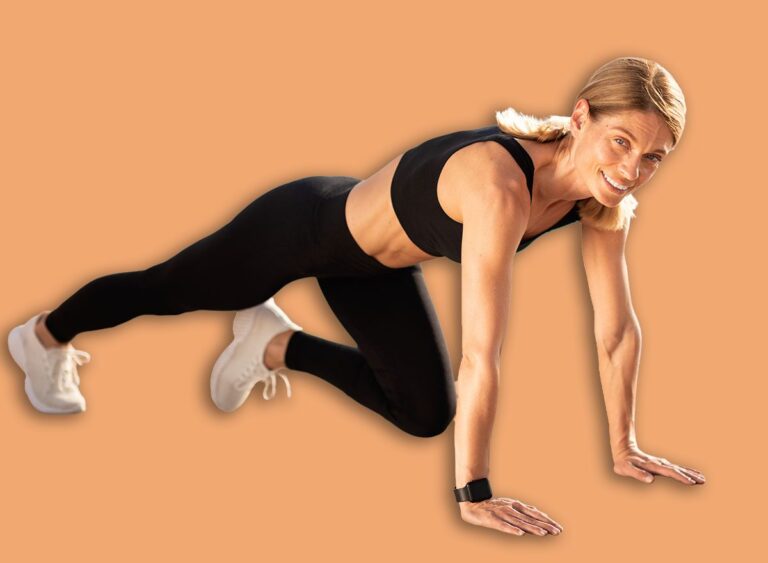
Slow mountain climbers force your core to maintain a strong plank position while one knee moves forward at a time. Each knee drive shifts your weight and support, requiring your abs to control your torso position continuously. Moving slowly directs your focus toward tension rather than turning the exercise into conditioning work. This measured pace also reduces strain on wrists, shoulders, and knees, which is important in your 60s.
Perform 2 to 3 sets of 8 to 12 reps per side, resting 30 to 45 seconds between sets. Keep your chest facing the floor as each knee drives forward, preventing your hips from dropping. Variations include incline mountain climbers, where your hands rest on an elevated surface like a bench to reduce intensity; shorter knee drives if full extension feels excessive; or faster mountain climbers once you have adapted to the slower version.
Why Visible Results Require More Than These Exercises
Building stronger abs happens relatively quickly with consistent training, but whether that strength becomes visible depends on factors beyond exercise selection. According to Eat This Not That, which consulted licensed nutritionists and dietitians for this guidance, visible abdominal definition after 60 depends on what happens outside your workouts.
The Role of Nutrition
Eating habits directly influence body fat levels. Cleaner eating patterns over 21 days can support fat loss, which reveals the abdominal muscles you’re training. This isn’t about extreme restriction; it’s about establishing patterns you can sustain beyond three weeks. The goal is combining these core exercises with nutrition choices that support visible results.
Daily Movement and Activity
Walking, yard work, household tasks, and other non-exercise activity influence the overall energy balance that determines whether your trained abs become visible. Daily movement outside scheduled workouts contributes significantly to fat loss. The 21-day window works best when you’re increasing this daily activity, not just adding these exercises to an already busy schedule.
Recovery and Training Load
Use these four exercises as regular core practice, but keep your total training workload at a level your body can recover from. Adding these sessions to an already demanding training program can undermine progress rather than accelerate it, reducing your recovery and increasing injury risk. Building a routine around these exercises and maintaining it past 21 days matters more than the initial three-week sprint itself.
Source: Eat This Not That
Frequently Asked Questions
Can I build a visible six-pack in 21 days after 60?
No single timeframe guarantees visible abs, but 21 days of focused core training combined with improved eating habits and increased daily movement builds a stronger foundation than sporadic ab workouts.
What makes these exercises different from standard ab crunches?
These four exercises train the core through bracing—holding tension while your limbs move—and direct abdominal tension, whereas crunches rely primarily on crunching up and down.
How do I progress these exercises if they get too easy?
Each exercise offers specific variations: bear planks progress from shorter to longer holds; dead bugs can use heel taps or opposite limb movements; reverse crunches can be slowed down; and mountain climbers can be sped up once you adapt to the slower version.
