
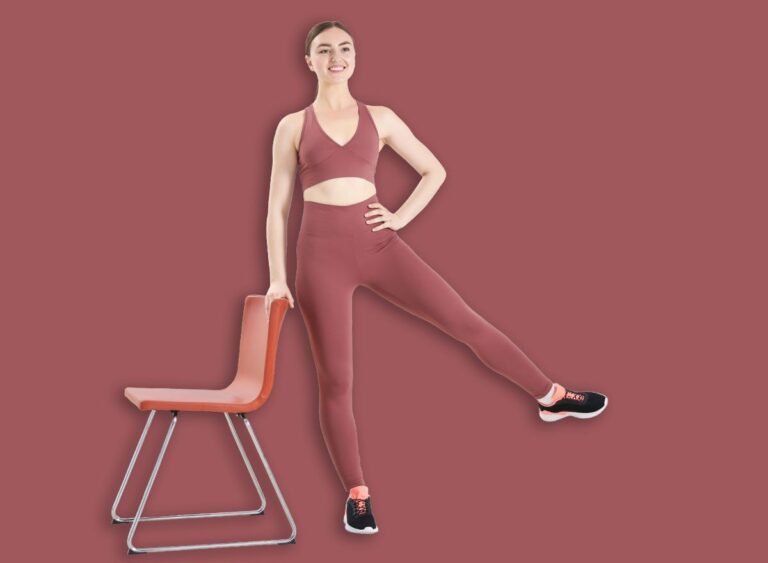
Key takeaways
- Balance after 70 depends on leg, hip and core strength, not just flexibility or balance practice alone.
- Sit-to-stands, single-leg work, chair planks and hip isolation exercises build the strength pattern your body needs for stability.
- Use the routine 2 to 4 days per week and progress through easier variations first before advancing to harder ones.
Balance doesn’t happen in isolation. After 70, your ability to stay steady depends directly on the strength in your legs, hips and core to hold your body in position when you shift your weight, stand up from sitting or catch yourself on an uneven step. Without that underlying strength, balance training leaves a critical gap in your stability toolkit.
Yoga builds mobility and some balance awareness, but according to Eat This Not That, this routine puts more emphasis on the strength that makes balance control possible. The chair serves two purposes: it offers support when you need it and makes every exercise easier to progress, so you can build the power underneath your balance skills without forcing yourself into advanced movements before you’re ready.
Why Strength Matters More Than Flexibility
Your legs hold you up, but your hips and core keep your body organized while you’re standing on them. The muscles around your hips maintain a steady pelvis when one foot leaves the ground, and stronger inner and outer thighs give you better control during weight shifts. Your core matters for the same reason: when your legs move, your torso has to stay stable.
The most effective approach combines bilateral exercises (using both legs together) with unilateral movements (one leg doing most of the work). Bilateral work lets you build force with a larger base of support, which teaches your muscles the pattern. Unilateral movements then demand more control from one side of your body at a time, which is closer to what happens when you’re walking or navigating an unexpected step.
Bilateral Foundation: Sit-to-Stands
Start here. Sit-to-stands strengthen your thighs and hips while training the weight shift from sitting to standing, which is one of the most useful balance transitions you make every day.
Basic Form and Progression
Keep both feet on the floor and control your movement both up and down. Once the two-leg version feels solid, you have options to make it harder: perform reps more slowly to increase time under tension, use higher seats to reduce the range of motion, or add weight by holding something across your chest.
Sets, Reps and Rest
Perform 2 to 3 sets of 6 to 10 reps, resting 45 to 60 seconds between sets. If you need easier variations, an elevated seat (higher chair or cushion) reduces how deep you have to bend.
Single-Leg Work: The Balance Challenge
Once bilateral sit-to-stands feel manageable, shift more of the demand to one side. This move asks one leg to control most of the stand while the other provides as little help as needed, which creates a much bigger balance challenge than two-leg work.
Finding Your Starting Point
Start from a higher seat or use the chair arms lightly if a true single-leg rep feels too demanding. The free foot can help with light assistance before you try a full single-leg stand.
Sets, Reps and Rest
Perform 2 to 3 sets of 3 to 6 reps per side, resting 60 seconds between sets. Progress by reducing how much you use the free foot, then by trying a lower seat or narrower base of support.
Core Stability: Chair Plank
Balance isn’t only legs. Your trunk has to stay organized while your weight moves underneath it, and a chair plank trains your core to brace correctly. The incline of the chair makes it simpler to focus on control without getting down to the floor.
How to Hold Position
Keep your ribs stacked over your hips during the hold. This cue prevents your lower back from sagging or your ribs from flaring out, which would weaken the core tension you’re building.
Sets, Reps and Rest
Perform 2 to 3 holds of 20 to 40 seconds each, resting 30 to 45 seconds between holds. Start at a higher incline (more upright) and progress by lowering the angle or holding longer.
Hip and Thigh Isolation Work
Your outer and inner hip muscles keep you steady when weight shifts to one side. These two exercises train those muscles directly without adding another balance challenge on top of the work.
Band Abductions for Outer Hip Strength
Sit with both feet planted on the floor and press your knees outward against a resistance band. This trains the outer hip muscles that stabilize your pelvis. Perform 2 to 3 sets of 10 to 15 reps with 30 seconds rest between sets. Make it easier with a lighter band or shorter hold times, or harder with a stronger band and slower reps.
Inner Thigh Squeeze for Control
Sit with a ball or pillow between your knees and squeeze it steadily. Your inner thighs control weight shifts from side to side, and this seated squeeze gives them direct work without forcing you to balance. Perform 2 to 3 sets of 10 to 15 reps with 30 seconds rest between sets. You can vary the intensity by using a firmer or softer pillow, changing how long you hold the squeeze, or adjusting how hard you press.
Building a Sustainable Routine
Balance improves faster when you give your body more strength to work with. Use this routine 2 to 4 days per week and let the harder variations come in gradually. Start with bilateral sits-to-stands and chair planks, add single-leg work once those feel manageable, then progress the difficulty of each exercise as your strength builds. The chair gives you the safety net to push harder without turning every rep into a test.
Source: Eat This Not That
Frequently Asked Questions
How many days per week should I do these chair exercises?
According to Eat This Not That, use this routine 2 to 4 days per week and let the harder variations come in gradually as your strength builds.
What is the difference between bilateral and unilateral exercises?
Bilateral exercises use both legs together and let you build force with a larger base of support, while unilateral movements work one leg at a time, creating more demand for control and balance on that single side.
Do I need special equipment for these exercises?
No. You need a sturdy chair for support, a resistance band for hip abductions, and a pillow or ball for inner thigh squeezes. All variations can be done at home with basic items.
