
Key takeaways
- Muscles still adapt to resistance training after 70, though recovery takes longer; the key is progressive overload rather than starting heavy.
- Box squats and kettlebell deadlifts build lower-body strength for everyday tasks like standing and stair climbing, with clear ways to add weight.
- Upper-body pressing (half-kneeling dumbbell press, incline push-ups) and pulling (band rows) together create a complete strength routine that requires no expensive equipment.
You can still build meaningful strength after 70. Age does change how quickly you recover and how much muscle you may have retained over the years, but it does not eliminate your ability to respond to resistance training. Give your muscles a consistent reason to work harder, and they will still adapt and improve. Rebuilding the strength you had at 50 requires a different approach than it did then, but the process works the same way: challenge your muscles enough to force adaptation, then gradually increase that challenge as the exercises stop feeling hard.
According to Eat This Not That, coaches working with older adults consistently see the biggest breakthroughs when they find a starting point that lets someone train hard enough to improve without the session feeling like a test. Once the movement feels solid, adding load or choosing a harder variation becomes much simpler. That progression strategy matters far more than trying to prove how much weight you can lift on day one.
Why Strength Training Still Works
The ability to build muscle and strength does not expire at a certain age. What changes is the timeline and the starting point. Your muscles still adapt to stress, but with a longer recovery window. At 50, pushing yourself hard in every session might have been the formula. At 70, that becomes a recipe for overuse injuries. The payoff comes not from single heavy lifts but from steady, progressive challenge over weeks and months.
These five exercises train all the major movement patterns—lower-body push, upper-body push, and upper-body pull—giving you a complete strength toolkit without overwhelming complexity. Each exercise has a clear way to increase difficulty, so the same basic routine can work for months or years as your strength returns.
Lower Body: Box Squat and Kettlebell Deadlift
Strength loss hits hardest in the hips and legs, where everyday tasks depend on it—standing from a chair, climbing stairs, recovering from a stumble. Two movements target this area and give you built-in ways to progress.
The Box Squat for Reliable Depth Control
The box squat gives you a consistent reset point for rebuilding leg strength. Holding a dumbbell or kettlebell at your chest adds resistance, while the box keeps the depth the same on every rep. Once you can stand from that position comfortably, add weight to keep progressing. Perform 2 to 3 sets of 6 to 10 reps, resting 60 to 90 seconds between sets. You can start with bodyweight, move to a heavier weight, or lower the box height as it gets easier.
The Kettlebell Deadlift for Hip Loading
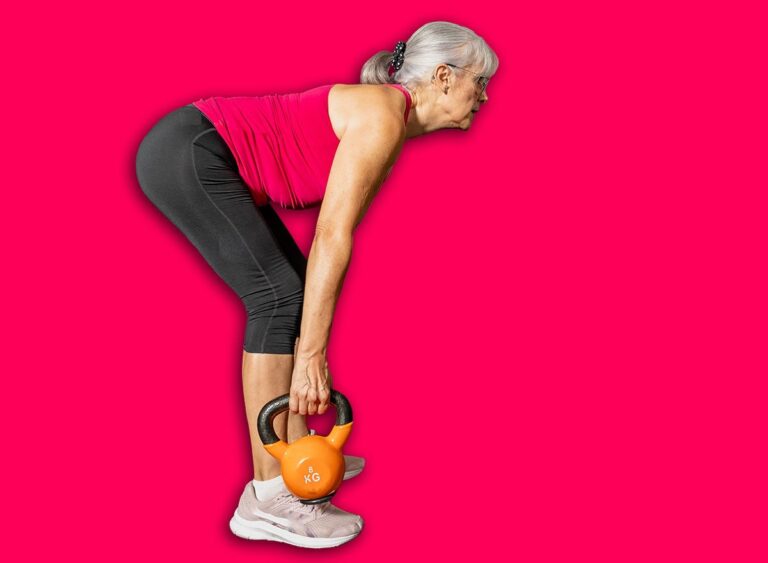
A kettlebell deadlift gives you a straightforward way to load the hips and legs from the floor. Keeping the weight close to your body makes the setup easy to manage, and the movement has plenty of room to grow as your strength returns. The key form point: keep the kettlebell close to you from the floor to standing. Perform 2 to 3 sets of 6 to 10 reps, resting 60 to 90 seconds. Add weight gradually once the reps feel solid. You can progress by using a heavier kettlebell, elevating the starting position slightly, or eventually adding a second kettlebell.
Upper Body Pressing: Two Approaches
Two pressing movements address shoulder and chest strength from different positions, so together they train multiple angles of upper-body strength.
Half-Kneeling Dumbbell Press Without Lower-Body Help
Pressing from half-kneeling makes a moderate dumbbell feel more demanding because your lower body cannot contribute much to the rep. Your shoulder handles the press while your core keeps you stable, making this a useful way to rebuild overhead strength without starting too heavy. Keep your ribs down as the weight travels overhead. Perform 2 to 3 sets of 6 to 10 reps per side, resting 45 to 60 seconds. Adjust by using a lighter dumbbell, pressing from a seated position, or eventually standing on both feet for a more demanding version.
Incline Push-Ups to Match Your Starting Strength
A floor push-up can be too big of a jump when rebuilding upper-body strength. Raising your hands lets you choose how much body weight you have to press, so the exercise meets you where you are. Lowering the surface over time gives you a built-in progression without changing the movement. Keep your body in one straight line throughout each rep. Perform 2 to 3 sets of 8 to 12 reps, resting 45 to 60 seconds. Start at a higher surface such as a wall or counter, then gradually move to a lower one, or progress to a slower tempo before attempting a lower incline.
Upper-Back Strength: Standing Band Row
Pulling strength deserves its own attention, especially if most of your upper-body work has been pressing. Pulling movements balance the pressing pattern, protect shoulder health, and keep posture strong as you age. A standing band row trains the upper back with easily adjustable resistance. Step farther from the anchor or move to a stronger band once your current setup stops feeling challenging. Perform 2 to 3 sets of 10 to 15 reps, resting 45 seconds. Progress by using a heavier resistance band, rowing with one arm, or adding a pause at the end of each rep.
Building Your Training Routine
Start with resistance you can control and give yourself somewhere to progress from. You do not have to chase the weights you lifted at 50 on day one. Pick a starting point that lets you complete all the reps with good form, then focus on doing that the same way every session. Once that feels easy, add a little weight, lower the surface on your push-ups, or move to a stronger band. That progression is where real strength comes back.
Source: Eat This Not That
Frequently Asked Questions
How much weight should I start with?
Pick a starting weight that lets you complete all the reps with good form. For a box squat or kettlebell deadlift, start light enough to control the movement. For pressing exercises, a moderate weight feels right when you can complete the reps without struggling or sacrificing form.
How long before I see strength gains?
The source does not provide a specific timeline, but the article emphasizes that age changes recovery speed. Consistent training—following the sets, reps and rest periods recommended for each exercise—will produce adaptation, though it may take longer than it did at 50.
What if an exercise is too hard or too easy?
Each exercise includes easier and harder variations. If it is too hard, use the lighter variation (for example, wall push-ups instead of incline push-ups, or a lighter kettlebell). If it is too easy, add weight, lower the surface, or move to a stronger band.
