
Key takeaways
- Balance is a trainable skill requiring work beyond walking, combining strength, proprioception, coordination, vision, and nervous system training.
- Five standing exercises—tandem stance, single-leg stance, standing march, standing clock reach, and tandem motion—target balance more effectively than walking alone.
- Progress through longer holds, slower movement, or advancing to the next level; precision and posture matter more than speed.
- Start with 2-3 sessions per week near a stable support surface, and expect improved stair confidence and reduced fall risk within weeks.
For adults over 70, balance becomes a performance metric as important as cardiovascular fitness or flexibility. A person who slips on stairs—or hesitates, grabbing the rail more often—isn’t facing just a health risk; they’re losing independence. Walking remains one of the best overall activities for longevity and cardiovascular health, yet walking alone doesn’t build the specific stability systems that prevent falls. Licensed nutritionists and fitness professionals recommend pairing your walking routine with targeted balance exercises that train the nervous system, proprioception, and lower-body muscle groups in ways a normal stride cannot. If you’re noticing you need to use a rail more often or feeling less steady, it’s time to focus on the right balance work.
Why Balance Becomes Critical After 70
The five systems that work together
Balance isn’t a single ability—it’s a product of five interdependent systems. Lower-body strength in your legs, hips, and core provides the foundation. Coordination links your muscles to your movement. Vision gives your brain the spatial reference it needs. Proprioception—your body’s sense of where it is in space—tells you when you’re tilting. Your nervous system ties all these elements together in real time, making micro-adjustments you don’t consciously think about. Walking uses some of these, but not all of them at the intensity needed to prevent the decline that comes with age.
What changes when you turn 70
The natural aging process reduces the sensitivity of your proprioceptive sensors and slows your nervous system’s reaction time by mere milliseconds—enough to matter when you’re stepping or turning. Muscle mass in the legs and core declines unless specifically trained. Vision changes, particularly depth perception and the ability to adjust between light levels. These changes compound, which is why someone might walk fine on a flat, well-lit surface but feel unsteady on stairs or outdoors in dim conditions. Targeted balance training addresses these specific deficits.
The Five Standing Exercises
Tandem Stance
Stand with one foot directly in front of the other, as if walking a tightrope. This narrower base of support forces your ankles, hips, and core to work harder than they do when your feet are side by side. If the full tandem stance feels too challenging at first, try a staggered stance—feet not quite in line, but closer together than normal. This is a progression you control.
Your eyes matter here: look forward, not down at your feet. Where your focus goes, your shoulders follow. Looking down causes your upper body to pitch forward, destabilizing the whole chain. Once you feel steady, keep your gaze ahead.
Single-Leg Stance
Lift one foot off the ground a few inches and hold it there. Don’t bend your knee and hoist your leg high; the goal is balance, not hip-flexor training. Start with a 5- or 10-second hold. As you improve, extend the duration. Your standing ankle, hip, and core engage automatically to keep your body aligned and prevent a fall.
This exercise doubles as a balance assessment. How long can you hold each side? A disparity between sides tells you where to focus your training.
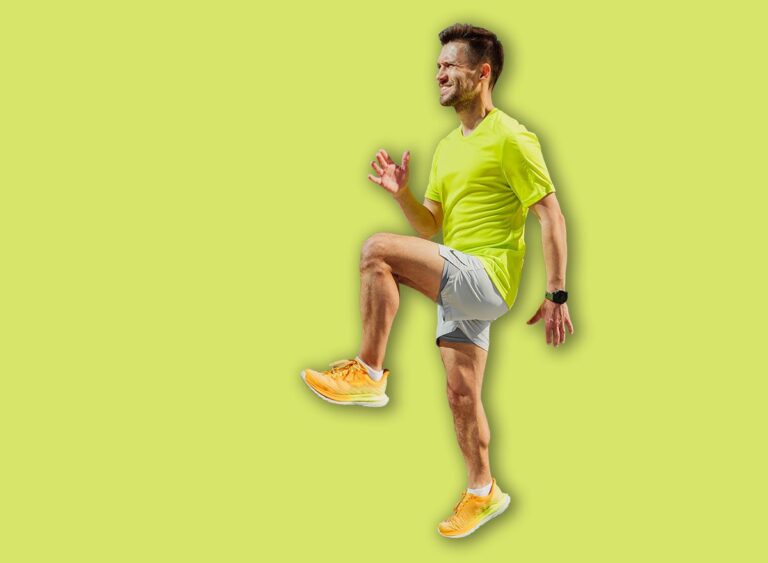
Standing March
From standing, shift your weight fully to your left leg, then step forward and shift to your right. Pause between each weight transfer. That pause is critical: it eliminates momentum and forces your muscles to do the stabilizing work rather than letting your joints coast through the motion. Avoid leaning left or right as you switch. Slower movement is better. This exercise teaches your body weight-transfer control, which is essential for preventing falls during normal daily movement.
Standing Clock Reach
Imagine you’re standing in the center of a clock face. Reach your arm forward to 12 o’clock, then to 1, then to 2, and so on around the dial. You can step if needed. This exercise trains balance in three planes of motion—forward-backward, side-to-side, and rotational. Real life requires all three. Stepping sideways, twisting to retrieve something, stepping backward—these all depend on the balance patterns this exercise builds. Start with small reaches and use any assistance you need as you’re learning the movement.
Tandem Stance with Motion
Once you’ve mastered the tandem stance hold and the other exercises, combine them: assume the tandem stance and now step forward, keeping one foot in front of the other. This isn’t a speed drill. It’s a precision exercise about controlled movement. Your ankles, hips, and core must stabilize you while you move. Posture matters. If your balance starts to break, pause after each step and reset before continuing.
Why These Exercises Beat Walking Alone
Walking is excellent for cardiovascular health, aerobic capacity, and general fitness. But it uses a wide base of support (both feet on the ground, alternating smoothly) and engages your balance systems at low intensity. These five exercises narrow your base of support, demand weight transfer, introduce instability in controlled ways, and require you to adjust in multiple planes of motion. They train the nervous system and proprioceptive sensors at higher intensities than walking can provide.
Professionals who’ve worked with clients over 70 for years can see the difference after just a few weeks of consistent balance training: clients regain confidence on stairs, stop grabbing rails, and feel steadier on uneven ground. They trip less. They recover faster if they do stumble. Walking should remain your cardio base and a key part of your daily activity, but balance training is the missing piece that prevents falls.
Progression and Safety
Start every session with the exercise near a stable object—chair, countertop, wall. You don’t have to touch it, but it should be within arm’s reach if you lose balance. As you improve, you can increase hold times on single-leg stance, slow down the standing march for more control, or try the next progression level. There’s no rush. A 70-year-old holding a 30-second tandem stance with perfect form has achieved more than someone holding it for two minutes while wobbling. Precision and posture are the markers of progress, not duration or difficulty.
These exercises can be performed daily or nearly daily since they don’t create the same muscle soreness as strength training. Start with 2-3 sessions per week if you’re new to balance work, then progress to more frequent sessions as your confidence builds. If you feel dizzy during one of these exercises, stop immediately and sit down. Frequent dizziness can indicate a medical condition that should be evaluated by your doctor before continuing.
Frequently Asked Questions
How often should I practice these exercises? Balance work can be done daily or nearly daily since it doesn’t create the same muscle soreness as strength training. Start with 2-3 sessions per week, then progress to more frequent sessions.
Do I need any special equipment? No. You need a stable surface nearby (chair, countertop, or wall) and floor space about the size of a yoga mat. Balance pads are optional.
What should I do if I feel dizzy during these exercises? Stop immediately and sit down. If dizziness is frequent, consult your doctor—it may indicate a condition that needs evaluation before you continue.
Frequently Asked Questions
How often should I practice these exercises?
Balance work can be done daily or nearly daily since it doesn't create the same muscle soreness as strength training. Start with 2-3 sessions per week, then progress to more frequent sessions.
Do I need any special equipment?
No. You need a stable surface nearby (chair, countertop, or wall) and floor space about the size of a yoga mat. Balance pads are optional.
What should I do if I feel dizzy during these exercises?
Stop immediately and sit down. If dizziness is frequent, consult your doctor—it may indicate a condition that needs evaluation before you continue.
