
Key takeaways
- Chair exercises reduce fall fear while building balance capability through a controlled progression from fully seated to partially supported to freestanding.
- Balance training must address three sensory systems—vestibular, visual, and somatosensory—plus strength, mobility, coordination, confidence, and reaction time.
- Five core chair exercises target sit-to-stand, marching, ankle strength, reaching and weight shifting, and supported standing balance.
- Chair-based training works as a practical entry point for older adults and complements other approaches like yoga without requiring special equipment.
Maintaining steady balance becomes increasingly critical as you move into your 60s and beyond. While many people assume yoga or specialized equipment is necessary to improve balance, a simple chair and your own body weight can deliver measurable results. Portia Page, a Balanced Body Educator and NCPT (National Certified Personal Trainer), shares five chair-based exercises that address the core components of balance without requiring you to step away from the security of supported movement.
Why Chair Exercises Outperform Unsupported Standing for Many Adults
Fear of falling is one of the most common barriers to balance training in older adults. For those who have experienced a previous fall, feel deconditioned, or lack confidence in unsupported movement, jumping directly to standing-only exercises can amplify anxiety rather than build capability. When fear takes over, your body tends to stiffen, breathing becomes shallow, and natural movement patterns deteriorate—ultimately making balance work less effective.
A sturdy chair changes this dynamic entirely. The presence of something to hold onto removes the immediate fear response while still allowing you to challenge your stability systems. According to Page, “the chair provides security without removing the opportunity to challenge the body.” This approach is especially valuable for people recovering from falls or managing deconditioning, as it preserves the learning benefit without triggering defensive tension.
Another key advantage is progression. Rather than an all-or-nothing approach where you’re either sitting or balancing unsupported, chair exercises allow gradual advancement. You might begin fully seated, progress to seated movements with greater reach and weight shifts, move to supported standing while holding the chair lightly, gradually decrease your reliance on the chair, and eventually perform freestanding balance work. This layered progression builds confidence at each stage.
The Balance Systems Your Exercises Must Train
Balance is not a single isolated ability. Instead, it requires coordination among three major sensory systems: vestibular (inner ear and spatial orientation), visual (what your eyes perceive), and somatosensory (body position awareness). Beyond these sensory components, balance also demands adequate mobility, strength, coordination, confidence, and reaction time. A comprehensive balance program addresses multiple elements simultaneously rather than focusing on just one.
Chair exercises excel at this because they can challenge several of these systems while keeping your center of mass supported. You build strength in the muscles that stabilize your joints, train your nervous system to process position changes, and practice weight shifting in a controlled environment. The progression model also allows fear to decrease over time, which directly improves your ability to move naturally and react quickly.
Five Chair Exercises to Build Stability
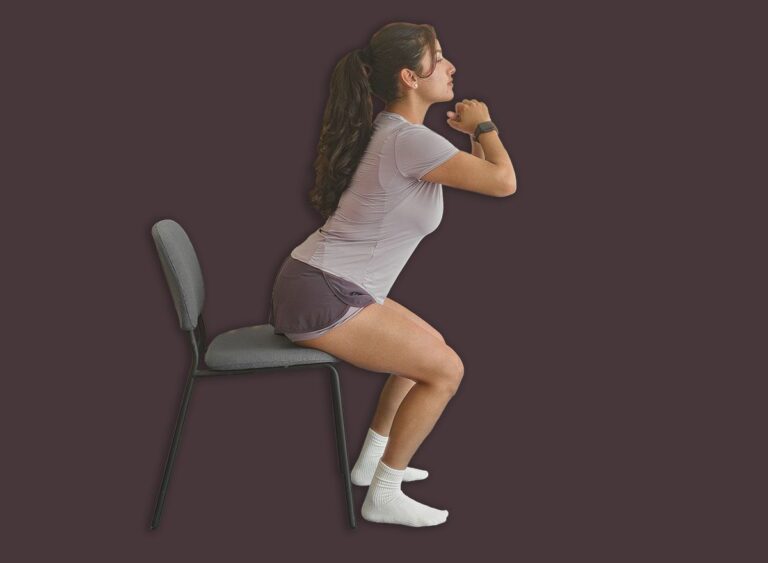
Sit-to-Stand: The Foundation Movement
The ability to rise from a seated position is one of the most functionally important movements you perform daily. Sit-to-stand strengthens your hips, glutes, thighs, and torso while practicing weight distribution and center-of-mass control. According to Page, “being able to control your center of mass as you move from sitting to standing is directly related to functional independence, and requires overall balance as well as strength.” This single exercise bridges seated safety and standing capability, making it essential for maintaining independence.
Marching: Building Trunk Stability and Alternating Weight Shifts
Marching while seated or lightly supported challenges your trunk stability, hip strength, and ability to shift weight from side to side. The alternating leg pattern directly mimics the weight transfer you perform with every step when walking. Page notes that this exercise “relates directly to walking, where we continually transfer our weight from one side of the body to the other.” By training this alternating pattern under controlled conditions, you develop the coordination needed for steady walking.
Ankle and Foot Strengthening: The Often-Overlooked Foundation
Your feet and ankles are frequently overlooked in balance discussions, yet they are critical. The muscles surrounding your ankles make continuous micro-adjustments throughout the day to keep you upright. Strengthening your calves and the muscles along the front of your lower leg, combined with increased foot awareness, supports steadier standing and walking. Page explains that “the muscles around the ankles continually make small adjustments to help keep us upright. Strengthening the calves and muscles along the front of the lower leg while improving awareness of the feet can support steadier standing and walking.” These small muscles provide the precision needed to catch yourself before a loss of balance becomes a fall.
Reaching and Weight Shifting: Practicing Real-World Movement
Balance is not about holding yourself perfectly still—it’s about moving your center of mass outside your base of support and then recovering control. Reaching across your body or to the side while seated, combined with weight shifts, teaches your nervous system to move beyond its centered position and return safely. Page points out that “reaching and weight shifting teach the body to move outside its usual centered position and then return safely. That’s a skill we use constantly in everyday life, like reaching into a cabinet, picking something up from the floor, turning, or moving around a piece of furniture, or stepping up or down from a curb.” These movements replicate the exact challenges your body faces throughout your day.
Supported Standing Balance: The Bridge to Independence
As you progress through seated exercises, the next phase involves practicing balance while standing with light contact on the chair. This exercise strengthens your hips and legs while developing proprioception—your body’s awareness of where it is in space. Page explains: “if we want to improve standing balance, we need to practice standing balance. This exercise provides a bridge between seated exercise and unsupported balance work. It strengthens the hips and legs, develops proprioception, and practices the single-leg support we need every time we take a step.” This stage is where chair-based training directly translates to real-world stability.
The Progression Model: Moving at Your Own Pace
The structured progression from fully seated to partially supported to freestanding is not arbitrary—it’s based on how your nervous system actually learns to balance. You don’t have to commit to all five exercises at once or progress at the same speed as someone else. Your starting point depends on your current confidence level, strength, and any previous fall history. Some people begin with full support and seat contact for all exercises, while others progress more quickly to supported standing variations.
This flexibility removes the pressure of an all-or-nothing approach. You can spend weeks on one phase without feeling stuck, because the progression is built into the program itself. Each variation of an exercise presents a legitimate challenge that develops the specific skills you need to move safely and confidently in daily life.
Why Chair Training Complements Rather Than Replaces Other Approaches
While yoga can certainly be a valuable part of a well-rounded balance routine, chair-based training offers something different: a practical, adaptable entry point for people who aren’t comfortable with unsupported standing. The two approaches address similar goals through different methods. Chair training prioritizes safety and progression, making it ideal for building confidence and foundational strength, while styles like yoga emphasize flow and full-body integration.
For many adults over 65, the combination of both approaches—starting with chair exercises to build capability and then incorporating other modalities as confidence grows—provides the most complete balance development. The key is choosing an entry point that you’ll actually stick with, and for many people, that starting point is a sturdy chair.
Frequently Asked Questions
Do I need yoga or special equipment to improve balance after 65?
No. A sturdy chair and your body weight can deliver measurable balance improvements. While yoga can be part of a well-rounded routine, chair exercises offer a practical, adaptable entry point especially for people who lack confidence in unsupported standing.
What sensory systems does balance training address?
Balance requires coordination among three systems: the vestibular system (inner ear and spatial orientation), the visual system (what your eyes perceive), and the somatosensory system (body position awareness). Beyond these, balance also demands mobility, strength, coordination, confidence, and reaction time.
Why is sit-to-stand considered such an important exercise?
Sit-to-stand is one of the most functionally important movements you perform daily. It strengthens your hips, glutes, thighs, and torso while practicing weight distribution and center-of-mass control, which are directly related to functional independence and balance.
