
Key takeaways
- Stouffer’s Salisbury Steak stands out as the customer favorite, delivering 360 calories per serving with a roasted beef patty topped with onions and gravy, accompanied by macaroni and cheese.
- Hill Country Fare, associated with Walmart’s private label frozen food line, offers one of the lowest-calorie Salisbury steak options at 150 calories per family-size patty with gravy.
- Salisbury steak originated as a therapeutic dietary intervention in the 19th century under Dr.
Stouffer’s Salisbury Steak meal has emerged as the top-rated frozen dinner option among consumers, earning a 4.1 out of 5 star rating from nearly 600 customer reviews and distinguishing itself through its use of 100% beef and absence of preservatives. Frozen food brands and select restaurant chains now dominate the Salisbury steak market, offering consumers multiple options ranging from 310 to 530 calories per serving, with macronutrient profiles that appeal to various dietary approaches. Customer preferences reveal a clear divide between premium frozen brands that prioritize whole meat ingredients and budget options that rely on processed meat blends.
Stouffer’s Leads the Pack With Pure Beef and Lower Sodium
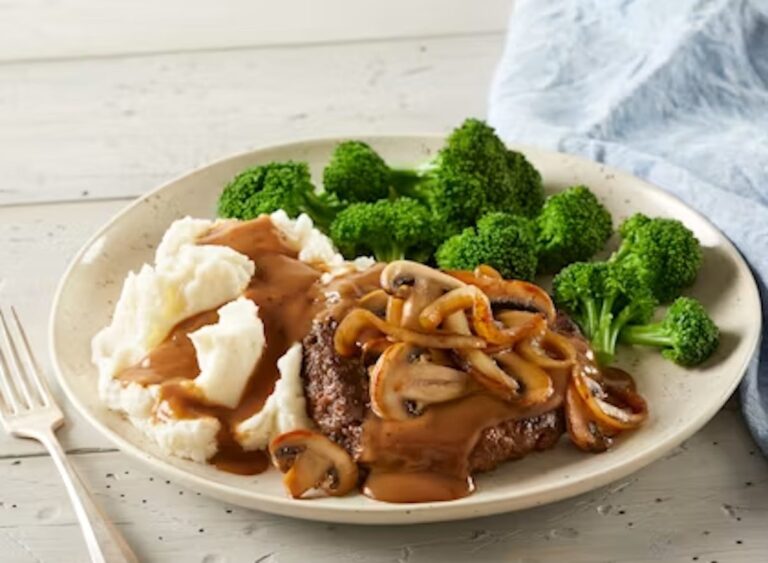
Stouffer’s Salisbury Steak stands out as the customer favorite, delivering 360 calories per serving with a roasted beef patty topped with onions and gravy, accompanied by macaroni and cheese. The brand’s commitment to 100% beef—without pork or textured vegetable protein (TVP) fillers—resonates with health-conscious consumers seeking whole meat products. At 1,010 milligrams of sodium per serving, Stouffer’s also maintains a notably lower salt content compared to competitors, making it a practical choice for those monitoring sodium intake.
The nutritional composition of Stouffer’s offering supports multiple dietary approaches. With 16% carbohydrates, 64% fat, and 20% protein per serving, the macronutrient distribution aligns with moderate-carb eating patterns. The absence of preservatives adds further appeal to consumers concerned about processed food additives, positioning Stouffer’s as a bridge between convenience and ingredient transparency.
Boston Market’s High-Sodium Challenge and TVP Content
Boston Market’s Salisbury Steak dinner presents a contrasting option that prioritizes affordability and portion size at the expense of sodium control. The 14.5-ounce meal delivers 530 calories with 38 grams of total carbohydrates and 32 grams of fat, but the sodium content reaches 1,450 milligrams—approximately 63% of the recommended daily value in a single serving. The steak itself comprises a meat blend of beef, pork, water, and textured vegetable protein, a common cost-reduction strategy in processed meat products.
For consumers tracking sodium intake or following specific dietary protocols, Boston Market’s high salt content presents a significant drawback. The inclusion of TVP as a protein extender also distinguishes it from competitors using whole meat, appealing primarily to budget-focused diners rather than those prioritizing ingredient quality. This trade-off between price and nutritional profile reflects broader industry trends in frozen meal manufacturing.
Hill Country Fare and Banquet: Budget Options With Trade-Offs
Hill Country Fare, associated with Walmart’s private label frozen food line, offers one of the lowest-calorie Salisbury steak options at 150 calories per family-size patty with gravy. The calorie density of 114 calories per 100 grams makes it attractive for calorie-conscious diners, though the macronutrient breakdown reveals 64% fat content—a consideration for those limiting fat intake. This ultra-lean calorie profile appeals specifically to consumers following strict calorie-deficit meal plans.
Banquet’s “Mega Meal” option, featuring three Salisbury steak patties, received a 3.2 out of 5 star rating from over 860 customer reviews, with criticism centering on the product’s high sodium and fat content derived from its processed meat blend. The three-patty format targets volume-focused consumers but sacrifices nutritional balance and ingredient quality. Customer feedback consistently notes that Banquet’s offerings lack the beef quality and flavor profile of premium brands, positioning it as a last-resort option rather than a preferred choice.
Nutritional Profiles for Diet-Specific Planning
A standard serving of Salisbury steak with gravy contains 12.2 grams of total carbohydrates and 10.8 grams of net carbohydrates, making it compatible with moderate Low-Carb and keto dietary approaches when paired with appropriate side dishes. The 23.1 grams of protein per serving supports muscle maintenance and satiety, while the 310-calorie baseline provides flexibility for meal planning across various caloric targets. These macronutrient values remain consistent across premium brands like Stouffer’s, establishing a reliable nutritional foundation for diet-focused consumers.
Per 100 grams of Salisbury steak, the dish delivers 149 calories, 7 grams of protein, 10.5 grams of fat, 4 grams of saturated fat, 1 gram of fiber, and 0.26 grams of sugar. The minimal sugar content and low glycemic index profile benefit consumers managing blood glucose levels, though the low fiber content suggests pairing these meals with high-fiber vegetables to create nutritionally balanced dinners. This nutritional foundation explains why the dish has maintained relevance across multiple dietary communities despite its mid-20th-century origins.
The Historical Roots: From Therapeutic Diet to Convenience Food
Salisbury steak originated as a therapeutic dietary intervention in the 19th century under Dr. James Salisbury, who prescribed lean, chopped meat as a treatment for digestive inflammation and metabolic instability. Salisbury believed that consuming this ground beef preparation reduced intestinal fermentation, calmed inflammation, and stabilized metabolism while providing “raw” nutrients to the body. The dish represented an early example of food-as-medicine, positioning meat consumption within a therapeutic framework rather than purely culinary context.
The transformation from medicinal prescription to mass-market frozen dinner reflects broader shifts in American food culture and convenience preferences. Modern frozen Salisbury steak dinners retain the fundamental composition—ground beef formed into patties and served with brown gravy—while adding side dishes and processing methods unimaginable to Dr. Salisbury. The dish’s persistence across decades demonstrates enduring consumer appeal despite the emergence of countless alternative frozen meal options.
Choosing Between Frozen Brands and Homemade Preparation
Consumers seeking to optimize their Salisbury steak dinners face a clear choice between premium frozen options like Stouffer’s and budget alternatives, with quality metrics centered on beef content percentage, sodium levels, and the presence or absence of preservatives. Stouffer’s 100% beef composition and lower sodium content command a price premium justified by ingredient transparency and customer satisfaction ratings. Conversely, budget brands prioritize portion size and affordability through meat blending and TVP inclusion, appealing to different consumer priorities.
Homemade preparation offers an alternative pathway for those with time availability and ingredient control priorities. Traditional Salisbury steak consists of ground meat mixed with breadcrumbs, an egg, and seasonings, shaped into patties and cooked like burgers, then topped with brown gravy made from pan drippings, flour, and beef stock. This approach allows substitution of whole-grain breadcrumbs, low-sodium stock, and elimination of added sugars, enabling customization impossible with frozen products. The gap between premium frozen brands and budget options continues widening as ingredient transparency becomes increasingly important to health-focused consumers.
